
On this page
Every business needs money before it earns any. Class 11 Business Studies covers where that money comes from in Chapter 8 of the NCERT Business Studies Class 11 textbook.
What does the CBSE syllabus include for sources of business finance?
In the CBSE Business Studies curriculum for 2026-27, this is Unit 7 in Part B (Finance and Trade), and it carries 20 marks together with Unit 8, Small Business. The content list names:
the meaning, nature and importance of business finance
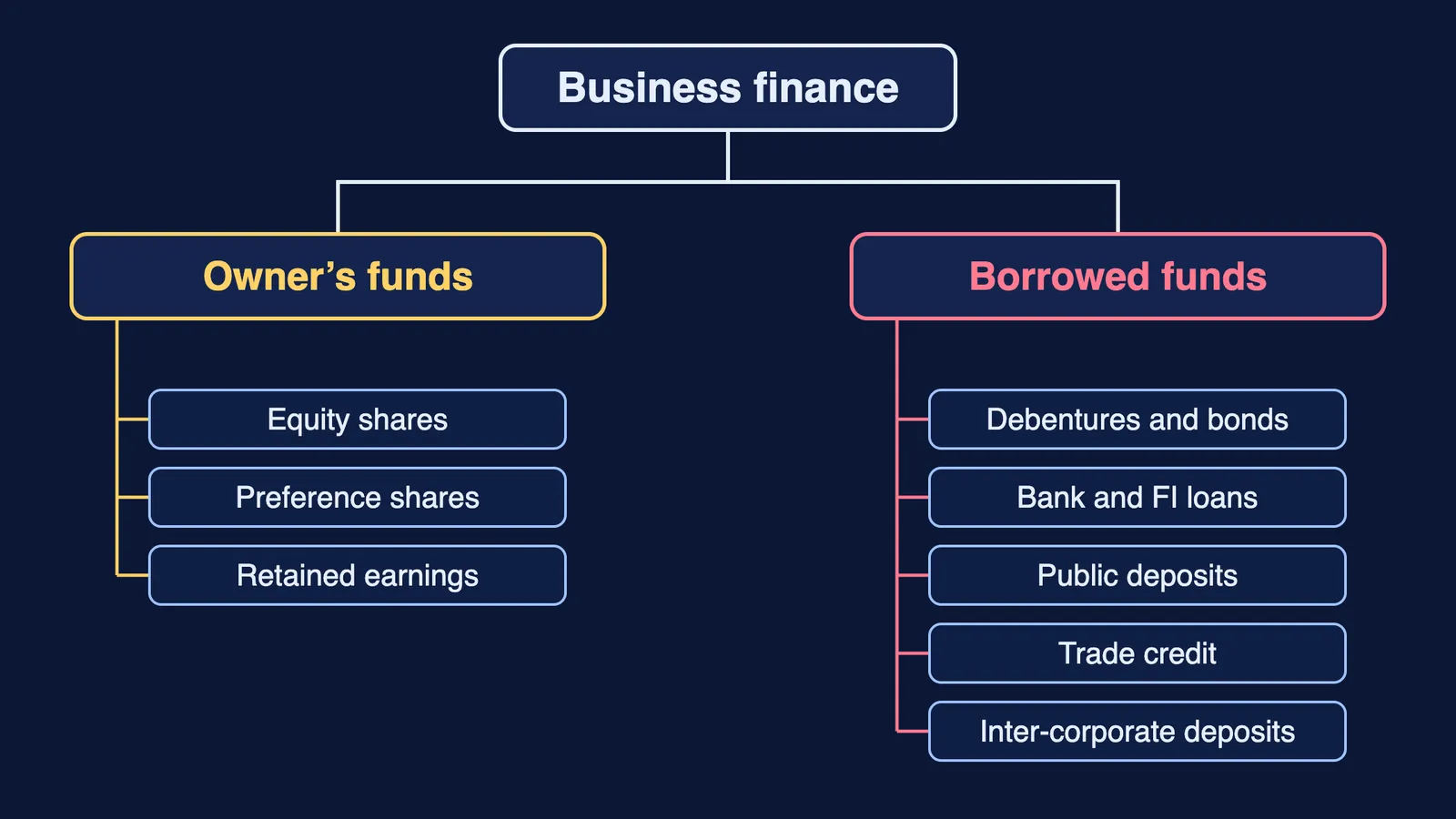
owners' funds: equity shares, preference shares and retained earnings
borrowed funds: debentures and bonds, loans from financial institutions and commercial banks, public deposits, trade credit and inter-corporate deposits (ICDs)
The learning outcomes also ask you to distinguish owners' funds from borrowed funds.
The NCERT chapter goes further, into factoring, lease financing, commercial paper, international sources such as GDRs, ADRs and FCCBs, and the factors that affect the choice of a source. These are not named in the current CBSE content list for this unit. Revise the listed sources first and ask your teacher about the rest.
What is business finance and why does a business need it?
NCERT defines business finance as the funds a business needs to carry out its activities (NCERT, Chapter 8). The need comes in two kinds:
Fixed capital: money locked up for a long time in land, buildings, plant and furniture.
Working capital: money for day-to-day running, such as raw materials, salaries and rent.
The textbook also sorts sources by period: long-term means more than five years, medium-term one to five years, and short-term up to one year.
What is the difference between owner's funds and borrowed funds?
Owner's funds are the money put in by the owners (a sole trader, partners or shareholders) plus profits reinvested in the business; borrowed funds are raised through loans and must be repaid after a set period (NCERT, Chapter 8). Compare them on five points:
Repayment: owner's funds stay for the life of the business; borrowed funds are repaid when the term ends.
Return: shareholders get dividends that depend on profit; lenders get a fixed rate of interest.
Bad years: interest is due even when the business makes a loss; equity dividend is not compulsory.
Control: owner's capital carries the right to control management; lenders get no vote.
Security: borrowed funds are generally given against fixed assets; owner's funds create no charge on assets.
Equity shares, preference shares and retained earnings: how do they compare?
Each behaves differently (NCERT, Chapter 8):
Equity shares represent ownership. Holders are residual owners, paid after every other claim, with no fixed dividend but a vote on management.
Preference shares sit in between. Holders get a fixed dividend before equity holders and are repaid before them on liquidation, but usually have no vote.
Retained earnings are profits kept in the business, also called ploughing back of profits. They carry no explicit interest or issue cost, but depend on how much the company earns.
Which sources count as borrowed funds?
Debentures and bonds: a fixed rate of interest; holders are creditors with no vote.
Commercial bank loans: usually short to medium term, against security.
Financial institution loans: long-term money for expansion and modernisation; these institutions are also called development banks.
Public deposits: money raised directly from the public, usually for up to three years, at a rate above bank deposit rates.
Trade credit: a supplier lets you buy now and pay later.
Inter-corporate deposits: unsecured short-term deposits one company places with another.
Worked example: matching the need to the source
A Pune bakery company needs an oven that will last ten years, and extra flour and ghee for the Diwali rush. Ask four questions of each need:
For how long? The oven is long-term; the festive stock is short-term.
Will the owners share control? If not, borrowing or retained earnings keep voting power where it is.
Can the business carry a fixed payment? Interest is due even in a weak month.
What security is available? A lender may want the oven or the building pledged.
The textbook answer: fund the oven from long-term sources (retained earnings, equity, debentures or a financial institution loan) and the Diwali stock from short-term ones (trade credit from the flour supplier, or a short bank loan). Paying for a ten-year asset with one-month credit is the mismatch to avoid.
How should you revise this chapter?
Draw the two-branch tree from memory, then write two merits and two limitations for each source. Pair it with forms of business organisation, since NCERT's list of sources is drawn up for companies, and with the nature and purpose of business. If you take Accountancy, see where capital and loans sit in financial statements of a sole proprietorship.
If maths is part of your commerce timetable, Fermi's AI tutor can work out what you already know and build a plan for the session, so you start with a clear next step.