

On this page
Chapter 2 of the NCERT Class 11 Business Studies textbook asks you to tell the forms of business organisation apart, usually as a "difference between" answer. The skill is knowing the exact basis on which two forms differ.
What are the forms of business organisation in Class 11?
The NCERT chapter lists five forms: sole proprietorship, Joint Hindu family business, partnership, cooperative society and joint stock company. Most questions compare the four below.
Sole proprietorship: a business owned, managed and controlled by one person, who receives all the profits and bears all the risks.
Partnership: the Indian Partnership Act, 1932 defines it as "the relation between persons who have agreed to share the profit of the business carried on by all or any one of them acting for all."
Cooperative society: a voluntary association of persons who join together with the motive of welfare of the members; registration is compulsory.
Company: an association of persons with a legal status independent of its members, governed by the Companies Act, 2013.
How do sole proprietorship, partnership, cooperative and company compare?
This is NCERT's own comparison (Table 2.5 in the chapter), arranged basis by basis so you can lift any line into an answer.
Formation: a sole proprietorship needs minimal legal formalities; registering a partnership is optional; a cooperative and a company must be registered, and forming a company is a lengthy and expensive process.
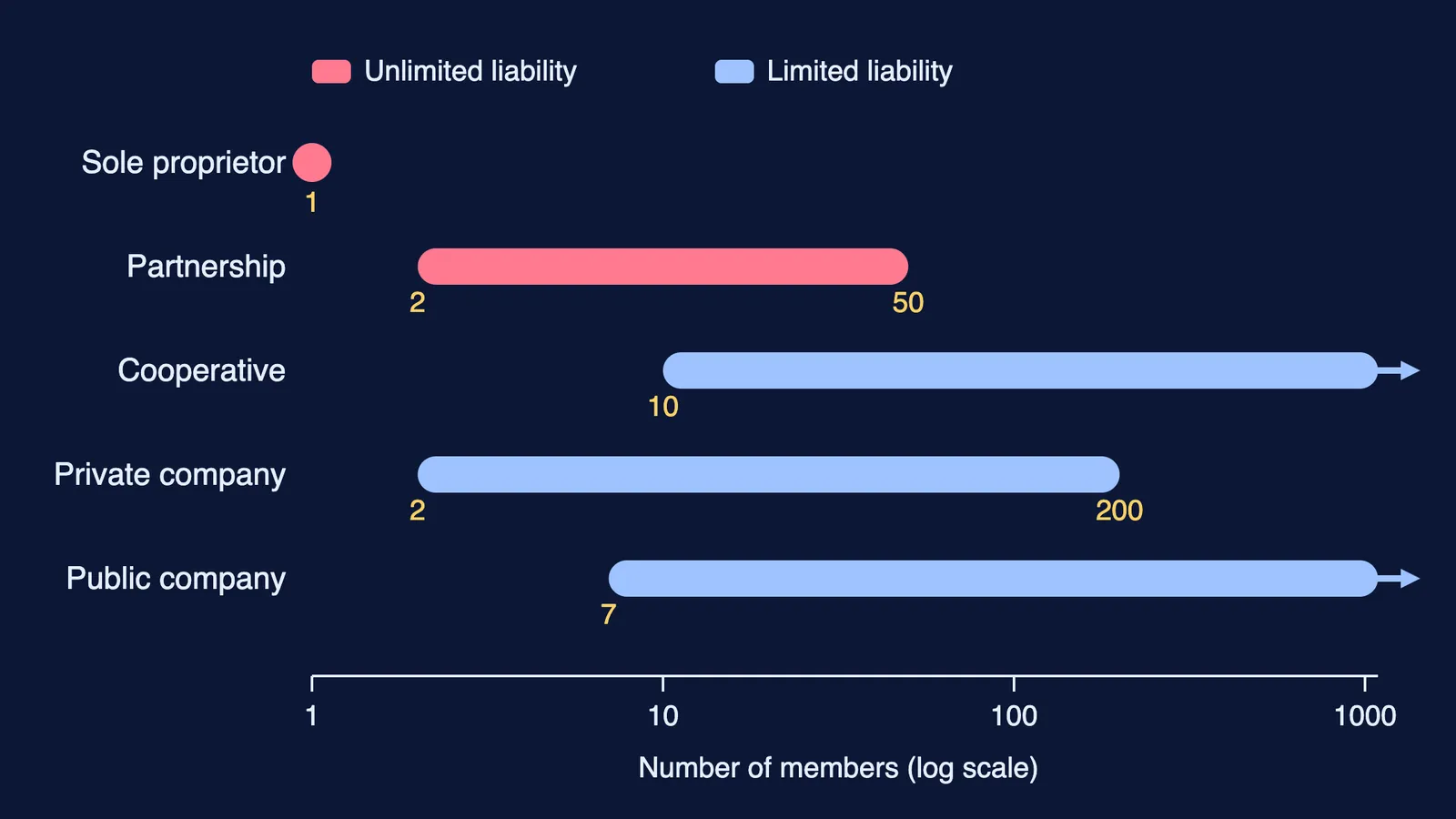
Members: a sole proprietorship has one owner; a partnership has 2 to 50 partners; a cooperative needs at least 10 adults, with no maximum; a private company has 2 to 200 members and a public company at least 7, with no maximum.
Liability: unlimited for a sole proprietor; unlimited, joint and several for partners; limited for cooperative members (to the capital they contribute) and for shareholders (to any amount unpaid on their shares).
Control: the owner decides alone; partners decide by consent; an elected managing committee runs a cooperative; a company's Board of Directors manages it, separate from its owners.
Continuity: a sole proprietorship and a partnership are affected by an owner's death or insolvency; a cooperative and a company are stable because of their separate legal status.
How does limited liability actually work?
NCERT explains liability with worked figures, a dry cleaner's debts and a shareholder's unpaid shares, and you can do the same. Two cases built on the rules in the chapter:
Riya and Kabir's partnership closes owing Rs 5,00,000, with assets worth Rs 3,00,000. The Rs 2,00,000 gap can be recovered from their personal property, and because liability is joint and several, either partner can be made to pay all of it if the other cannot.
Meera holds 1,000 shares of Rs 10 in a company and has paid Rs 6 on each. If the company fails, the most she can be asked to pay is the unpaid Rs 4 per share: Rs 4,000. Her house and savings are safe.
In a company whose shares are fully paid, the same Rs 2,00,000 shortfall would be the creditors' loss, not the shareholders'.
Which form of business organisation should you choose?
NCERT names the factors that decide the choice: capital, cost and ease of formation, transfer of ownership, managerial skills, regulation, flexibility, continuity and liability. Turn them into four questions for any case study.
How much money is needed? Small: sole proprietorship or partnership. Large: company.
Can the owners risk personal property? If not: company or cooperative.
Must the business outlive its founders? Then a form with separate legal status.
Is the aim service to members, not profit? Then a cooperative, like the Amul cooperative model.
Worked case: two friends start a home tiffin service with their savings. Small, yes, no, no: a partnership fits. Investors and three cities later would point to a private company.
How do you write a difference-between answer for full marks?
Draw two columns, with the basis of comparison at the start of every row.
Give one short line for each form on that basis.
Choose bases with numbers or legal terms first: members, liability, registration, continuity.
For a 4-mark question, give four bases. For a case study, name the form, then quote the line from the case that proves it.
For case questions in later chapters, see how to prove which management principle a case shows. Economics uses the same basis-by-basis method in forms of market compared feature by feature.
If you also take maths or a science and don't know where to begin, Fermi's AI tutor works out what you already know and builds a plan for the session.
Start tonight with the members line: it has the most numbers to get right.


