

On this page
The markets chapter in Class 11 economics can feel like four lists to memorise. There is a shorter way in: ask how many sellers there are, how alike their products are, and how easily a new firm can get in.
What are the four forms of market in Class 11?
The NIOS economics lesson on forms of market classifies markets by the number of firms, the ease of entry and exit, and the degree of product differentiation. It splits them into a perfect market and imperfect markets: monopoly, monopolistic competition and oligopoly.
Perfect competition: a very large number of buyers and sellers trade a homogeneous product at a price fixed by the market.
Monopoly: a single seller, no close substitutes and barriers to entry. The NIOS example is Indian Railways.
Monopolistic competition: many sellers, each selling a product that differs in some way from the others. The NIOS examples are restaurants and toothpaste.
Oligopoly: competition among the few. The NIOS examples are mobile service providers, the car industry and airlines.
NIOS ranks perfect competition as the most competitive form and monopoly as the least.
What does the Class 11 economics syllabus actually ask?
The 2026-27 Class 11 Economics (030) syllabus, as published by Delhi's Directorate of Education, gives "Forms of Market and Price Determination under perfect competition with simple applications" 8 of the 80 theory marks. Its Unit 7 lists the features of perfect competition, market equilibrium and the effects of shifts in demand and supply (short run only), plus price ceilings and price floors. So know perfect competition in depth, and the other three, which the unit title still names, well enough to compare.
The prescribed NCERT book's chapter on the theory of the firm under perfect competition lists four features (many buyers and sellers, a homogeneous product, free entry and exit, perfect information) and says they produce its single most distinguishing characteristic: price-taking behaviour.
How do perfect competition and monopoly differ, feature by feature?
All four forms, from the NIOS lesson.
Number of sellers: very many under perfect competition; many under monopolistic competition; a few under oligopoly; one under monopoly, so the firm and the industry are the same.
Product: homogeneous under perfect competition; differentiated but close substitutes under monopolistic competition; homogeneous or close substitutes under oligopoly; no close substitute under monopoly.
Entry and exit: free under perfect competition; blocked by strong barriers under monopoly.
Control over price: the perfectly competitive firm is a price taker; the monopolist is a price maker and can practise price discrimination; oligopoly prices tend to be rigid; monopolistic competitors sometimes compete without changing price, through promotion schemes, gifts and advertising.
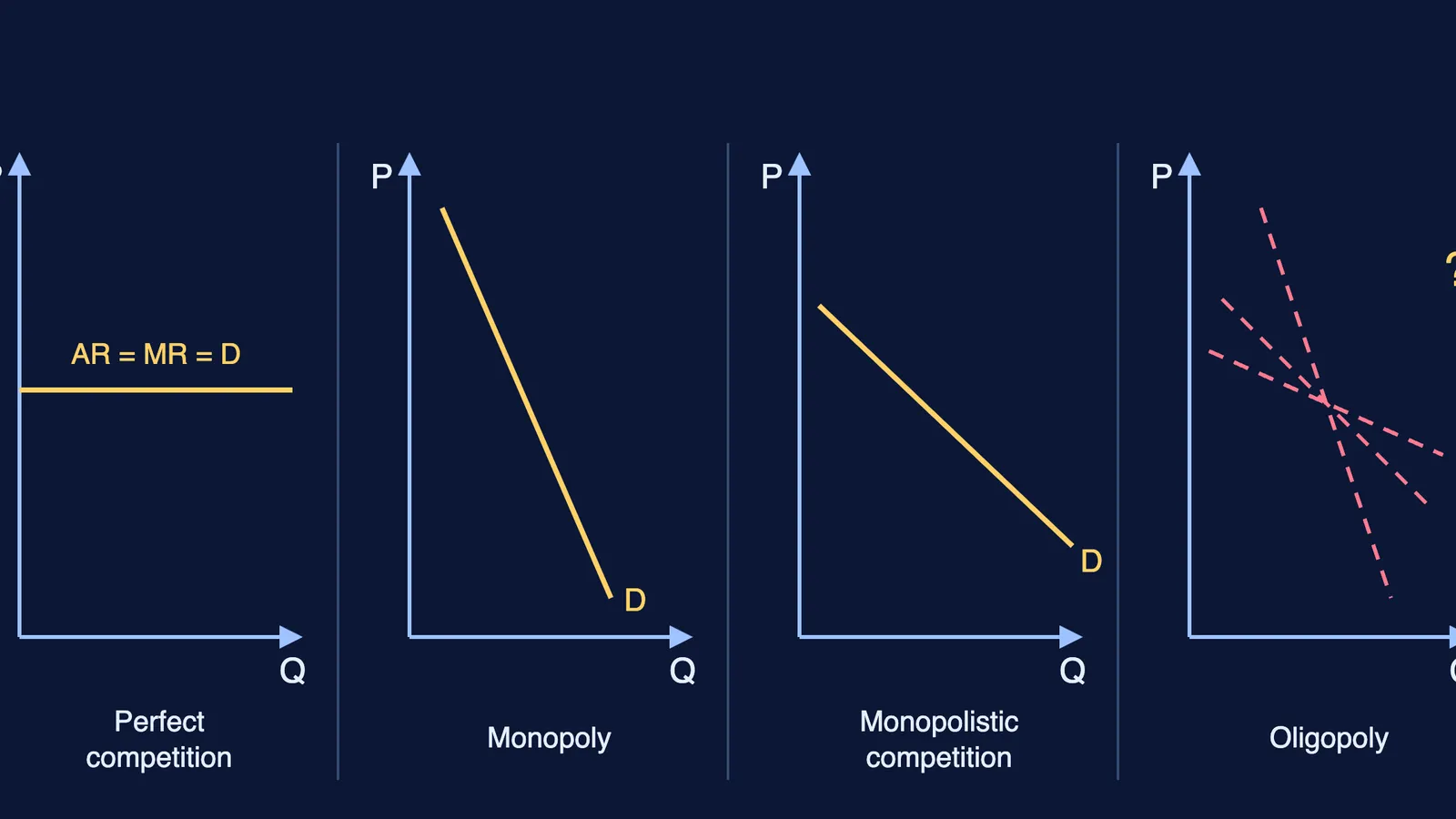
Demand curve facing one firm: horizontal and perfectly elastic under perfect competition; downward sloping under monopoly; downward sloping but less steep under monopolistic competition; indeterminate under oligopoly, because each firm's sales depend on how its rivals react.
Selling costs: none needed under perfect competition; heavy under monopolistic competition; also borne by oligopoly firms.
How do you classify a market you see around you?
Ask in order and stop at the first yes:
Is there only one seller, with no close substitute? Monopoly.
Are there only a few sellers who watch and answer each other's prices? Oligopoly.
Are there many sellers, each with its own brand, flavour or packaging? Monopolistic competition.
Are there many sellers of an identical product, with every buyer knowing the price? Perfect competition.
Try it on markets from the NIOS lesson. Indian Railways stops at question 1. Mobile service stops at question 2: NIOS calls interdependence a very significant feature of oligopoly and shows it with two cola makers: one cuts its price from Rs 10 to Rs 8 a bottle, the rival replies with Rs 7, and the first firm's demand may fall even below where it started. The toothpaste aisle stops at question 3.
For perfect competition, NCERT's perfect competition chapter builds a market for candles at Rs 10 a box. Total revenue is Rs 20 for 2 boxes and Rs 30 for 3, so marginal revenue is (30 - 20) / (3 - 2) = Rs 10, and average revenue (TR / q) is Rs 10 too. Price, AR and MR are equal, so the firm's demand curve is flat.
How should you answer a comparison question in the exam?
NIOS itself sets the question "Draw a comparison between perfect competition and monopoly". Answer in matching pairs (sellers, product, entry, price control, demand curve), not two separate paragraphs, with a flat demand line for one and a falling one for the other.
If the slope of a straight line still feels shaky, the Fermi Concept Library has its own lesson for every concept in mathematics, so you can revise slope before you draw. If you check your curves with an AI, our guide to checking an AI's demand-supply shift diagram shows a sketch-first method.
A 20-minute revision plan, five minutes each:
Write the three sorting features and four forms from memory.
Draw the demand curve facing one firm under each form.
Classify five markets from your own week.
Write the perfect competition and monopoly comparison as five matched pairs.
Curious where economics leads? Read how to become an economist in India or share our guide to careers after commerce, explained for families.


