On this page
An economist studies how people, firms and governments make choices with limited money, time and resources, and then uses data to test those ideas. In India, economists commonly work in universities and research institutes, in government policy jobs, or in the central bank and the financial sector. Many of these roles ask for a master's degree, so this guide works backwards from that.
Which degree should you choose after Class 12?
The common first step is a bachelor's in economics, but the entry rules often care more about your maths than your economics marks.
BA (Hons) Economics at Delhi University. For 2025-26 admissions, the CUET combination approved for this course was one language, plus Mathematics or Applied Mathematics, plus any two other subjects from DU's list of CUET papers (University of Delhi, Academic Council minutes). Economics itself was not compulsory, but maths was. Check the current year's bulletin before you pick your CUET papers.
Bachelor of Statistics (Hons) at the Indian Statistical Institute. The 2026-27 notice requires Class 12 with Mathematics and English, and lists a stipend of ₹5,000 per month (ISI Admission Notice 2026-27).
A maths, statistics or engineering degree also works if you plan to move into economics for your master's.
That last route is open because some master's programmes do not ask for an economics bachelor's. ISI's two-year MS in Quantitative Economics accepts a bachelor's degree of three or more years in any discipline, and lists a stipend of ₹8,000 per month (ISI Admission Notice 2026-27). Selection is by written test and/or interview (the 2026 ISI Admission Test was on 10 May), so the filter is the test, not your degree's name. Our guide to economics honours with maths goes deeper.
How much maths do you need to become an economist?
More than most Class 11 students expect. The clearest public evidence is the Indian Economic Service syllabus. In UPSC's 2026 notice, General Economics Paper I has a whole part called "Quantitative Methods in Economics", covering differentiation and integration, optimisation, matrices, linear programming, regression, time series and measures of inequality such as the Gini coefficient (UPSC IES/ISS Examination Notice 2026).
In school terms, that means the chapters you meet in Class 11 and 12 maths are the foundation: functions and graphs, derivatives and maxima-minima, integrals, matrices, probability and statistics. You do not need to be a maths topper. You do need to be comfortable reading an equation and asking what it says about the real world.
If calculus or matrices feel shaky, the Fermi Concept Library has a lesson for every concept in mathematics, so you can close one gap at a time before college starts.
How do you get into research or government policy roles?
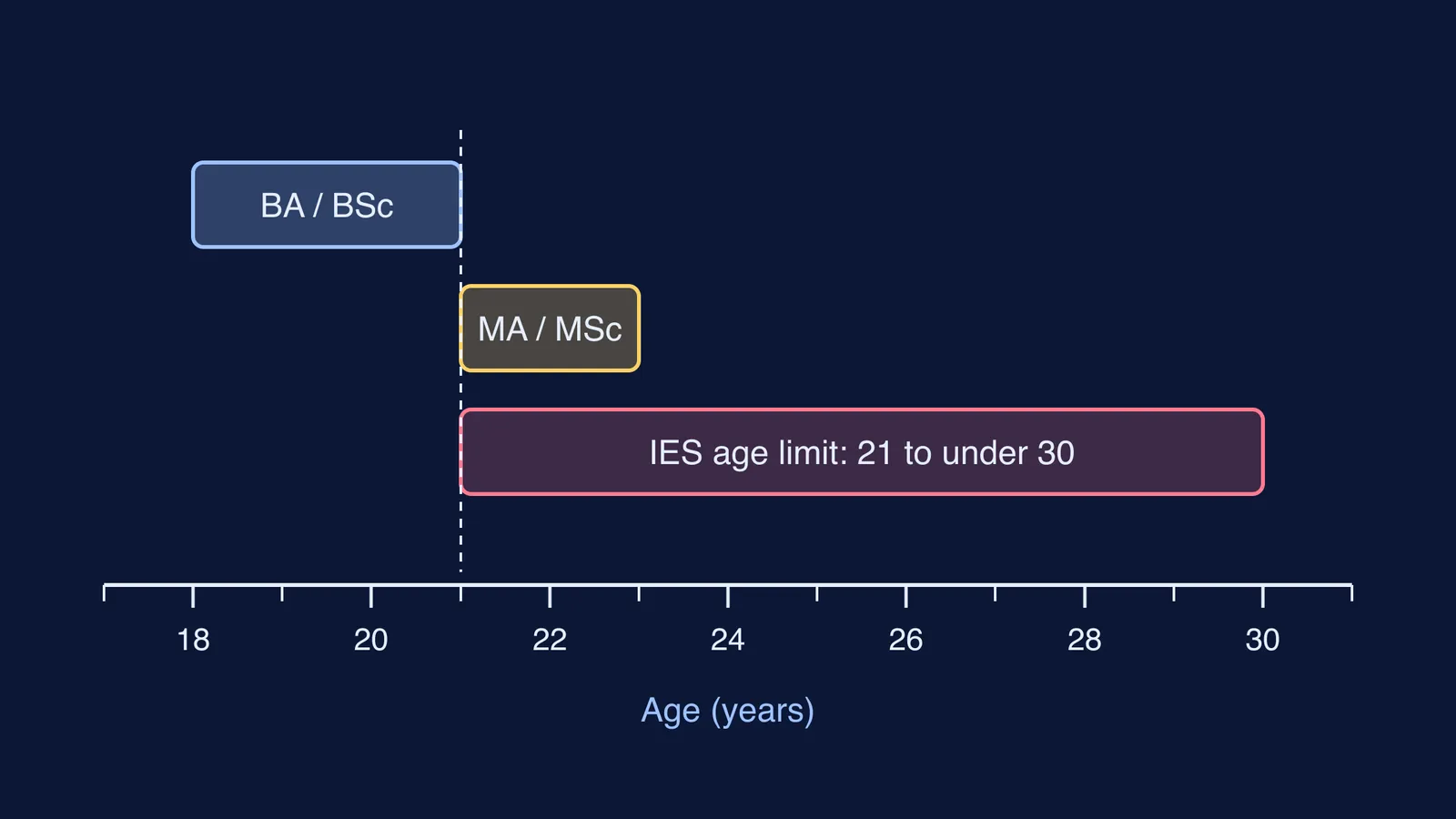
Government policy. The Indian Economic Service is the civil-service route built specifically for economists. UPSC requires a postgraduate degree in Economics, Applied Economics, Business Economics or Econometrics, and candidates must be at least 21 and under 30 on 1 August of the exam year, with relaxations for some categories (UPSC IES/ISS Examination Notice 2026). The 2026 notice listed 16 tentative vacancies in the Indian Economic Service, with the exam starting on 19 June 2026. The selection has a written exam and a personality test. If you are stronger in statistics than economics, the sister exam is covered in our guide to the Indian Statistical Service route.
Research. A research career usually means a PhD. ISI, for example, offers a Junior Research Fellowship in Quantitative Economics for anyone with a master's degree in any discipline with economics, mathematics or statistics studied at either level. It lists a fellowship of ₹37,000 per month and permits registration for a PhD at ISI (ISI Admission Notice 2026-27). The Indira Gandhi Institute of Development Research was established by the Reserve Bank of India on 28 December 1987 to promote research on development issues (RBI history, 1985 to 1991). For what doctoral life actually involves, read our guide to a research career and PhD in India.
What should you do now? A plan from Class 11
Class 11: keep Mathematics (or Applied Mathematics). It is the one subject that keeps every route above open.
Class 12: check the current CUET subject rules for your target courses, and look at ISI's sample questions if you are considering the B.Stat.
College years 1 to 3: take every maths and statistics elective you can, and learn one data tool such as a spreadsheet or a programming language.
Final year: apply for master's programmes, including entrance tests like ISI's for courses that accept any bachelor's degree.
During the master's: decide between research (PhD and fellowships) and policy (the IES exam, while you are within the UPSC age limit).
To practise the calculus that turns up in first-year economics, the Fermi Problem Library has worked problems with a step-by-step solver that explains the reasoning rather than printing an answer.
Start with one thing this week: open the latest official notice for the course or exam you want, and note its maths requirement.