On this page
Memorising "h/4 from the base" works until a question hands you a hollow cone, a cone on a hemisphere, or asks for the distance from the tip. If you can rebuild the result in six lines, those twists stop being traps.
The standard tables agree: Wikipedia's list of centroids gives the centroid of a right circular cone of height h at h/4 from the base, and Jeremy Tatum's Classical Mechanics notes on LibreTexts/01%3A_Centers_of_Mass/1.S%3A_Centers_of_Mass_(Summary)) put it 3/4 of the way from the vertex to the centre of the base. Here is why.
How do you find the centre of mass of a solid cone by integration?
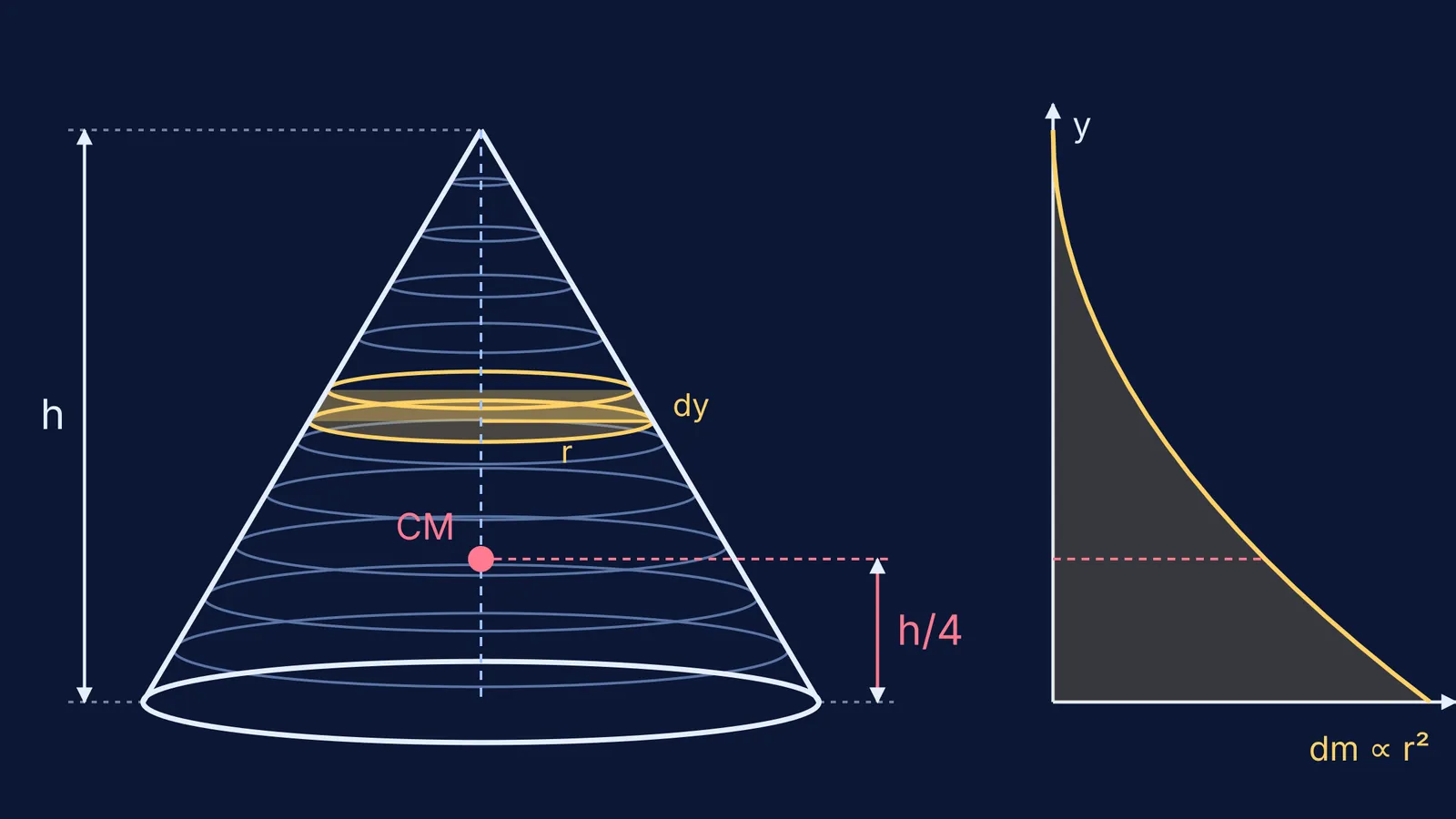
Take a uniform solid cone with base radius R, height h and density ρ. Measure height y upward from the centre of the base.
Choose the element. Cut a thin horizontal disc at height y, thickness dy.
Find its radius. By similar triangles the radius shrinks linearly to zero at the tip: r = R(1 − y/h).
Write its mass. dm = ρπr² dy = ρπR²(1 − y/h)² dy.
Total mass. Integrating from 0 to h gives M = ρπR²h/3, one-third of a cylinder.
First moment. ∫ y dm = ρπR² ∫ y(1 − y/h)² dy from 0 to h. Expand: y − 2y²/h + y³/h². Integrate: h²/2 − 2h²/3 + h²/4 = h²/12. So ∫ y dm = ρπR²h²/12.
Divide. y_cm = (ρπR²h²/12) ÷ (ρπR²h/3) = h/4.
R and ρ cancel, so every uniform solid cone balances at a quarter of its height.
Putting the origin at the tip makes r = Ry/h and the algebra shorter; the MiniPhysics derivation does this and gets 3h/4 from the apex. For the same ∫x dm ÷ ∫dm recipe in one dimension, see the centre of mass of a rod with variable density.
Why is it h/4 and not h/2 or h/3?
Disc mass grows with r², so slices near the base far outweigh those near the tip. The top half of the height is a cone of half the size, holding (1/2)³ = 1/8 of the volume, so the bottom half holds 7/8.
A pattern for checking yourself:
A uniform rod: element mass constant along its length, centre at 1/2 of the length.
A triangular sheet: strip mass grows with width (r¹), centroid at 1/3 of the height from the base; Tatum's notes give 2/3 of the way from the vertex.
A solid cone: disc mass grows with r², centre at 1/4 of the height from the base.
Each extra power of r pushes the centre closer to the heavy end. The same r² weighting explains why a cone's volume is one-third of a cylinder's.
What about a hollow cone or a hemisphere?
Change where the mass sits and the answer changes, even with the same outline. Tatum's summary table/01%3A_Centers_of_Mass/1.S%3A_Centers_of_Mass_(Summary)) lists these:
Solid cone: 3/4 of the way from the vertex, so h/4 above the base.
Hollow cone (curved surface only): 2/3 of the way from the vertex, so h/3 above the base.
Solid hemisphere of radius a: 3a/8 from the flat face.
Hollow hemisphere: a/2 from the flat face.
The hollow cone sits higher because a ring's mass grows with r, not r².
Worked example: a cone on a hemisphere
A toy is a solid cone of radius 3 cm and height 12 cm glued base-to-face on a solid hemisphere of radius 3 cm, both of the same material. Where is its centre of mass?
Take the joining circle as y = 0, with the cone above.
Cone: volume (1/3)π(3²)(12) = 36π cm³; centre at 12/4 = 3 cm above the joint.
Hemisphere: volume (2/3)π(3³) = 18π cm³; centre at 3(3)/8 = 1.125 cm below the joint, so y = −1.125 cm.
Combine: y_cm = (36π × 3 + 18π × (−1.125)) ÷ 54π = 87.75 ÷ 54 = 1.625 cm.
The centre of mass is 1.625 cm above the joint, inside the cone. With one density, volume stands in for mass. Resting on its round face, the toy rocks back upright only if this point lies below the hemisphere's centre (the joint), so this one tips over. That test is the idea behind stable, unstable and neutral equilibrium of a cone.
A three-line checklist before you write h/4
Is it solid (h/4) or only a curved surface (h/3)?
Is the question measuring from the base or the apex?
For a combined body, did you give the part below your origin a negative y?
To practise on more shapes, the Fermi Problem Library has worked problems with a step-by-step solver that explains the reasoning rather than printing an answer. If the gap is the idea of centre of mass itself, start from its lesson in the Fermi Concept Library.