

On this page
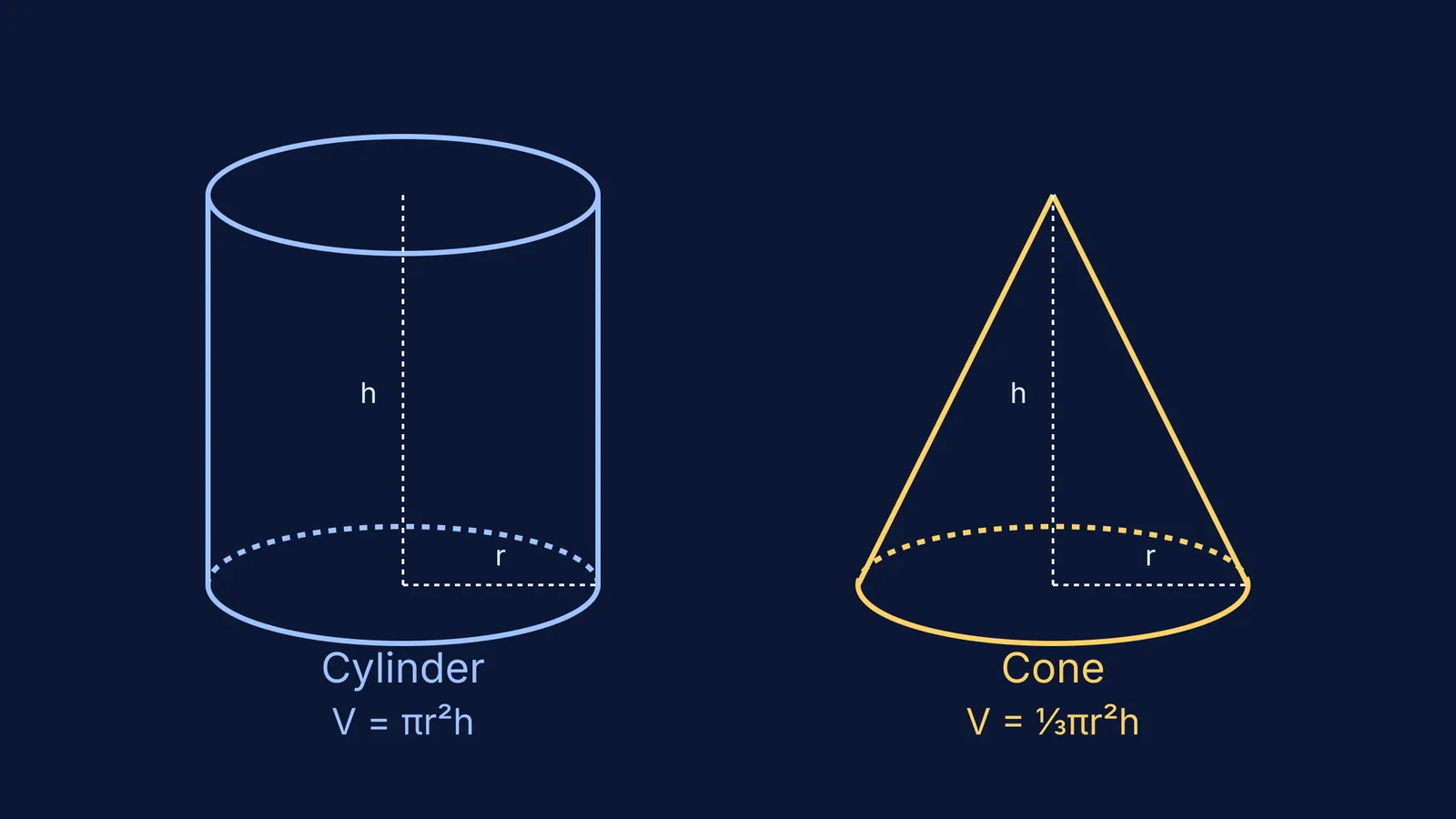
If you take a hollow cylinder and a hollow cone that share the same base radius and the same height, and fill the cone with water, it will take exactly three full cones to fill the cylinder to the brim. The formula for a cylinder is πr²h, so the formula for a cone is exactly ⅓πr²h.
Why is a cone one-third of a cylinder?
This 1/3 ratio is not a rough approximation; it is a perfect mathematical truth. The reason it appears is that while a cylinder's cross-section stays constant from top to bottom, a cone's cross-section shrinks.
Because the radius shrinks steadily (linearly) as you move from the base to the apex, the area of the circular cross-section shrinks quadratically. For example, halfway up the cone, the radius is half its original size, but the area of that slice is only one-quarter of the base area. When you use integration to sum up an infinite number of these squared slices along the height, the mathematics naturally yields a factor of exactly one-third. (This is similar to finding an Area using horizontal strips: integrating with respect to y).
How do you prove the volume of a cone without calculus?
The simplest mathematical proof does not start with circles; it starts with a cube.
Imagine a solid, transparent cube. Choose one corner to be your apex. Now, identify the three square faces of the cube that do not touch that corner. If you draw straight, internal lines connecting the outer edges of those three faces to your chosen apex, you will slice the cube into exactly three oblique (slanted) square-based pyramids).
Because a cube is perfectly symmetric in all three dimensions, these three pyramids are entirely identical in shape and volume. Since three identical pyramids combine to form one whole cube, the volume of a single pyramid must be exactly one-third of the cube's total volume (which is ⅓ × Base Area × Height).
The 17th-century Italian mathematician Bonaventura Cavalieri showed that this rule extends to other solid shapes. Cavalieri's principle states that if two solid objects have the same height, and their horizontal cross-sections at every single level have the exact same area, they must contain the same total volume). You can picture this like a stack of paper; pushing the stack so that it slants to one side changes its overall shape, but it does not change the amount of paper. Since a circular cone is mathematically just a pyramid with a circular base, the 1/3 ratio that applies to a square-based pyramid applies to the cone as well.
Who discovered the volume of a cone?
The history of this formula is a story of intuition running ahead of formal proof.
The Greek philosopher Democritus (who lived from c. 460 to c. 370 BC and is most famous for his atomic theory) was the first to assert that a cone is one-third the volume of its bounding cylinder.
Democritus likely pictured the cone as a stack of incredibly thin, step-like circular slices, similar to a stack of coins that gets progressively smaller. By treating the cone as a sequence of separate layers, he could intuitively grasp the 1/3 relationship. However, because his slices would leave the edges of the cone slightly jagged rather than perfectly smooth, he could not provide a proof that satisfied the high standards of Greek geometry at the time.
It took another Greek mathematician, Eudoxus of Cnidus, to supply the formal proof several decades later. Eudoxus bypassed the problem of jagged edges. He used the "method of exhaustion" — an ancient technique that paved the way for modern integral calculus. He approximated the exact volume of the cone by inscribing smaller and smaller pyramids inside it. By increasing the number of sides on the base of the inscribed pyramids until the empty space inside the cone was entirely exhausted, Eudoxus proved the 1/3 ratio (much like the work of Liu Hui and how doubling a polygon's sides closes in on pi).
How do you remember 3D volume formulas?
Formulas are much easier to remember when you group them by their geometry rather than memorising them individually. Use this simple rule to navigate mensuration problems:
Straight walls: If a shape's cross-section stays constant from top to bottom (like a cylinder, a cube, or a rectangular prism), its volume is always just its Base Area multiplied by its Height.
Pointy tops: If a shape tapers to a single point (like a cone or any pyramid), its volume is always exactly ⅓ of its Base Area multiplied by its Height.
When you need help visualising why a mathematical rule works, the Concept Library connects formulas to the physical intuitions behind them. If you are stuck on a geometry problem, Fermi's AI tutor can step in — it works out what you know, builds a plan for the session, and teaches through it by writing on a board and drawing the figure to show you exactly how the pieces fit together.


