

On this page
If your child has picked commerce, someone at the next family function will ask, "So, CA?" If you studied science or arts yourself, CA, CS and CMA can sound alike. This guide explains the common paths in plain words.
What careers come after commerce stream?
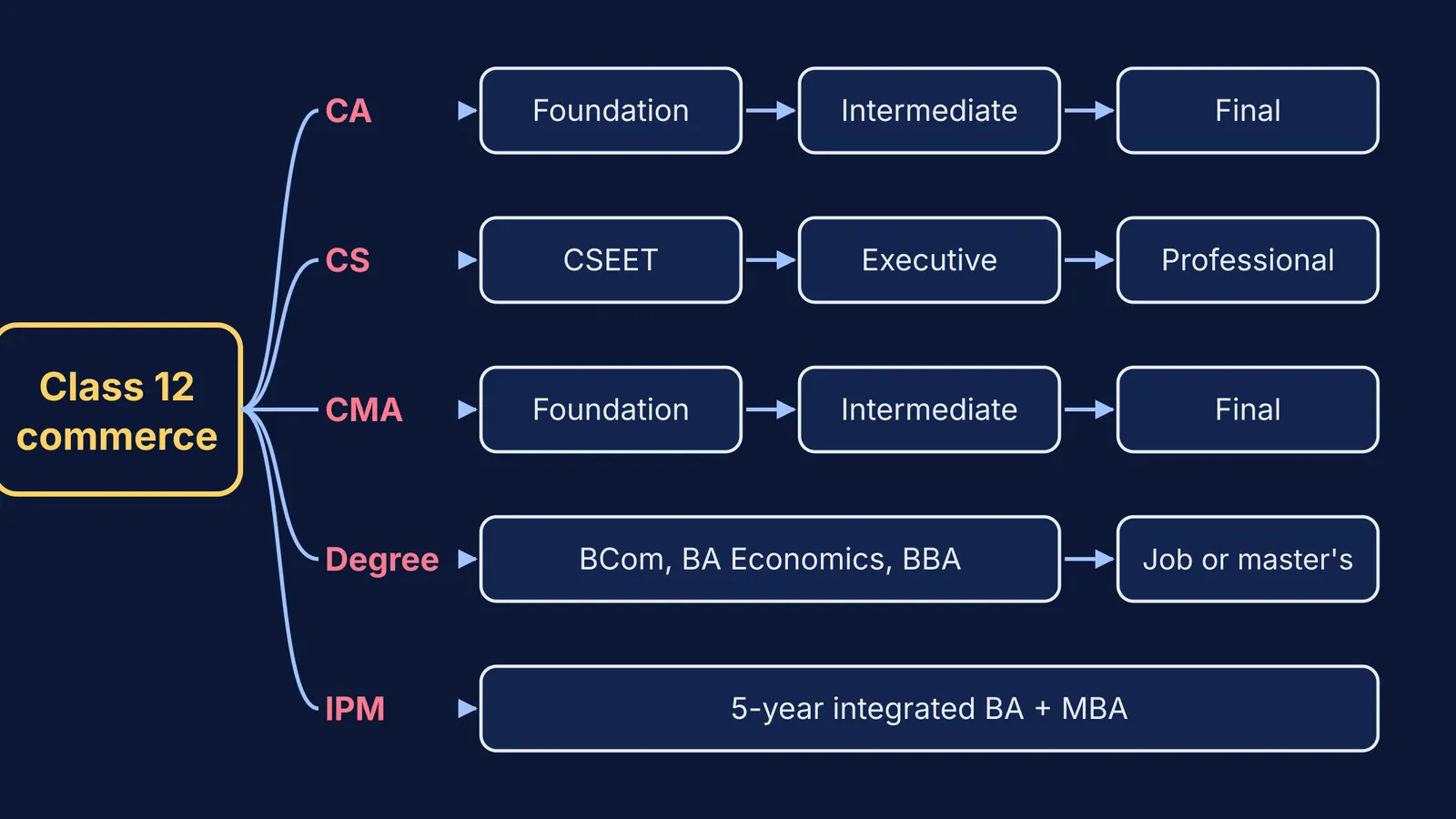
The paths after commerce fall into two groups.
Professional qualifications: chartered accountant (CA), company secretary (CS) and cost and management accountant (CMA). Each is run by its own institute and studied in stages, with exams along the way.
University degrees: BCom, BA or BSc in economics, and management degrees such as BBA, followed by a job or a master's.
Commerce is a well-trodden road. According to the Ministry of Education's All India Survey on Higher Education 2021-22, commerce accounted for 13.3% of undergraduate enrolment among the institutions that responded, behind arts (34.2%) and science (14.8%).
What is CA, and how long does it take?
A chartered accountant works with a business's money: accounts, audit and tax. The Institute of Chartered Accountants of India (ICAI) runs the course in three levels: Foundation, Intermediate and Final. Under the ICAI's new scheme of education and training, practical training that begins on or after 1 July 2023 lasts two years and must be done without a break.
What this means for your family: CA is not one exam. It is a multi-year route of study, exams and real office work, so your child needs patience as much as marks.
What do CS and CMA mean?
A company secretary handles a company's legal paperwork, such as filing, registering and attesting documents on its behalf, and may also act as a legal adviser or planner inside the firm. The Institute of Company Secretaries of India (ICSI) runs CS in three stages: an entrance test called CSEET, then the Executive and Professional programmes, with practical training before membership, as this summary of ICSI admission rules sets out. Students can take CSEET once they have appeared for their Class 12 exams, according to this CSEET FAQ.
A cost and management accountant focuses on costing and management accounting inside organisations. The Institute of Cost Accountants of India offers the CMA course in Foundation, Intermediate and Final levels, and Foundation is open after Class 12, per this overview of the CMA course.
What about economics and management degrees?
For undergraduate programmes at central universities, and at the state, deemed and private universities that take part, admission uses the CUET (UG) score from the National Testing Agency. So Class 12 marks are only part of the story; your child also needs to plan the CUET subjects that their chosen course asks for.
Economics suits a child who asks why prices rise or why some jobs pay more. Many economics programmes expect comfort with maths, which is why we wrote a separate guide to choosing economics honours with maths. If Class 11 maths is the worry, the Fermi Concept Library has a lesson for every concept in mathematics, so a gap can be filled before it grows.
Management can start straight after school. IIM Indore's Integrated Programme in Management runs for five years in 15 terms, takes students who have passed Class 12, and awards a Bachelor of Arts (Foundations of Management) and an MBA. Our explainer on IPMAT and integrated management after Class 12 covers the entrance test.
How do you choose between CA, CS, economics and management?
Look at how your child likes to work, not at which title sounds grand. Use this match-up as a starting point:
Enjoys rules, numbers that must balance and long exam cycles: CA or CMA.
Enjoys law, careful reading and getting documents exactly right: CS.
Enjoys asking why, with graphs and maths: economics.
Enjoys people, organising and persuading: management (BBA or an integrated programme).
A worked example. Ananya is in Class 11 commerce. She likes accountancy, finds memorising legal sections dull, and scores well in maths. The family is torn between CA and CS. The match-up points her towards CA or economics, not CS. Her plan for the next six months:
Spend an evening with a working chartered accountant and ask what a normal Tuesday looks like.
Read the ICAI training rules together, so the length of the route is not a surprise.
List the CUET subjects that economics courses on her shortlist ask for, as a backup route.
Decide in Class 12, not now.
What can you say when relatives ask why not science?
A short, calm answer protects your child from a long debate. Try: "She chose commerce because she enjoys accounts and maths. She's looking at CA and economics, and she'll decide in Class 12." Then change the subject. Our guide to career talks with relatives who work shows how to turn those same relatives into useful sources instead.
If the pressure around stream choice starts affecting your child's sleep or mood, talk to a school counsellor, or call Tele MANAS, a free, 24x7 national mental-health helpline, on 14416.
This week, go through the match-up list with your child; it gives you both a shared starting point.


