

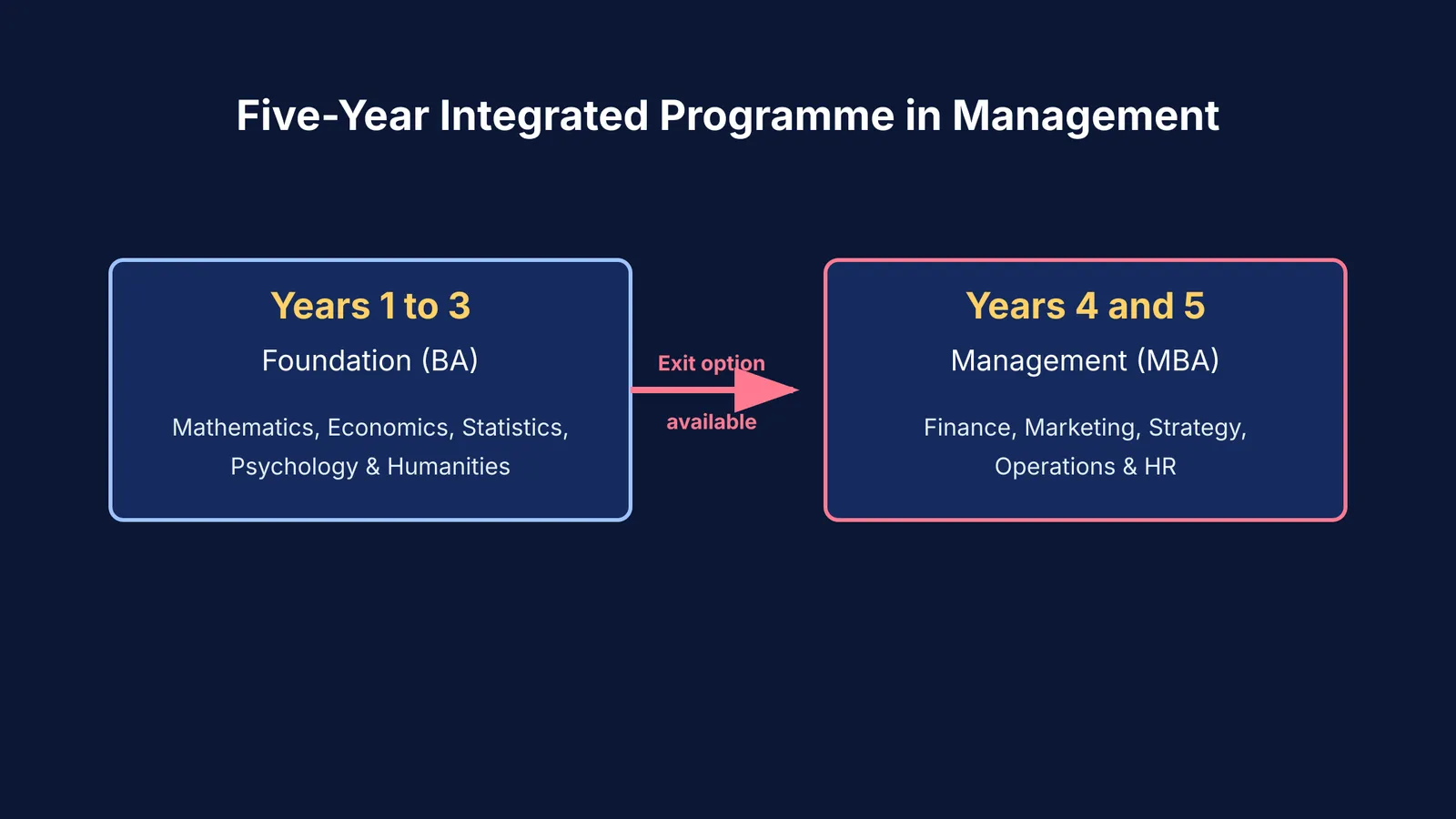
The Integrated Programme in Management (IPM) is a five-year dual-degree course offered by several Indian Institutes of Management (IIMs). IIM Indore launched the first such programme in 2011 [[1]](https://www.iimidr.ac.in/academic-programmes/five-year-integrated-programme-in-management-ipm/). It is designed for students who are already certain they want a career in business management directly after completing their 12th standard, allowing them to bypass the intense competition of the CAT exam after graduation.
The degree is structured in two distinct phases:
First three years (Foundation): Students study a broad foundation including Mathematics, Statistics, Economics, Psychology, Sociology, and Humanities [[1]](https://www.iimidr.ac.in/academic-programmes/five-year-integrated-programme-in-management-ipm/). IIM Indore awards a Bachelor of Arts in Foundations of Management.
Final two years (Management): Students join the standard Post Graduate Programme (PGP) alongside graduates who entered through the CAT exam, following the identical MBA curriculum [[1]](https://www.iimidr.ac.in/academic-programmes/five-year-integrated-programme-in-management-ipm/).
The programme includes an exit option, allowing students to leave with a bachelor's degree after the third year. The domestic fees for the first three years at IIM Indore are ₹6,00,000 per annum, before shifting to the standard MBA fee structure for the final two years [[1]](https://www.iimidr.ac.in/academic-programmes/five-year-integrated-programme-in-management-ipm/).
What is the IPMAT test pattern?
Admission is primarily through the Integrated Programme in Management Aptitude Test (IPMAT), though some institutes use a joint test.
The IIM Indore IPMAT tests two main areas: Quantitative Ability (Multiple Choice and Short Answer) and Verbal Ability (English Proficiency) [[1]](https://www.iimidr.ac.in/academic-programmes/five-year-integrated-programme-in-management-ipm/). Competition is exceptionally high; IIM Indore has a sanctioned intake of exactly 150 domestic students each year [[1]](https://www.iimidr.ac.in/academic-programmes/five-year-integrated-programme-in-management-ipm/). Candidates who clear the aptitude test are shortlisted for a Personal Interview (PI) to assess their communication skills and confidence.
For IIM Bodh Gaya and IIM Jammu, the National Testing Agency (NTA) conducts the Joint Integrated Programme in Management Admission Test (JIPMAT) [[2]](https://exams.nta.ac.in/JIPMAT/). The JIPMAT is a 150-minute computer-based test comprising 100 multiple choice questions [[2]](https://exams.nta.ac.in/JIPMAT/). It covers Quantitative Aptitude, Data Interpretation and Logical Reasoning, and Verbal Ability, with candidates earning +4 marks for every correct answer and losing 1 mark for each incorrect one [[2]](https://exams.nta.ac.in/JIPMAT/).
Is the integrated management programme right for you?
Deciding to commit to a five-year degree straight out of school requires careful thought. Use this checklist to see if the IPM aligns with your strengths:
Are you comfortable with advanced mathematics? The IPMAT relies heavily on calculus, combinatorics and probability.
Do you want a multidisciplinary foundation? The first three years cover sociology, psychology and humanities alongside quantitative subjects.
Are you certain about a management career? Unlike a general BTech or BSc which leaves career options wide open, the IPM is focused on business leadership from day one.
Do you want to avoid the CAT? The IPM guarantees an IIM MBA without facing the intense post-graduation competition of the CAT, provided you maintain the required academic standards during the foundation years.
If you are preparing for the Quantitative Ability sections, a firm grasp of combinatorics and probability is essential. You can brush up on the fundamentals with our guides on with and without replacement probability and converting odds in favour and odds against.
If you are struggling with the mathematical reasoning required for the IPMAT, Fermi's AI tutor can help. When you bring a difficult quantitative problem, Fermi works out what you already know, builds a plan for the session, and teaches through it—writing on a board, drawing the figure, and checking understanding as it goes. If you need step-by-step guidance on past papers, the Fermi Problem Library explains the reasoning for each step rather than printing an answer.
Because the foundation years of the IPM itself require strong quantitative skills—including statistics and econometrics—thorough preparation in school-level mathematics pays off throughout the five-year degree. Reviewing the CBSE Class 10 maths theorems you must be able to prove is a sensible first step to ensure your fundamentals are secure.


