On this page
In a Business Studies case, knowing Fayol’s 14 principles by heart is not enough. You have to spot one inside a short story and prove it with a line from the case. AI can help you practise, if it shows its evidence and you guess first.
What does a business studies case study question test?
CBSE’s case study question bank for Class 12 Business Studies gives you a short story, then quotes a line back and asks “Which principle of management is being followed here?” The same set quotes “She appoints a team of designers and crafts people” and asks which function of management it highlights. The skill is matching one sentence to one textbook idea.
The CBSE 2025-26 sample paper marking scheme shows how this is scored: in question 24, a 3-mark case on levels of management, you get “1 mark for identification” and 2 for explanation.
Which principle does each line of this case show?
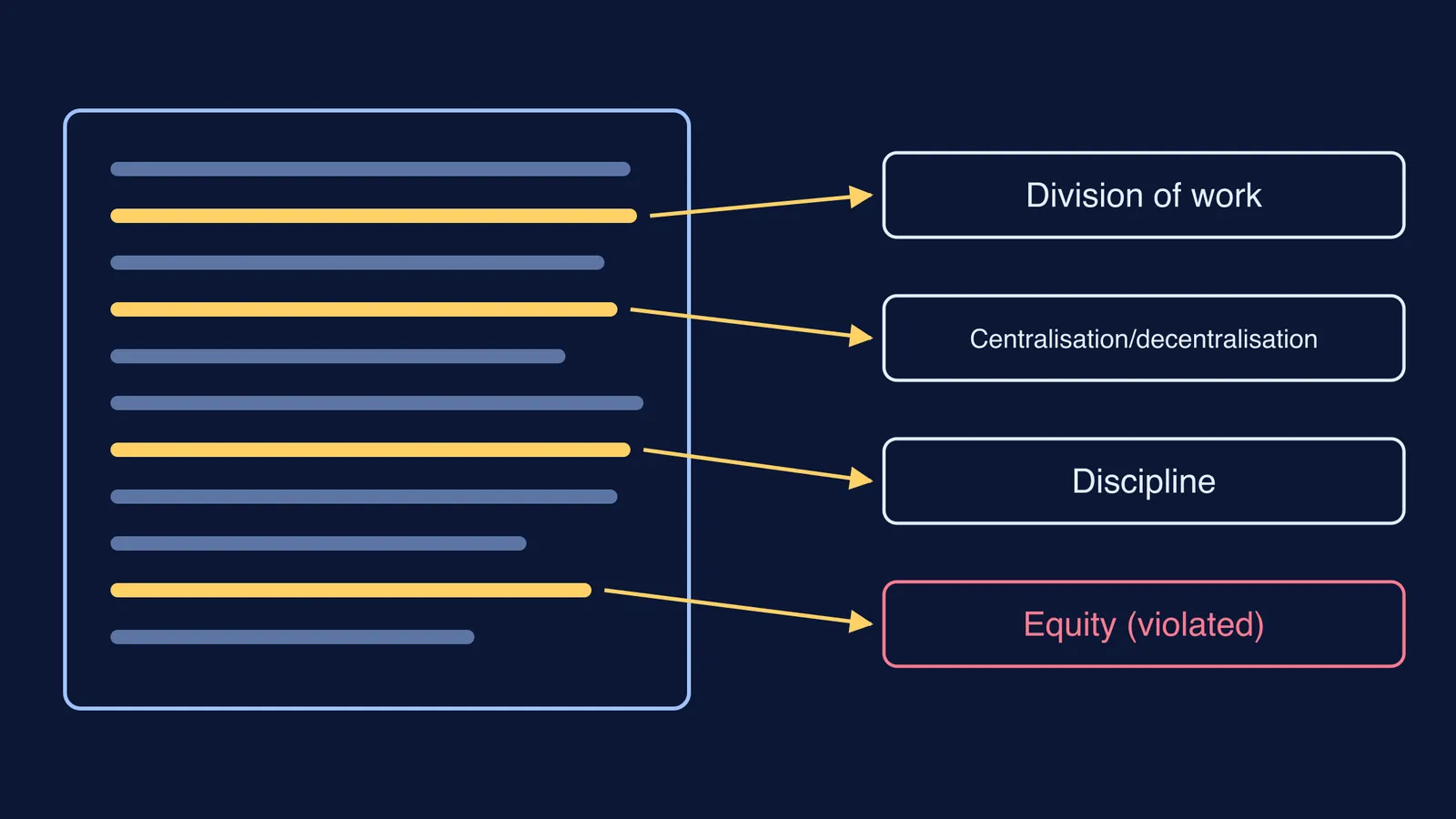
Take the boutique case from that CBSE question bank: Aditi has opened a boutique in Kolkata. Here is each line, the principle it shows, and the wording it matches in NCERT Class 12 Business Studies, Chapter 2.
“She has divided the work in smaller units and each employee is well trained to perform his/her task efficiently.” This is division of work. NCERT: “Work is divided into small tasks/jobs. A trained specialist who is competent is required to perform each job.”
“The sales persons are allowed to close a deal with a buyer by giving a maximum of 5 percent discount, whereas the decision to give any further discount rests with Aditi as the final authority.” This is centralisation and decentralisation. NCERT quotes Fayol on the need to balance “subordinate involvement through decentralisation with managers’ retention of final authority through centralisation.”
“She honoured her commitment by giving bonus to her employees.” This is discipline. NCERT’s own example of discipline is workers putting in extra hours while management promises higher wages, so that both “honour their commitments”.
“Communication from top to bottom should follow the official lines of command.” This is scalar chain. NCERT: “The formal lines of authority from highest to lowest ranks are known as scalar chain.”
“She tends to be more biased towards her female employees, when it comes to solve the conflicts among employees.” This violates equity. NCERT says there should be “no discrimination against anyone on account of gender, religion, language, caste, belief or nationality”.
How do I ask AI to justify the principle?
If the AI answers first, you nod along and never practise the spotting. Make it your checker instead, with this script:
Paste the case and say: “Don’t answer yet. I will name the principle or function for each line.”
Write your guess for each line, with the exact words that made you choose it.
Then ask: “For each line, tell me if I am right. Quote the exact line from the case, name the principle or function, and point to the words in the line that show it. If two principles look close, explain why the other one is wrong.”
Finish with: “Write one new line, from a different business, that shows the same principle.”
Step 3 does the work. “Quote the exact line” stops the AI answering from a vague sense of the whole case, and “why the other one is wrong” trains you on look-alike pairs.
Can I trust the AI’s answer?
Not on its own. A chatbot can sound certain and still pick the wrong look-alike, so the final check is the NCERT chapter. If the AI’s reason does not match NCERT’s wording, mark it and ask your teacher. The same habit works in accountancy, as in our guide to checking AI journal entries with the golden rules.
Why explain your own pick? A review of ten learning techniques by Dunlosky and colleagues (2013) gave self-explanation and elaborative interrogation (explaining why something is true) “moderate utility” ratings, and noted they have not been adequately evaluated in educational settings. Pointing to the words that show a principle is a small version of that.
If you also study maths or science, Fermi’s AI tutor teaches rather than answers: it notices where you are stuck and decides whether to explain, ask or show.
How do I practise spotting principles before the boards?
Do one chapter’s case set from the CBSE question bank each day, using the script above.
For every line, write the principle or function, the words you quoted, and the NCERT phrase they match.
Keep a list of wrong picks. Most will be look-alike pairs, such as discipline and remuneration, or unity of command and unity of direction.
Once a week, ask the AI for five new lines on your weakest pairs and label them without help.
Then move on to writing full answers with our guide to answering business studies case study questions for full marks, and see how to practise CBSE case study questions with AI for other subjects.