On this page
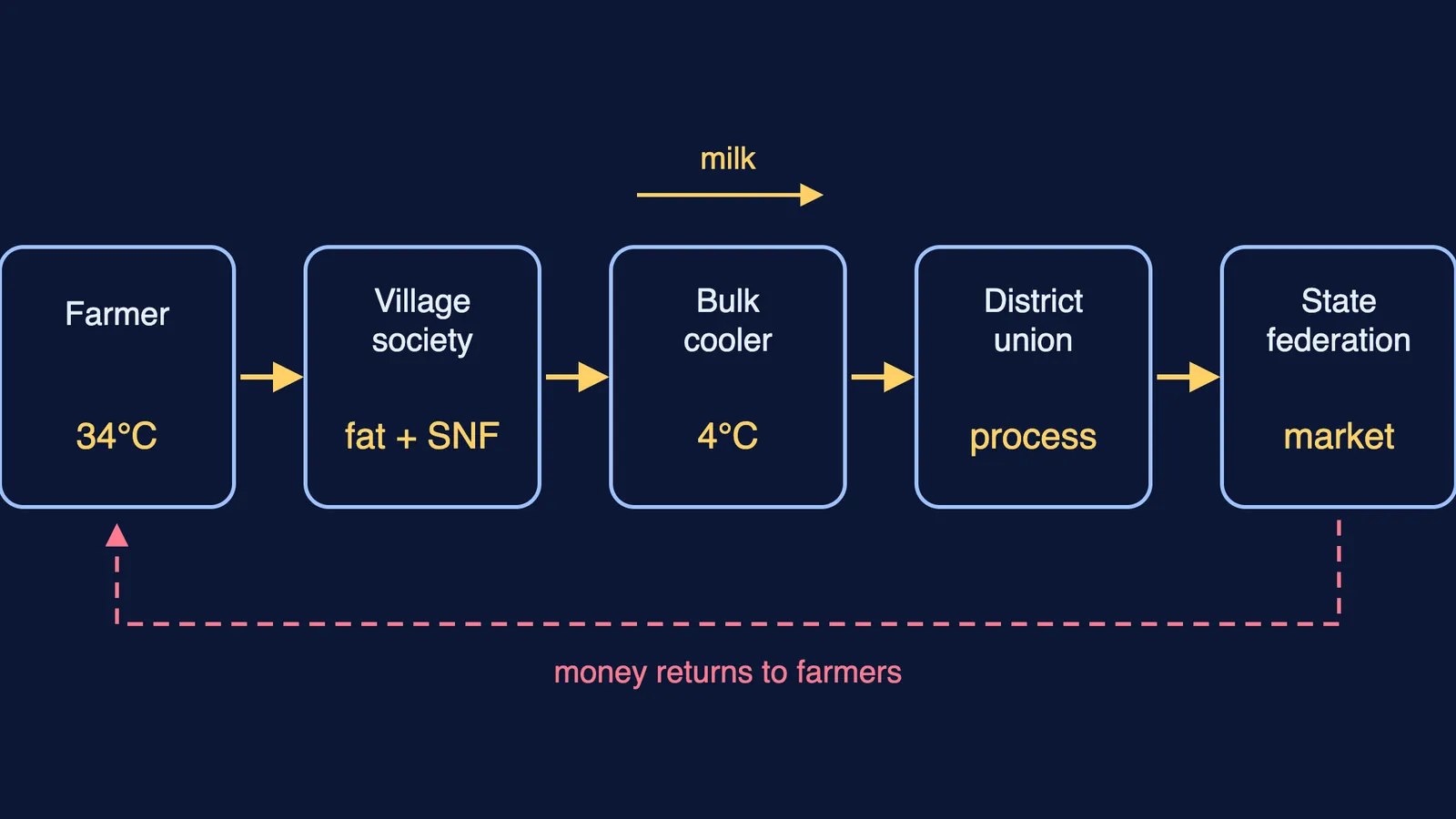
In Gujarat's villages, farmers carry milk to a society they own, where it is tested, chilled and sent to a dairy. The Amul model joins an ownership structure that returns the money to farmers with simple science that keeps the pay fair and the milk safe.
How does the Amul model work?
Amul began in 1946 as the Kaira District Co-operative Milk Producers' Union in Anand, Gujarat (Drishti IAS, citing PIB). Its structure is called the Anand pattern, and the National Dairy Development Board describes three tiers:
Village dairy cooperative society. Milk producers form it. Each member's milk is tested and paid for by its percentage of fat and SNF (solids-not-fat: protein, lactose and minerals). At year end, part of the profit returns to members as a bonus based on the quantity of milk they poured.
District milk union. Owned by the village societies, it buys all their milk, then processes and markets it.
State federation. Formed by the unions, it markets their milk and products. In Gujarat this is the Gujarat Cooperative Milk Marketing Federation (GCMMF), which held its golden jubilee in February 2024 (PIB).
At that event, the Prime Minister cited more than 18,000 milk cooperative committees and more than 3.5 crore litres of milk processed per day (PIB, 22 February 2024). Nationally, the National Dairy Development Board was founded in 1965 (NDDB) and launched Operation Flood, its rural dairy development programme, in 1970 (NDDB).
How does the Gerber method measure milk fat?
What a dairy sells is the fat and other solids, so the society pays for what is in the can. The Gerber method was developed and patented by Niklaus Gerber of Switzerland in 1891 (Wikipedia: Gerber method). The IIT Kanpur virtual dairy lab gives the standard steps:
Put 10 mL of sulphuric acid in a glass tube called a butyrometer.
Add 10.75 mL of milk, then 1 mL of amyl alcohol, and stopper it.
Shake to mix, then warm it in a water bath at 65°C for 5 minutes.
Centrifuge at 1100 rpm for 4 minutes, then warm again at 65°C for 3 minutes.
Read the level of the fat layer on the butyrometer's scale.
The acid dissolves the milk's non-fat solids and makes the liquid denser, and the amyl alcohol helps the fat separate. Fat has a specific gravity of about 0.9, while the acid-milk mixture is about 1.43 (IIT Kanpur virtual lab, theory). In the centrifuge the denser liquid is flung outward and the lighter fat collects in a clear column you can read. It is the same principle that makes cream rise to the top of milk, lighter fat separating from a denser liquid, sped up by spinning.
Why is milk chilled before it reaches the dairy?
Milk leaves the animal warm, and warm milk lets bacteria multiply. A 2023 study on an Anand Agricultural University cow farm in Anand looked at how fast cooling helps (Vekariya, Patel and Kathiriya, Indian Journal of Dairy Science). Its authors note that at Indian collection centres with bulk milk coolers, adding the second milking to chilled milk warms the blend to about 18 to 20°C, and it then takes about another one and a half hours to get back to 4°C. On the study farm, milk from the morning milking was at 34°C.
The researchers pre-cooled raw milk to 30°C, 20°C, 10°C or 4°C before storing it at 4°C. Lowering the pre-cooling temperature from 30°C to 10°C significantly reduced the aerobic plate count and the psychrotrophic count (bacteria that grow in the cold). Going on to 4°C made no significant further difference, so they settled on 10°C (same study).
Many societies chill milk in a bulk milk cooler, and tankers carry it to the union's dairy, where it is pasteurised (see pasteurised vs UHT milk) and often homogenised (see what homogenised milk means).
Why does watering milk earn a farmer nothing?
Take two farmers who each bring 10 kg of milk. The rates below are made up to show the method; real societies set their own.
Rates: ₹800 per kg of fat and ₹300 per kg of SNF.
Farmer A: 6.5% fat and 9.0% SNF, so 0.65 kg fat and 0.90 kg SNF. Pay: 520 + 270 = ₹790.
Farmer B: 4.5% fat and 8.5% SNF, so 0.45 kg fat and 0.85 kg SNF. Pay: 360 + 255 = ₹615.
Farmer B adds 1 kg of water: 11 kg at about 4.1% fat and 7.7% SNF. Still 0.45 kg fat and 0.85 kg SNF. Pay: still ₹615.
Try your own rates and check that adding water never changes the pay. If density or the centrifuge step is hard to picture, the Fermi Simulation Lab has interactive simulations for ideas easier to see than to read, and the Fermi Concept Library has a lesson on each concept behind them.