On this page
Financial statements turn a year of journal entries, ledger posting and the trial balance into an answer: did the business make a profit, and what does it own and owe? Below are both statements, the adjustments, and one solved example you can check line by line.
What are the financial statements of a sole proprietor?
NCERT's Financial Statements I chapter says a firm usually prepares two statements: the trading and profit and loss account, and the balance sheet. The trading and profit and loss account, also called the income statement, shows the profit earned or loss sustained during the accounting period. The balance sheet shows the financial position of the business in the form of assets, liabilities and capital. Both are prepared from the trial balance and any additional information given.
The same chapter sets the sorting rule. Revenue items form part of the trading and profit and loss account; capital items help prepare the balance sheet. Expenditure whose benefit lasts one accounting period is revenue expenditure, such as salaries and rent. Expenditure whose benefit lasts longer than one period, such as buying furniture, is capital expenditure.
If the earlier steps still feel shaky, it helps to check your journal entries with AI the right way before you build final accounts on top of them.
What goes in the trading account and what goes in profit and loss?
NCERT Chapter 8 lists the items on each side:
Trading account, debit: opening stock, purchases less returns, wages, carriage inwards, fuel and power, and other direct expenses.
Trading account, credit: sales less returns, and closing stock.
Profit and loss account, debit: salaries, rent, interest paid, commission paid, repairs and miscellaneous expenses.
Profit and loss account, credit: gross profit, plus other incomes such as rent received, interest received, discount received and commission received.
The balance of the trading account is gross profit. Gross profit, less the indirect expenses, plus other incomes, gives net profit, which is added to capital on the balance sheet.
Why do final accounts need adjustments?
NCERT's Financial Statements II chapter explains that profit is measured on the accrual basis: revenue when earned, not when received, and expenses when incurred, not when paid. So some trial balance figures need correcting first.
The chapter lists 11 items that usually need adjustment: closing stock, outstanding expenses, prepaid expenses, accrued income, income received in advance, depreciation, bad debts, provision for doubtful debts, provision for discount on debtors, manager's commission and interest on capital (NCERT Chapter 9).
The same chapter gives the key rule: every adjustment is reflected at two places in the final accounts to complete the double entry. Closing stock, for example, is credited to the trading account and shown on the asset side of the balance sheet.
Worked example: final accounts with four adjustments
A trader's trial balance on 31 March 2026 shows these debits: opening stock ₹20,000, purchases ₹1,00,000, wages ₹6,000, carriage inwards ₹4,000, salaries ₹18,000, rent ₹12,000, furniture ₹40,000, debtors ₹30,000 and cash ₹9,000. Credits: sales ₹1,60,000, creditors ₹25,000 and capital ₹54,000. Both sides total ₹2,39,000.
Adjustments, treated as in NCERT Chapter 9: closing stock ₹30,000; salaries outstanding ₹2,000; rent prepaid ₹3,000; depreciation on furniture at 10%.
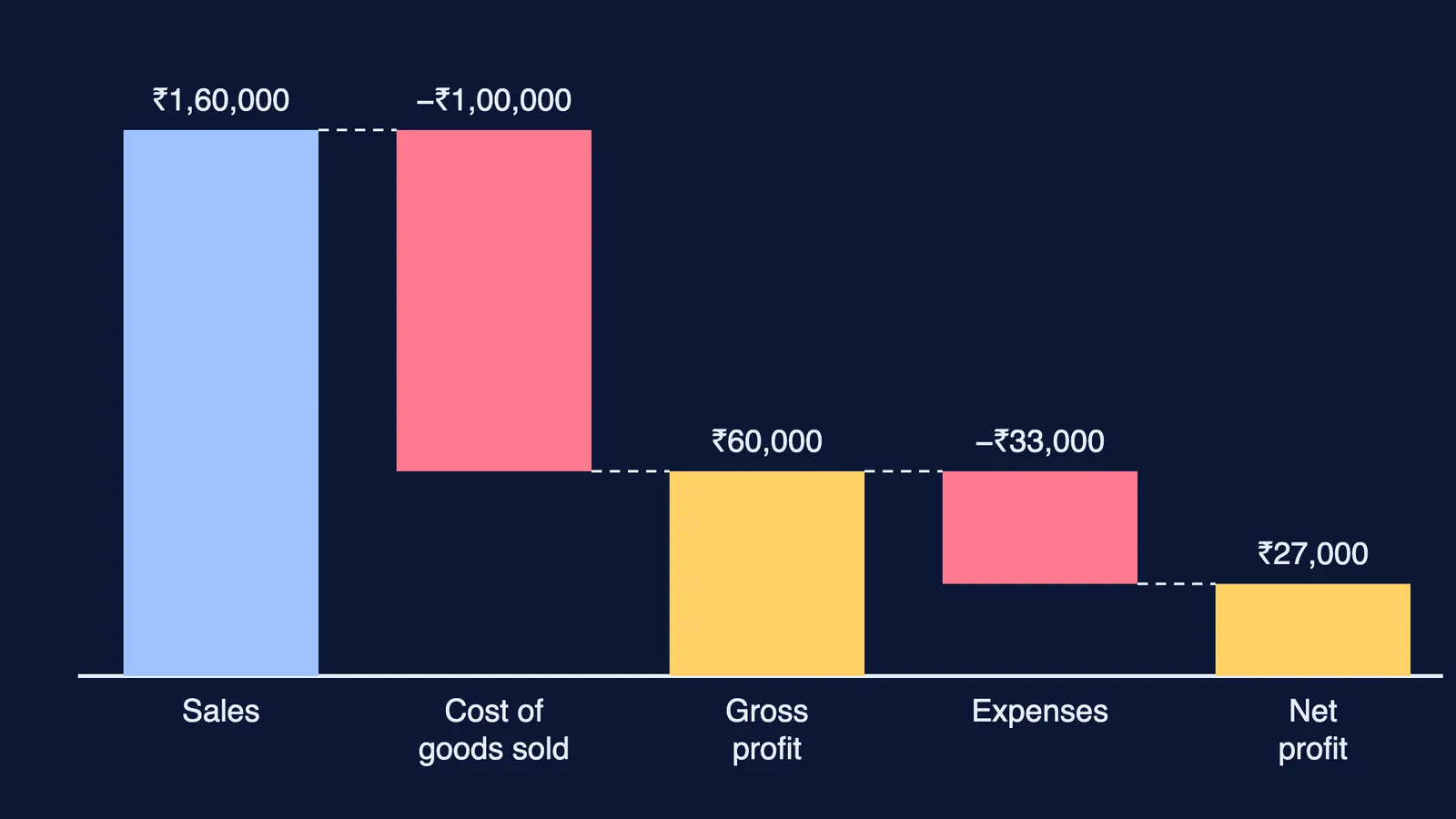
Trading account: debit side ₹20,000 + ₹1,00,000 + ₹6,000 + ₹4,000 = ₹1,30,000. Credit side: sales ₹1,60,000 + closing stock ₹30,000 = ₹1,90,000. Gross profit = ₹60,000.
Profit and loss account: salaries ₹18,000 + ₹2,000 = ₹20,000; rent ₹12,000 − ₹3,000 = ₹9,000; depreciation 10% of ₹40,000 = ₹4,000. Expenses total ₹33,000, so net profit = ₹60,000 − ₹33,000 = ₹27,000.
Balance sheet, liabilities side: capital ₹54,000 + net profit ₹27,000 = ₹81,000; creditors ₹25,000; outstanding salaries ₹2,000. Total ₹1,08,000.
Balance sheet, assets side: furniture ₹40,000 − ₹4,000 = ₹36,000; closing stock ₹30,000; debtors ₹30,000; prepaid rent ₹3,000; cash ₹9,000. Total ₹1,08,000.
The two sides agree, because each adjustment touched one account in the income statement and one line on the balance sheet.
How should you practise final accounts?
Write the adjustments list first and mark each one's two places before you draw any format.
Do one full question by hand every few days rather than reading solved ones; final accounts are a skill of steps, not a set of facts.
Redo any question that did not tally the next day, from a blank page.
Depreciation and prorated expenses are percentage maths. If maths is part of your stream, Fermi's AI tutor can work out what you already know and build a plan for the session, so you start with a clear next step. Still choosing subjects? Read how to decide on commerce with or without maths, and see how to use AI for Business Studies case questions.