On this page
Many small shops never keep full double-entry books. This topic shows how to find their profit anyway, by comparing the owner's capital on two dates.
Is incomplete records in the Class 11 syllabus for 2026-27?
Yes. The CBSE Accountancy (055) curriculum for 2026-27 lists "Incomplete Records" in Unit 3, Financial Statements of Sole Proprietorship, with this scope: "Features, reasons and limitations. Ascertainment of Profit/Loss by Statement of Affairs method. (excluding conversion method)".
Unit 3 carries 24 marks in the same curriculum, shared with the whole of financial statements, so CBSE prints no separate figure for this topic. The paper is 80 marks of theory plus 20 marks of project work.
Note that the NCERT Financial Accounting Part II, Reprint 2026-27, contains only Chapter 8 and Chapter 9, Financial Statements I and II; it has no chapter on incomplete records. Learn it from your teacher's notes and the CBSE scope above. For the method we follow the ICAI Foundation study material chapter on incomplete records.
What are incomplete records, and why do businesses keep them?
Incomplete records (often called the single entry system) means some transactions are recorded in full, some only on one side and some not at all, as the ICAI chapter explains. Usually the owner keeps a cash book and the accounts of debtors and creditors, and little else.
The ICAI chapter gives these reasons:
The owner does not know double-entry accounting.
The business is small and full books seem like too much time and effort.
Records were destroyed, for example in a fire.
Its features: no uniform method, so practice differs from firm to firm; real and nominal accounts are mostly missing; and the cash book often mixes business and personal money.
What are the limitations of incomplete records?
The ICAI chapter has no list headed limitations, but its features suggest these:
The method is inaccurate, unscientific and unsystematic.
Without nominal accounts, there is no proper Trading and Profit and Loss Account.
Profit is only an estimate, and the statement of affairs is not a true balance sheet.
Mixed personal and business cash makes drawings hard to separate from expenses.
How do you find profit by the statement of affairs method?
A statement of affairs looks like a balance sheet, but capital is the balancing figure: capital equals assets minus liabilities. It is the accounting equation used in reverse.
You prepare one statement at the start of the year and one at the end. Then, following the ICAI format:
Profit or loss = Closing capital + Drawings − Fresh capital introduced − Opening capital
Add drawings back because they reduced closing capital without being a loss. Take fresh capital out because it raised closing capital without being a profit. A negative answer is a loss.
Worked example: Kavya's stationery shop
Kavya keeps only a cash book and a list of debtors and creditors.
On 1 April 2025: cash ₹8,000; bank ₹22,000; debtors ₹30,000; stock ₹45,000; furniture ₹20,000; creditors ₹18,000; bills payable ₹7,000.
On 31 March 2026: cash ₹6,500; bank ₹41,000; debtors ₹36,000; stock ₹52,000; furniture ₹20,000; creditors ₹21,500; rent outstanding ₹2,000. Depreciate furniture by 10% and create a 5% provision on debtors. She withdrew ₹2,500 a month and brought in fresh capital of ₹15,000 during the year.
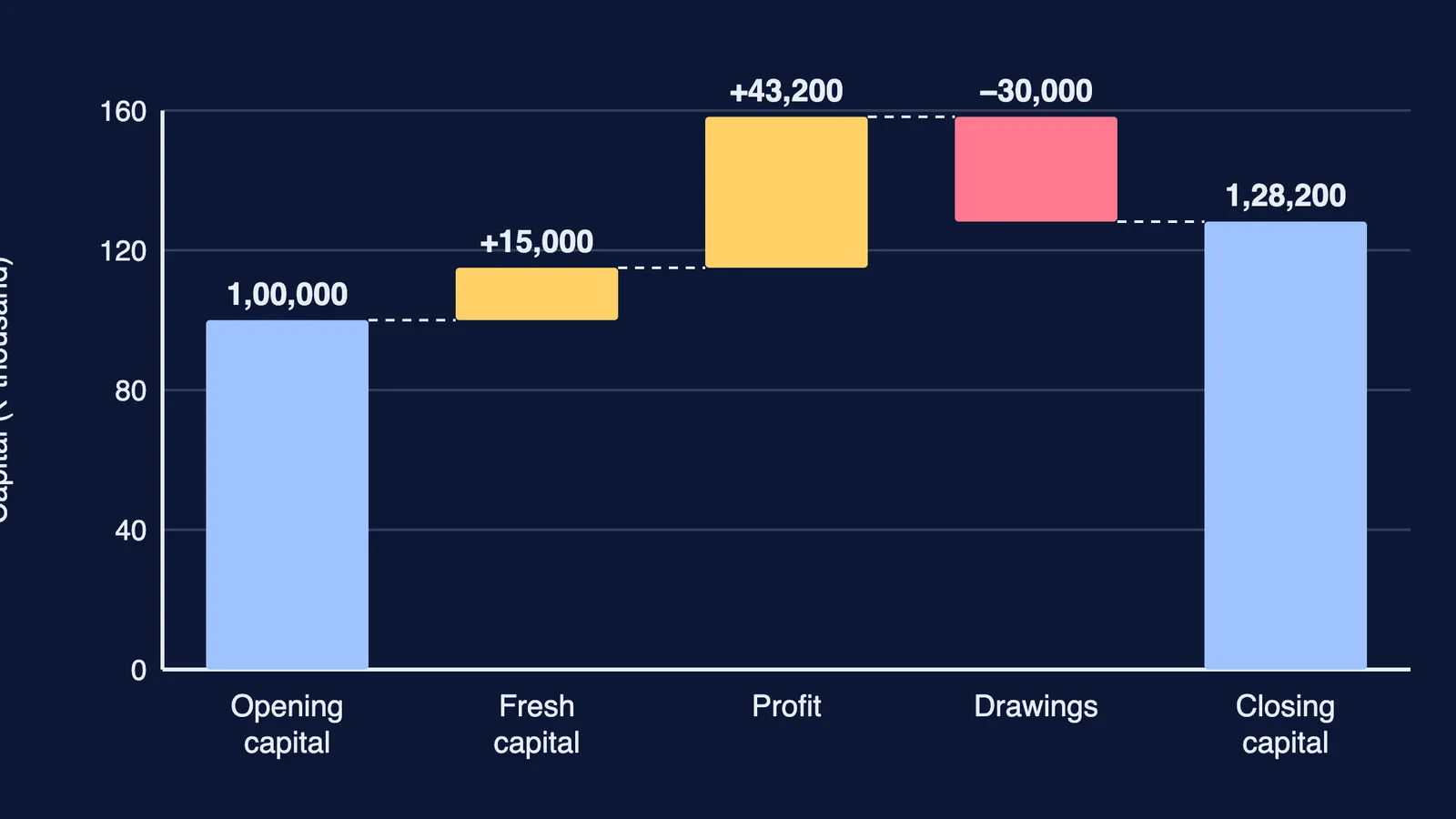
Step 1: Opening capital. Assets total ₹1,25,000 and liabilities ₹25,000, so opening capital is ₹1,00,000.
Step 2: Closing capital. Debtors less provision are ₹36,000 − ₹1,800 = ₹34,200. Furniture less depreciation is ₹20,000 − ₹2,000 = ₹18,000. Assets total ₹6,500 + ₹41,000 + ₹34,200 + ₹52,000 + ₹18,000 = ₹1,51,700. Liabilities are ₹21,500 + ₹2,000 = ₹23,500. Closing capital is ₹1,28,200.
Step 3: Statement of profit.
Closing capital: ₹1,28,200
Add drawings (₹2,500 × 12): ₹30,000, giving ₹1,58,200
Less fresh capital: ₹15,000, giving ₹1,43,200
Less opening capital: ₹1,00,000
Profit for the year: ₹43,200
Check: in a capital account, the credit side (₹1,00,000 + ₹15,000 + ₹43,200) and the debit side (₹30,000 + ₹1,28,200) both total ₹1,58,200.
How can you practise this topic?
Mark values are our suggestion, not CBSE's. Answers follow each question.
(1 mark) In a statement of affairs, which item is found as the balancing figure? *Answer: capital.*
(3 marks) Opening capital ₹60,000, closing capital ₹52,000, drawings ₹18,000, fresh capital ₹5,000. Find the profit or loss. *Answer: profit ₹5,000.*
(3 marks) Profit ₹24,000, opening capital ₹80,000, closing capital ₹95,000, fresh capital ₹10,000. Find the drawings. *Answer: ₹19,000.*
(4 marks) At year end assets are ₹70,000 and liabilities ₹18,000. Opening capital was ₹65,000 and drawings ₹9,000. No fresh capital came in. Find the profit or loss. *Answer: closing capital ₹52,000; loss ₹4,000.*
(3 marks) Give three limitations of incomplete records. *Answer: any three from the list above.*
It shares a unit with final accounts, so revise it with our guide to financial statements of a sole proprietorship with adjustments.
Not sure which items belong in the statement? Fermi's AI tutor works out what you already know and builds a plan for the session, so you start with a clear next step.