On this page
If you are starting CBSE Class 11 Accountancy in 2026-27, the accounting equation is the idea everything else rests on. Journal entries, ledgers and the balance sheet all assume it.
What is the accounting equation in Class 11?
The accounting equation states that a business's assets always equal its liabilities plus its capital, written A = L + C (NCERT Accountancy Part I, Chapter 3).
Assets are what the business owns, liabilities are what it owes outsiders, and capital is the owner's claim. NCERT gives two rearranged forms for finding a missing figure, A − L = C and A − C = L, and also calls it the balance sheet equation. The chapter we read is the Reprint 2026-27 edition of the textbook (NCERT prelims).
In the CBSE Class XI Accountancy curriculum for 2026-27, the topic appears in Unit-2: Accounting Process as "Accounting Equation Approach: Meaning and Analysis, Rules of Debit and Credit". That unit carries 44 marks out of the 80-mark theory paper.
How does each transaction keep the equation balanced?
Every transaction has two sides, so it changes the equation in one of four ways:
Both sides go up: you buy goods on credit (assets up, liabilities up).
Both sides go down: you pay a creditor (assets down, liabilities down).
One asset swaps for another: you buy a machine by cheque (machine up, bank down; totals unchanged).
A swap on the right side: a creditor's claim turns into capital (liabilities down, capital up; totals unchanged).
Profit adds to capital; expenses and drawings reduce it.
Worked example: a print shop's first month
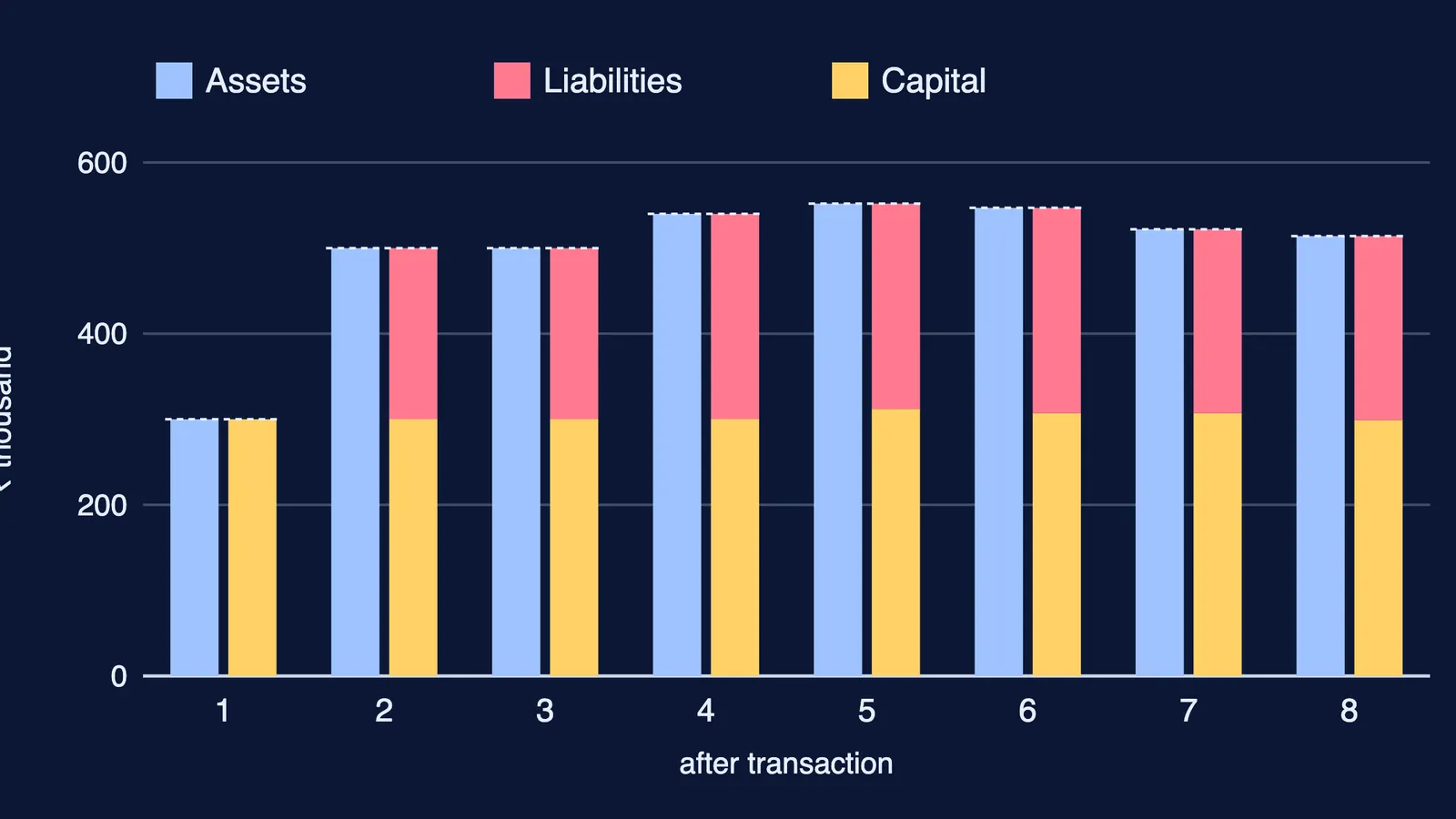
Meera opens a small print shop. Here is each transaction with the equation after it:
Starts the business with cash ₹3,00,000. Cash +3,00,000, capital +3,00,000. 3,00,000 = 0 + 3,00,000.
Takes a bank loan of ₹2,00,000, paid into the bank. Bank +2,00,000, loan +2,00,000. 5,00,000 = 2,00,000 + 3,00,000.
Buys a printer for ₹1,50,000 by cheque. Printer +1,50,000, bank −1,50,000. 5,00,000 = 2,00,000 + 3,00,000.
Buys paper worth ₹40,000 on credit. Stock +40,000, creditors +40,000. 5,40,000 = 2,40,000 + 3,00,000.
Sells paper costing ₹24,000 to a school for ₹36,000 on credit. Stock −24,000, debtors +36,000, capital +12,000 (the profit). 5,52,000 = 2,40,000 + 3,12,000.
Pays the electricity bill of ₹5,000 in cash. Cash −5,000, capital −5,000. 5,47,000 = 2,40,000 + 3,07,000.
Pays the paper supplier ₹25,000 by cheque. Bank −25,000, creditors −25,000. 5,22,000 = 2,15,000 + 3,07,000.
Withdraws ₹8,000 cash for personal use. Cash −8,000, capital −8,000. 5,14,000 = 2,15,000 + 2,99,000.
At the end, assets are cash ₹2,87,000 + bank ₹25,000 + printer ₹1,50,000 + stock ₹16,000 + debtors ₹36,000 = ₹5,14,000. Liabilities are loan ₹2,00,000 + creditors ₹15,000 = ₹2,15,000, and capital is ₹2,99,000. ₹2,15,000 + ₹2,99,000 = ₹5,14,000, so the equation holds. The chart above shows all eight steps.
What are the rules of debit and credit?
NCERT sorts accounts into five groups and gives two rules (NCERT Chapter 3, section 3.3.1):
Assets and expenses (losses): an increase is debited and a decrease is credited.
Liabilities, capital and revenues (gains): an increase is credited and a decrease is debited.
They follow from the equation: assets sit on the left of A = L + C and grow on the debit (left) side; liabilities and capital sit on the right and grow on the credit side. For Meera's shop:
Transaction 3: debit Printer ₹1,50,000 (asset up), credit Bank ₹1,50,000 (asset down).
Transaction 7: debit Creditors ₹25,000 (liability down), credit Bank ₹25,000 (asset down).
Transaction 8: debit Drawings ₹8,000 (capital down), credit Cash ₹8,000 (asset down).
Debits always equal credits. For journal entries, our guide on checking journal entries with the golden rules shows how to test each line.
Which mistakes cost marks?
Removing stock at selling price. In transaction 5, stock falls by the cost (₹24,000), not the sale price. The ₹12,000 difference goes to capital as profit.
Treating drawings as a business expense. Drawings reduce capital but are not a business expense.
Adding a loan to capital. A bank loan is a liability, even though it arrives as cash.
Ignoring outstanding expenses. Rent due but unpaid is an expense now and a liability until it is paid, so capital falls and liabilities rise.
Checking both sides pays off later in rectification of errors and in bank reconciliation statements.
If you are not sure where to start with a chapter, Fermi's AI tutor works out what you already know and builds a plan for the session.