On this page
The Human Eye and the Colourful World is Chapter 10 of NCERT Class 10 Science. This guide maps the whole chapter for the CBSE 2026-27 exam. For lens-power numericals on myopia and hypermetropia, see our guide to the human eye and its defects.
How many marks is this chapter worth in 2026-27?
The CBSE Class X Science curriculum for 2026-27 gives Unit III, Natural Phenomena, 12 of the 80 theory marks. The 12 are shared with Light: Reflection and Refraction; CBSE prints no figure for this chapter alone.
The unit lists the eye, defects of vision, refraction through a prism, dispersion and scattering, with daily-life applications "(excluding colour of the sun at sunrise and sunset)". Practical 13, tracing rays through a glass prism, sits here too. NCERT's boxed information is not assessed in the year-end exam, so the eye-donation box is reading only.
In the 2026-27 sample paper, the last 5-mark question offers a choice between the eye and dispersion with the sky. Both options ask for definitions and a diagram; the sky option adds a "state why" part.
What does the chapter cover, section by section?
Work from the current NCERT chapter (Reprint 2026-27):
10.1 The eye. Most refraction happens at the cornea; the lens gives fine adjustment. The iris sets pupil size; the retina signals the brain through the optic nerves. Accommodation, near point (about 25 cm), far point (infinity) and cataract.
10.2 Defects. Myopia (concave lens), hypermetropia (convex lens), presbyopia, and bifocals for both.
10.3 Prism. Light bends towards the normal entering glass and away leaving it; the angle of deviation lies between incident and emergent rays.
10.4 Dispersion. Red bends least and violet most, giving VIBGYOR; Newton's inverted second prism recombines it; raindrops make a rainbow opposite the Sun. See dispersion by a glass prism for the numbers.
10.5 Atmospheric refraction. Twinkling stars, steady planets, early sunrise, late sunset, the flattened Sun.
10.6 Scattering. Tyndall effect, blue sky, red danger signals.
The 2026-27 reprint mentions the reddening of the Sun only in passing, with no section explaining it, matching the curriculum's exclusion.
How does the eye lens change its power?
Ciliary muscles thin the lens for distant objects and thicken it for near ones. How much?
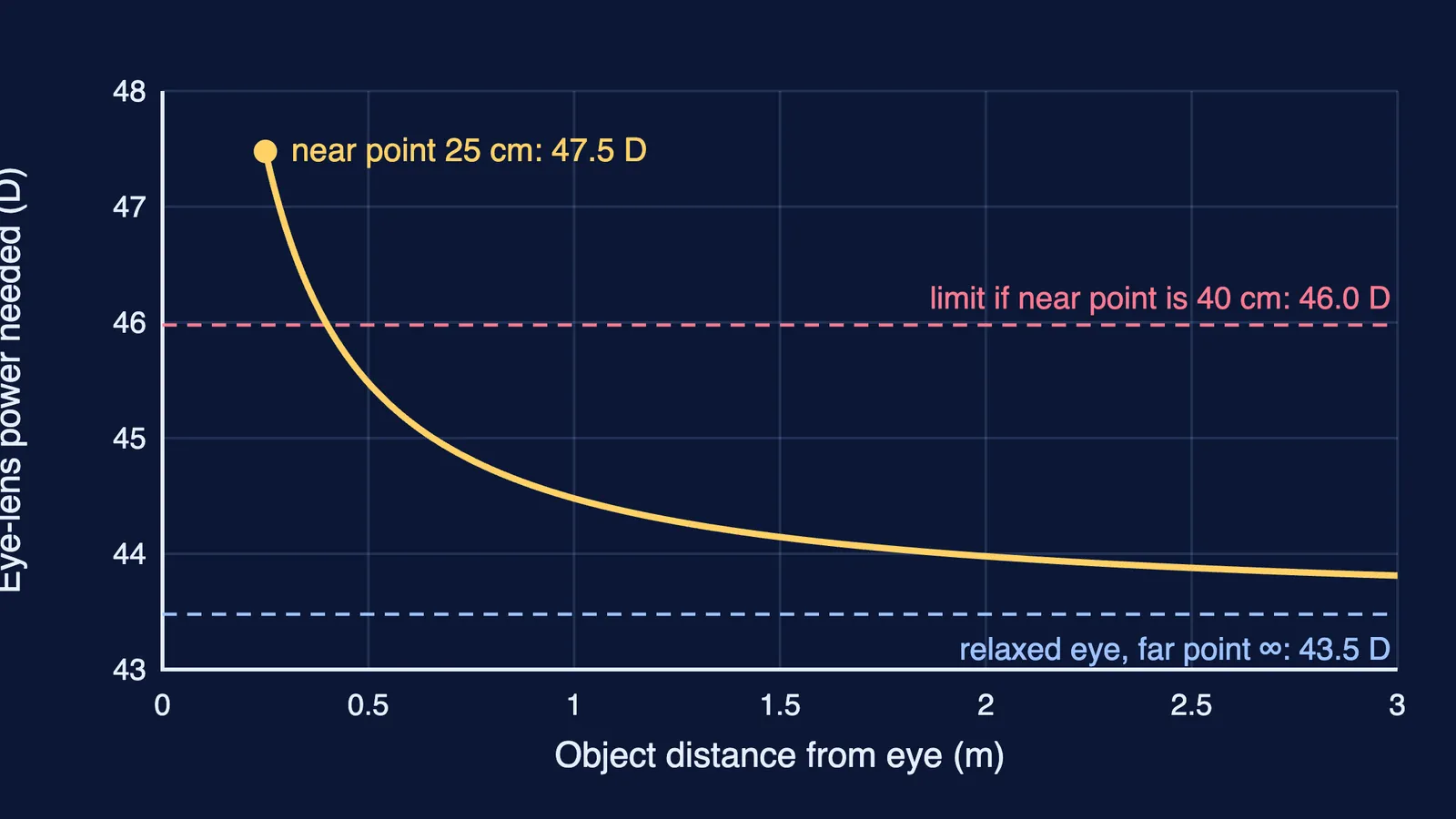
Worked example. Treat the eye as one thin lens with the retina fixed 2.3 cm behind it, the eyeball size in the NCERT chapter. It is a simplified model.
Distant object: v = +0.023 m. 1/f = 1/v − 1/u = 1/0.023 = 43.5 D, so f = 2.30 cm.
Object at 25 cm: u = −0.25 m. 1/f = 43.5 + 4.0 = 47.5 D, so f = 2.11 cm.
The lens adds 4.0 D to go from far to near. That extra power is accommodation.
If the near point recedes to 40 cm, the eye can add only 1/0.4 = 2.5 D, so reading at 25 cm needs a +1.5 D lens. The lens formula agrees: object at 25 cm, virtual image at 40 cm, 1/f = −2.5 + 4 = +1.5 D.
Why do stars twinkle but planets do not?
Air's refractive index varies and keeps shifting, so starlight bends by changing amounts. A star is almost a point source, so its position and brightness flicker. A planet looks like a disc, and the flicker from its many points averages out, per the NCERT text.
The same bending shows you the Sun about 2 minutes before actual sunrise and after actual sunset, says NCERT. The Sun crosses 360° in 24 hours, 0.25° per minute, so 2 minutes is about 0.5° if the Sun climbed straight up. Near the horizon, the air bends sunlight by roughly half a degree.
Why is the sky blue and the danger signal red?
Air molecules are smaller than the wavelength of visible light and scatter blue more than red; the NCERT chapter notes red light's wavelength is about 1.8 times blue's. Without an atmosphere the sky would look dark, as it does at very high altitudes. Fog and smoke scatter red least, so red signals stay red at a distance.
Which questions should you practise?
Our own questions, with marks in the sample paper's style.
(1 mark) Assertion: A star near the horizon looks higher than it is. Reason: starlight bends as it enters denser air.
(2 marks) Why does a prism give a spectrum but a glass slab does not?
(2 marks) In our model eye, find the power needed for an object 50 cm away. (Answer: +45.5 D)
(3 marks) Chalk dust near a laser pointer shows its beam. Name and explain the effect.
(3 marks) A 60-year-old holds the newspaper at arm's length. Name the likely defect, two causes and the lens.
(5 marks) Draw the Sun's actual and apparent positions at sunrise, explain them, and estimate the angle.
Not sure which part to revise first? Fermi's AI tutor works out what you already know, builds a plan for the session, and teaches through it. For the lens formula behind all this, see Light in Class 10: reflection, refraction and the lens formula.