On this page
Class 11 Accountancy rests on one habit: record each transaction in the journal, then post it to the ledger without losing a rupee. Here are the syllabus, the formats, an original worked set and the slips that cost marks.
Where is this in the 2026-27 CBSE syllabus?
The CBSE Accountancy curriculum for 2026-27 lists "Recording of Transactions: Books of Original Entry- Journal" and "Ledger: Format, Posting from journal and subsidiary books, Balancing of accounts" under Unit-2: Accounting Process. In the same document, Unit-2 carries 44 marks out of the 80-mark Class XI theory paper, with 20 marks for project work.
In NCERT Financial Accounting Part 1, Chapter 3, Recording of Transactions-I (Reprint 2026-27) covers the journal, the ledger and posting, and Chapter 4, Recording of Transactions-II covers balancing the accounts.
What is the difference between journal and ledger?
NCERT calls the journal the basic book of original entry, recording transactions in chronological order (Chapter 3). The ledger is the principal book, holding a separate account for each item. Posting is the process of transferring entries from the journal to the ledger.
Journal columns: Date, Particulars, L.F. (ledger folio), Debit amount, Credit amount.
Ledger account: a title ending in "Account", a Dr. (left) side and a Cr. (right) side, each with Date, Particulars, J.F. (journal folio) and Amount.
Narration: the short explanation written below each entry.
Fill in the L.F. column when you post, not when you write the entry.
How do you write a journal entry with narration?
Apply Chapter 3's rules of debit and credit: an increase in an asset or an expense is debited; an increase in a liability, capital or revenue is credited. Decreases go the other way.
Name the accounts affected and classify each one.
Apply the rule to find the debit and the credit.
Write the debit account first, ending with "Dr."; write the credit account below, indented, starting with "To".
Add the narration, then check that debits equal credits.
Worked set: Meera Stationers, April 2026
These six transactions are made up for practice; we checked every total with a short Python script.
1 April: Started business with cash ₹1,50,000. Cash A/c Dr. ₹1,50,000; To Capital A/c ₹1,50,000 (Being capital introduced).
3 April: Deposited ₹60,000 in the bank. Bank A/c Dr. ₹60,000; To Cash A/c ₹60,000 (Being cash deposited into bank).
6 April: Bought goods on credit from Sharma Paper Mart for ₹40,000. Purchases A/c Dr. ₹40,000; To Sharma Paper Mart A/c ₹40,000 (Being goods bought on credit).
10 April: Sold goods for cash ₹25,000. Cash A/c Dr. ₹25,000; To Sales A/c ₹25,000 (Being goods sold for cash).
15 April: Paid Sharma Paper Mart ₹39,200 in cash in full settlement of ₹40,000. Sharma Paper Mart A/c Dr. ₹40,000; To Cash A/c ₹39,200; To Discount Received A/c ₹800 (Being payment made, discount received).
22 April: Paid rent ₹8,000 in cash. Rent A/c Dr. ₹8,000; To Cash A/c ₹8,000 (Being rent paid).
Entry 5 is a compound entry: one debit, two credits. The ₹800 discount is a gain, so it is credited.
How do you post to the ledger and balance an account?
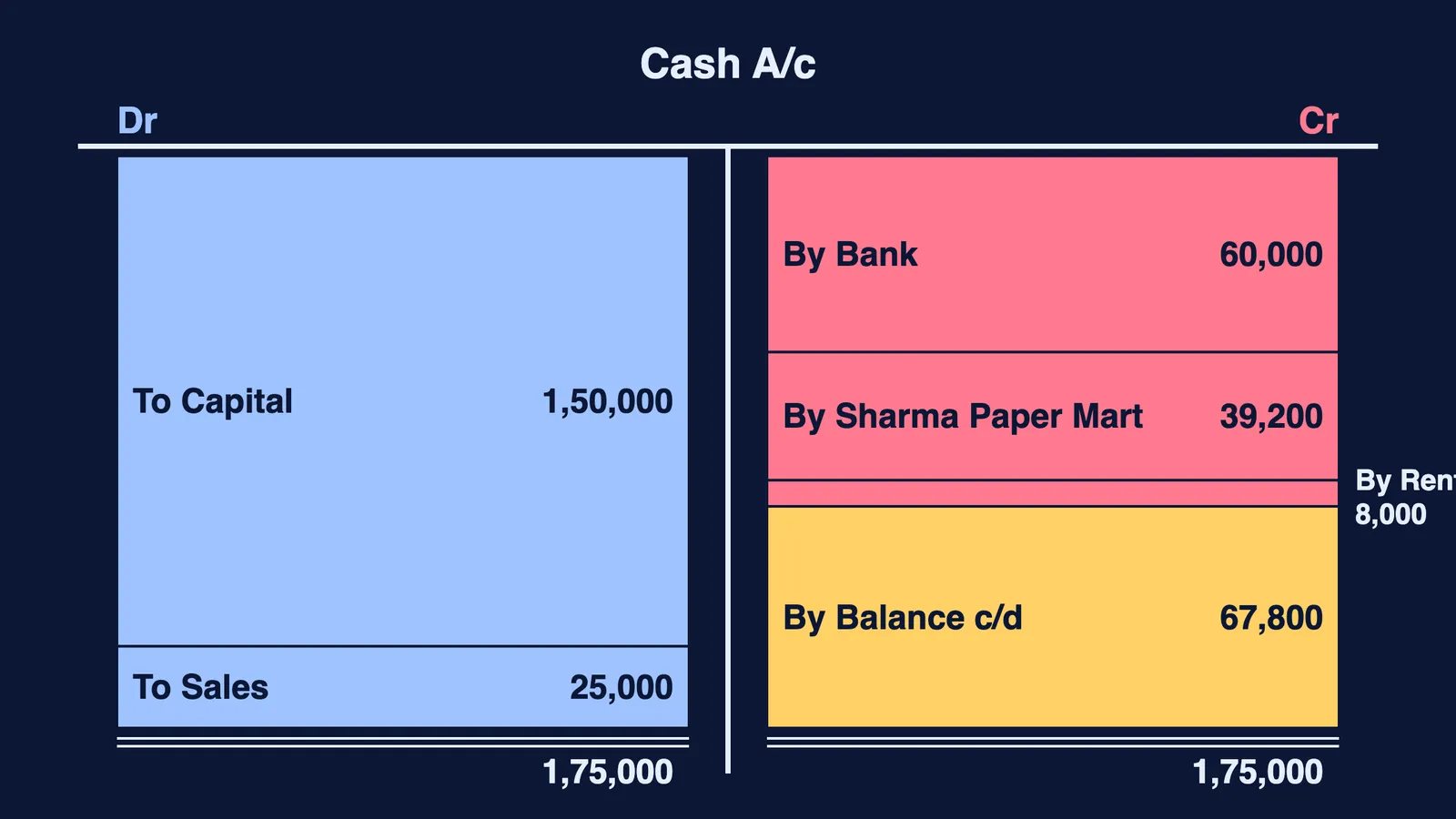
To post, find each account in the ledger, write the entry on the correct side and name the other account in Particulars (NCERT Chapter 3). NCERT's own examples write only the account name; the traditional "To" (debit side) and "By" (credit side) prefixes used below are also widely seen. Cash Account for April:
Debit side: 1 April To Capital ₹1,50,000; 10 April To Sales ₹25,000. Total ₹1,75,000.
Credit side: 3 April By Bank ₹60,000; 15 April By Sharma Paper Mart ₹39,200; 22 April By Rent ₹8,000. Total ₹1,07,200.
To balance, write the difference on the shorter side as "Balance c/d" so the totals match (NCERT Chapter 4). Here ₹1,75,000 minus ₹1,07,200 leaves ₹67,800, entered as By Balance c/d. Both columns now total ₹1,75,000. On 1 May it comes down as To Balance b/d ₹67,800: the cash Meera still holds.
Sharma Paper Mart Account closes at nil. NCERT notes that expense and revenue accounts, such as Rent and Sales, are not balanced but closed by transfer to the trading and profit and loss account.
Which mistakes cost marks in journal and ledger questions?
Debiting "Goods" instead of Purchases or Sales: Chapter 3 splits the goods account into five: purchases, sales, purchases returns, sales returns and stock.
Posting ₹40,000 to Cash in entry 5: only ₹39,200 left the cash box.
Putting Balance c/d on the bigger side, or forgetting to bring it down as b/d.
Leaving out narrations.
Practise with how to check AI-written journal entries with the golden rules and how to avoid mistakes in ledger questions; to fix errors later, see rectification of errors in Class 11.
If you are unsure where to begin revising, Fermi's AI tutor can work out what you already know and build a plan for the session, so you sit down to a clear next step.