

On this page
When you balance an account in commerce exams, few feelings are more frustrating than watching the two columns fail to match. You re-add every line, check your journal entries, and stare at the ledger while exam minutes tick away.
In Indian board exams and competitive commerce papers like CA Foundation, accountancy is celebrated as a scoring subject because answers are objective. Yet examiners consistently report that students lose marks not from difficult concepts, but from clerical slips, inverted entries, and untidy presentation. Avoiding these errors does not require re-reading the textbook; it requires changing how you practice.
Why do students make careless mistakes in ledger accounts?
When you construct a ledger account from scratch, your brain is doing four tasks at once. You must interpret the economic transaction, apply debit and credit rules, draw neat multi-column tables, and add up four-digit or five-digit numbers without a calculator.
Cognitive load theory explains why this leads to frequent slips. In a paper on accounting instruction published in *Issues in Accounting Education*, researcher Gregory R. Mostyn (Mostyn, 2012) explained how cognitive constraints limit novice learners when they face complex tasks, causing working memory to overload. Working memory can only hold a few novel elements at once; when it is overloaded, basic errors slip through unnoticed.
A 2005 empirical study by Abdel K. Halabi and colleagues in *Issues in Accounting Education* (Halabi et al., 2005) demonstrated that studying worked examples was more efficient for students with no prior knowledge of accounting than problem-solving exercises. Reviewing fully completed ledger solutions allows you to internalise the physical layout and posting rhythm before testing yourself.
Once you have studied clean examples, working through problems with a step-by-step solver in the Fermi Problem Library lets you rehearse transaction rules without the distracting overhead of drawing empty grids by hand. This matches what cognitive scientists found in a comprehensive review of learning techniques: retrieval practice is most effective when initial concepts are already clear.
Which ledger errors happen most often during exam practice?
In the official CBSE Class 12 Accountancy Marking Scheme, marks are step-allocated for formats, journal folios, and balancing entries. Most lost marks fall into four recurring traps:
Format omissions: Leaving out "Dr." and "Cr." headers, skipping the Journal Folio (J.F.) column, or omitting the prefixes "To" on the debit side and "By" on the credit side.
Directional reversal: Posting an entry to the opposite side of the account, such as crediting Cash when goods were sold for cash.
Casting errors: Adding columns incorrectly during summation, especially under time pressure.
Balancing confusion: Writing "Balance c/d" (carried down) on the larger side instead of the smaller side, or forgetting to bring down the opening balance ("Balance b/d") into the subsequent accounting period.
A study on error diagnosis by Mark W. Nelson in *The Accounting Review* (Nelson, 1993) suggested that novices can improve their diagnostic performance by increasing their knowledge of specific error frequencies.
How can the rules of nine and two catch hidden slips?
When your ledger totals fail to agree, do not immediately erase your work. Professional bookkeepers rely on two mathematical checks to locate discrepancies in seconds.
The Rule of Nine for Transposition and Slide Errors:
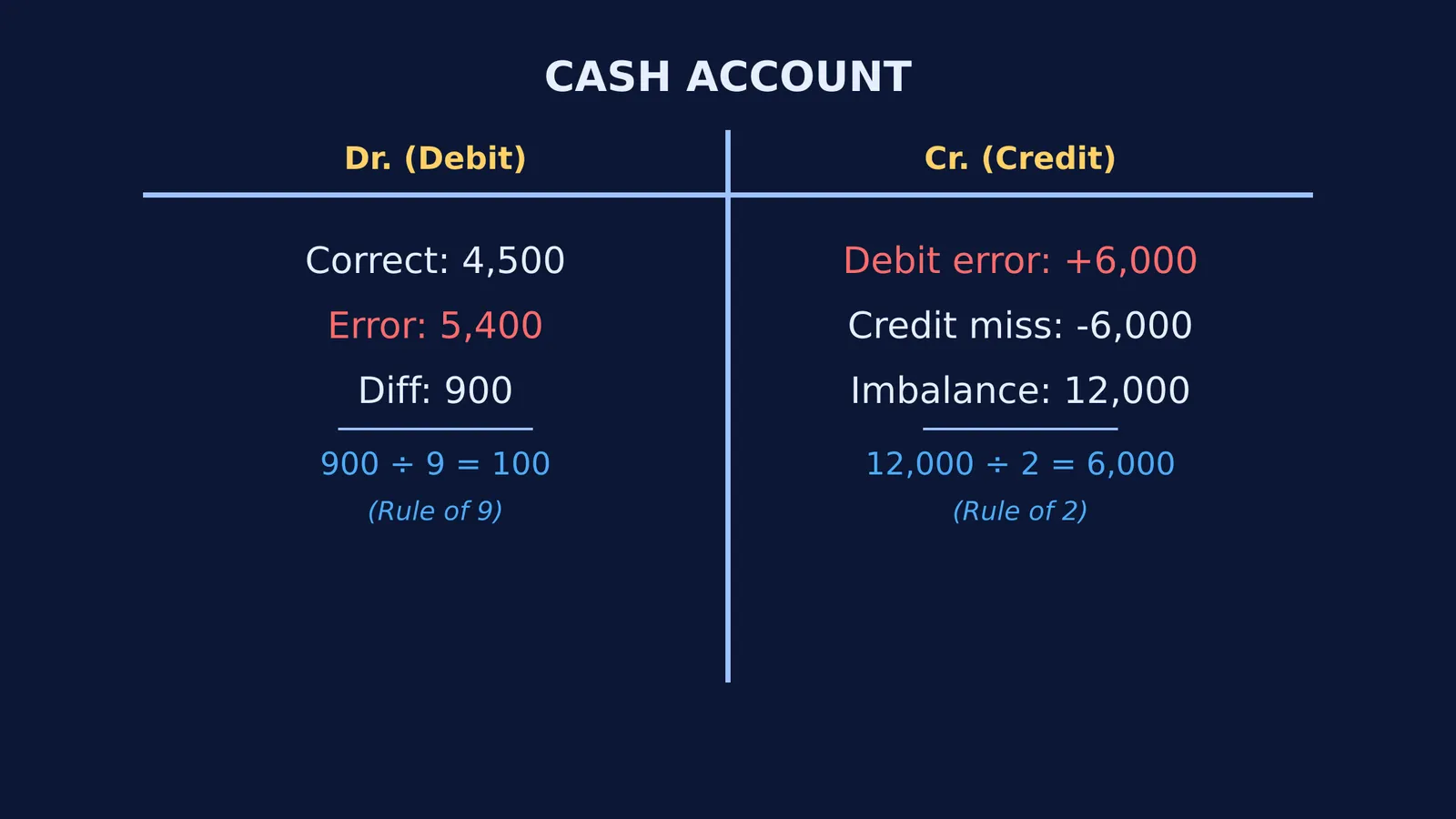
If you reverse two adjacent digits—for instance, writing ₹5,400 instead of ₹4,500—the difference between the two numbers is ₹900. Mathematically, the difference between any number and its transposition is always divisible by 9, because (10a + b) − (10b + a) = 9(a − b). Slide errors, where a student accidentally drops a zero (writing ₹540 instead of ₹5,400, leaving a difference of ₹4,860), are also divisible by 9 (4,860 ÷ 9 = 540). If the difference between your debit and credit totals is divisible by 9, stop calculating totals and search your ledger specifically for swapped digits or misplaced decimal places.
The Rule of Two for Wrong-Side Entries:
If you record a ₹6,000 credit transaction on the debit side, the debit column is ₹6,000 too large and the credit column is ₹6,000 too small. This produces an overall discrepancy of ₹12,000, which is double the misposted figure. When your trial balance or ledger check shows an even imbalance, divide the discrepancy by 2. Then scan your journal entries for that exact quotient.
Practising targeted checks with Fermi's AI tutor helps you distinguish whether a mistake came from an accounting principle error or a simple clerical calculation slip.
What does an effective timed ledger practice routine look like?
According to the CBSE Senior Secondary Accountancy Curriculum, students must demonstrate both technical accuracy and speed across full accounting cycles. You can build that fluency with a structured daily routine:
Master the template drill: Practice drawing standard 8-column T-accounts with a ruler until neat formatting takes only seconds.
Adopt the tick-and-post habit: Post complete transactions directly from your journal while making a light pencil tick beside each item. Never post all debits first and credits later; partial omissions happen when you jump across pages.
Pencil-cast before penning totals: Write column subtotals lightly in pencil in the margin before writing the balancing figure in ink. This prevents messy scratch-outs on your answer sheet.
Run timed extraction sprints: Set a timer and extract a few ledger accounts from raw journal entries to simulate actual exam pressure.
Pairing these timed sprints with mock test error analysis and a spaced revision schedule turns ledger posting into an automatic, high-scoring habit.


