On this page
International business is the last theory unit of Class 11 Business Studies and the one with the most steps to remember. Here is what is on the syllabus, then both procedures in order, with a worked example.
What does the CBSE 2026-27 syllabus include in international business?
It has not been dropped: in the CBSE Business Studies curriculum for 2026-27, Part B (Finance and Trade) lists International Business as Unit 10 (its detailed outline calls it International Trade), and Unit 9 (Internal Trade) and Unit 10 together carry 20 of the 80 theory marks.
It lists five topics:
International trade: concept and benefits
Export trade: meaning and procedure
Import trade: meaning and procedure
Documents: indent, letter of credit, shipping order, shipping bill, mate's receipt, and DA/DP
The World Trade Organization (WTO): meaning and objectives
One thing to notice: modes of entry are not named in that 2026-27 content list, although the NCERT chapter (reprint 2026-27) still explains them. Read them anyway and check with your teacher.
What are the modes of entry into international business?
A mode of entry is the route a firm takes into a foreign market. The NCERT chapter describes five:
Exporting and importing: the easiest start, with little invested abroad, but extra transport and duty costs.
Contract manufacturing: a foreign producer makes goods to the firm's specifications.
Licensing and franchising: a foreign firm uses the firm's patents, technology or brand for a fee called royalty; franchising is the services version, with stricter rules.
Joint ventures: a firm jointly owned by two or more independent firms, often a foreign and a local one.
Wholly owned subsidiaries: 100 per cent ownership and full control, but the parent bears all the losses.
What are the steps in the export procedure?
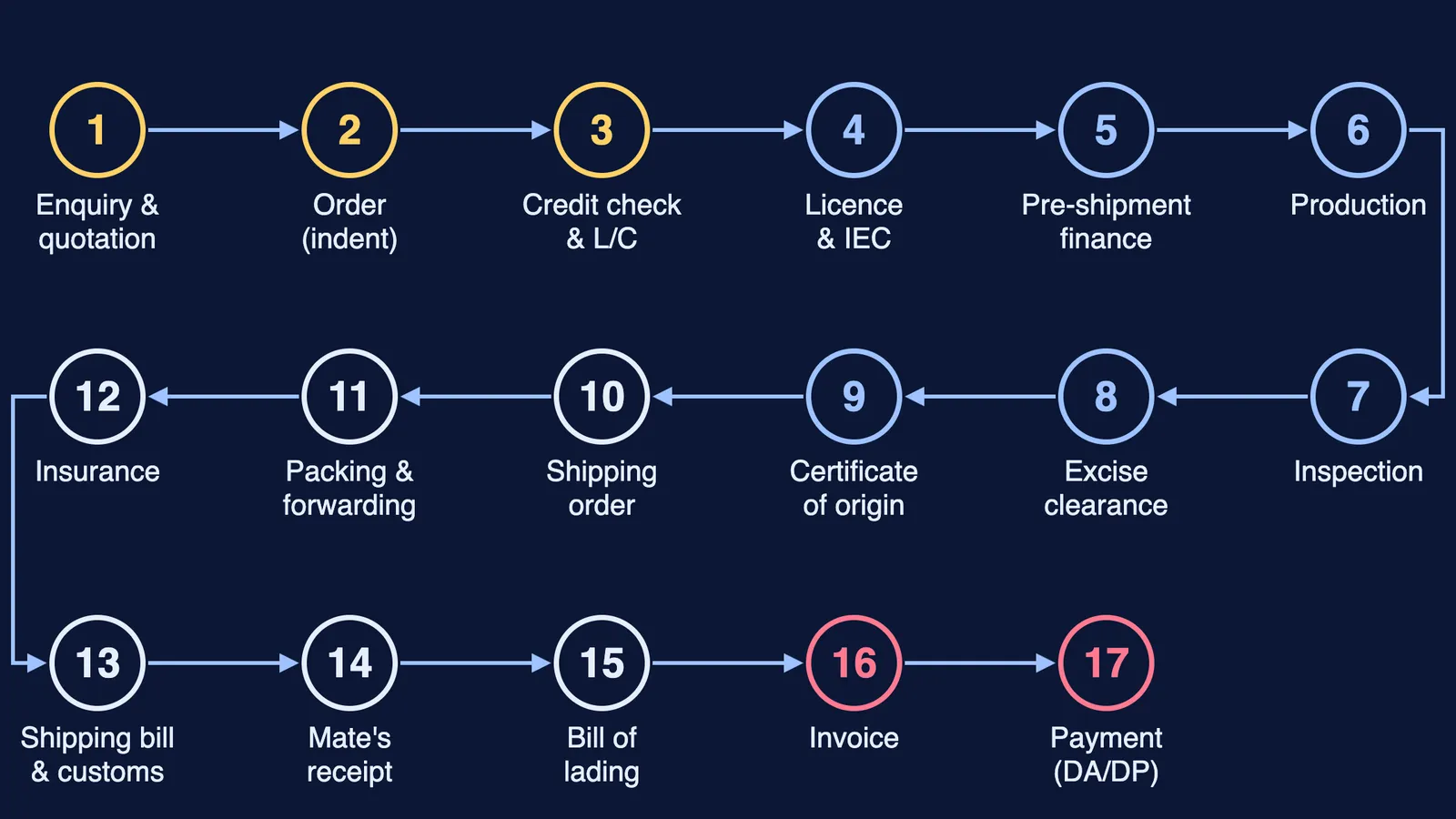
The NCERT chapter sets out 17 steps for a typical export and says the number and order can vary from one deal to another. Group them into four stages:
Securing the order: (1) the buyer sends an enquiry and the exporter replies with a quotation called a proforma invoice; (2) the buyer places the order, called an indent; (3) the exporter checks the buyer's creditworthiness and asks for a letter of credit, which is a guarantee from the importer's bank that it will pay.
Getting ready: (4) the export licence, which needs an RBI-authorised bank account, an Import Export Code (IEC) from the DGFT, export promotion council membership and ECGC registration; (5) pre-shipment finance from the bank; (6) producing or buying the goods; (7) pre-shipment inspection where required; (8) excise clearance; (9) a certificate of origin.
Shipping: (10) booking space, for which the shipping company issues a shipping order; (11) packing and forwarding to the port; (12) marine insurance; (13) customs clearance using the shipping bill, the main document customs relies on; (14) the mate's receipt, issued by the ship's officer once the cargo is on board; (15) paying freight and getting the bill of lading.
Getting paid: (16) preparing the invoice; (17) sending the documents through the bank with a bill of exchange. Under a sight draft (documents against payment) the importer pays to get the documents; under documents against acceptance (usance draft) the importer signs to pay later. That is your syllabus's DA/DP.
What are the steps in the import procedure?
The NCERT chapter gives 10 steps for bringing goods into India:
Trade enquiry, answered with a proforma invoice
Import licence if the goods need one, and the IEC number
Foreign exchange, sanctioned through an RBI-authorised bank
Placing the order or indent
Obtaining a letter of credit and sending it to the supplier
Arranging finance early, to avoid demurrage at the port
Receiving the shipment advice
Retirement of import documents: paying or accepting the bill of exchange to collect the documents
Arrival of goods, reported in the import general manifest
Customs clearance: delivery order, bill of entry, duty, then the release order
How do you remember which document comes when?
Follow one shipment: imagine a Tiruppur garment maker selling shirts to a store in Germany.
The German store sends an enquiry; the Tiruppur firm replies with a proforma invoice.
The store sends an indent, and its bank opens a letter of credit.
The firm books a ship (shipping order) and its agent files the shipping bill for customs.
Once the cartons are loaded, the ship's officer signs the mate's receipt.
The agent trades the mate's receipt and freight for the bill of lading.
The documents and a bill of exchange travel through the banks, on DP or DA terms.
Check yourself: close the book, write the 17 export steps under the four stage headings, then list each syllabus document with who issues it. If you get stuck on the bill of exchange, our guide to bills of exchange in Class 11 Accountancy covers the same instrument from the accounts side.
For the country-level view, see international trade in Class 12 Geography. If you take Mathematics alongside Business Studies, the Fermi Problem Library has worked problems with a step-by-step solver that explains the reasoning rather than printing an answer.