On this page
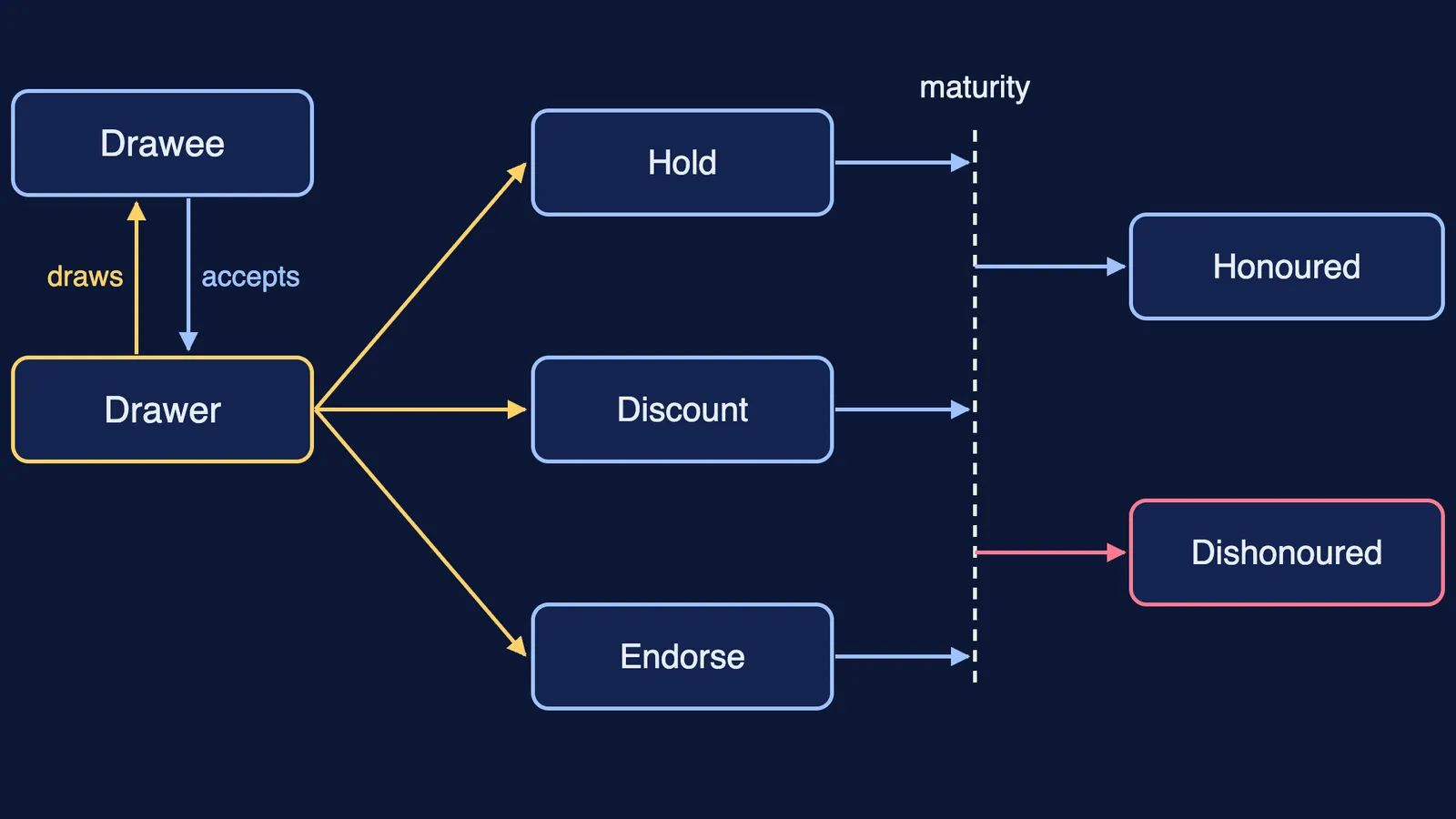
A bill of exchange puts a seller's credit to a buyer in writing. The seller draws an order to pay, the buyer accepts it, and the seller can keep it, discount it with a bank or pass it to a creditor. Here are the parties, the due-date rule and one worked example in both sets of books.
What is a bill of exchange?
Under Section 5 of the Negotiable Instruments Act, 1881, a bill of exchange is "an instrument in writing containing an unconditional order, signed by the maker, directing a certain person to pay a certain sum of money only to, or to the order of, a certain person or to the bearer of the instrument".
Check whether your board still examines this chapter. The CBSE Accountancy curriculum for 2025-26 has no bills of exchange unit for Class XI. The topic has its own unit in the ICAI's CA Foundation accounting study material (the October 2020 edition), and other boards set their own syllabus, so confirm against your school's current one.
Who are the parties to a bill of exchange?
Section 7 of the Act names them:
Drawer: the maker of the bill, usually the seller who is owed money.
Drawee: the person directed to pay, usually the buyer. Once the drawee signs their assent on the bill and delivers it, they are called the acceptor.
Payee: the person named to receive the money. Often this is the drawer, but it can be the drawer's creditor.
The drawer treats the accepted bill as an asset called Bills Receivable, and the acceptor treats it as a liability called Bills Payable, as the ICAI Board of Studies notes on bills of exchange explain.
How do you find the date of maturity?
A bill not payable on demand, at sight or on presentment matures on the third day after the day it is expressed to be payable, under Section 22 of the Act; these are the days of grace. For a bill payable some months after date, the period ends on the same day of the month as the bill's date (Section 23). For a bill payable some days after date, you leave out the date of the bill itself (Section 24). If the maturity date is a public holiday, the bill is due on the preceding business day (Section 25).
So a bill dated 1 March 2026 and payable two months after date runs to 1 May; add three days of grace and it matures on 4 May 2026.
What are the journal entries when a bill is held, discounted or dishonoured?
Here is one example. On 1 March 2026, Ravi sells goods worth ₹20,000 to Meena on credit and draws a bill on her for that amount, payable two months after date. Meena accepts it and returns it. The entries follow the pattern in the ICAI Board of Studies notes.
In Ravi's books (the drawer):
On the sale: Meena A/c Dr ₹20,000; To Sales A/c ₹20,000.
On receiving the accepted bill: Bills Receivable A/c Dr ₹20,000; To Meena A/c ₹20,000.
Ravi now has three choices:
Held to maturity and honoured on 4 May: Bank A/c Dr ₹20,000; To Bills Receivable A/c ₹20,000.
Discounted with his bank on 4 March, the bank deducting ₹400: Bank A/c Dr ₹19,600; Discount A/c Dr ₹400; To Bills Receivable A/c ₹20,000. If Meena then pays the bank at maturity, Ravi passes no entry.
Endorsed to Arjun, a creditor: Arjun A/c Dr ₹20,000; To Bills Receivable A/c ₹20,000.
If Meena dishonours the bill, the holder may have the dishonour noted by a notary public, and the note records the notary's charges, under Section 99 of the Act. Say the noting charges are ₹100. Ravi recovers the bill amount and the charges from Meena:
If Ravi held the bill: Meena A/c Dr ₹20,100; To Bills Receivable A/c ₹20,000; To Cash A/c ₹100.
If he had discounted it (the bank pays the charges): Meena A/c Dr ₹20,100; To Bank A/c ₹20,100.
If he had endorsed it (Arjun pays the charges): Meena A/c Dr ₹20,100; To Arjun A/c ₹20,100.
In Meena's books (the drawee):
On the purchase: Purchases A/c Dr ₹20,000; To Ravi A/c ₹20,000.
On accepting the bill: Ravi A/c Dr ₹20,000; To Bills Payable A/c ₹20,000.
On paying at maturity: Bills Payable A/c Dr ₹20,000; To Bank A/c ₹20,000.
On dishonour: Bills Payable A/c Dr ₹20,000; Noting Charges A/c Dr ₹100; To Ravi A/c ₹20,100.
How should you practise this chapter?
Work every question in five steps:
Name the drawer, drawee and payee.
Work out the maturity date.
Mark the path: held, discounted or endorsed.
Write both sets of books and compare them.
Test each entry with our guide to checking journal entries with the golden rules.
If the interest arithmetic behind discounting slows you down, Fermi's AI tutor can work out what you already know and build a plan for the session.
Still weighing where commerce leads? Read our explainer on careers after commerce, from CA to economics.