

On this page
An element's place in the periodic table is written into its electronic configuration. For the first 20 elements, hydrogen to calcium, you need only two counts: how many shells are occupied, and how many electrons sit in the last one. Learn one exception and the method works for all of them.
How do you find the period from electronic configuration?
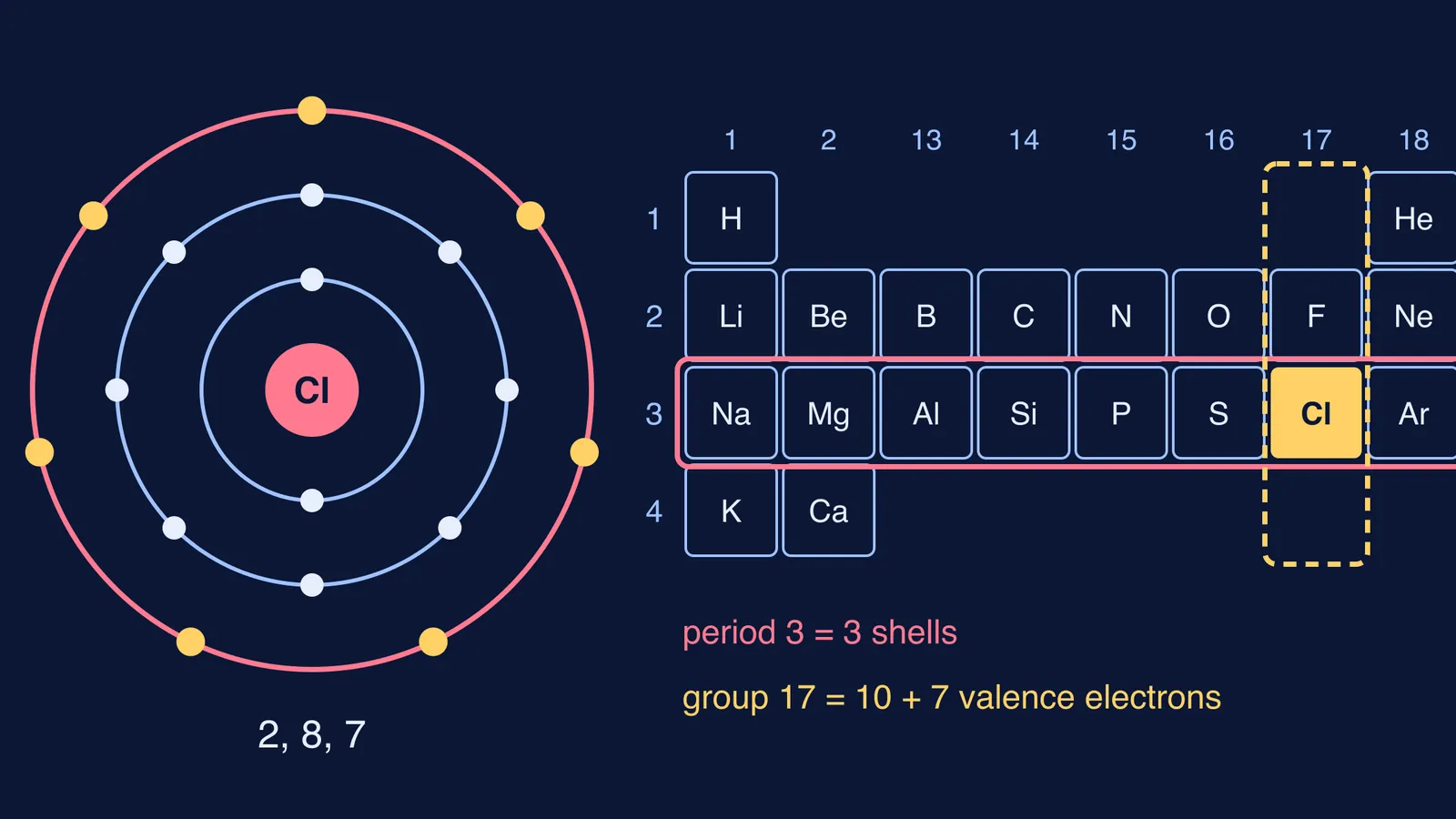
Count the shells. NCERT's Class 11 chemistry textbook puts it in one line: the period "indicates the value of n for the outermost or valence shell" (NCERT Class 11 Chemistry, Unit 3, section 3.5). Each new period starts when electrons begin to fill a new shell.
Sodium is 2, 8, 1. Three shells, so period 3.
Fluorine is 2, 7. Two shells, so period 2.
Potassium is 2, 8, 8, 1. Four shells, so period 4.
The same chapter notes that period 1 holds two elements, periods 2 and 3 hold eight each, and period 4 starts at potassium, whose added electron enters the 4s orbital (NCERT Class 11 Chemistry, Unit 3). That is why potassium is 2, 8, 8, 1 and not 2, 8, 9: the 19th electron opens the fourth shell.
How do you find the group from valence electrons?
Valence electrons are the electrons in the outermost shell, the one with the highest value of n (OpenStax Chemistry 2e, section 6.4). Elements in the same group have the same number of valence electrons (helium is the exception, below), which is why they behave alike.
Since 1988, IUPAC has recommended that the columns be numbered simply from 1 to 18 (IUPAC Periodic Table of Elements). The first 20 elements use only eight of those columns. NCERT describes groups 1 and 2 as the s-block, with outer configurations ns¹ and ns², and groups 13 to 18 as the p-block, running from ns²np¹ to ns²np⁶; the d-block in between is groups 3 to 12 (NCERT Class 11 Chemistry, sections 3.6.1 to 3.6.3). Turned into a rule:
1 or 2 valence electrons: group = number of valence electrons.
3 to 8 valence electrons: group = 10 + number of valence electrons.
The 10 stands for the d-block columns, groups 3 to 12, which the numbering counts even though none of the first 20 elements sits there.
Hydrogen is the other special case: NCERT places it separately at the top, because it has one s-electron like group 1 but can also gain an electron like the halogens. See why hydrogen's place in the periodic table is anomalous.
Worked examples: three elements, step by step
Write the shell-wise configuration: fill 2, then 8, then 8, then the rest.
Count the shells: that is the period.
Count the electrons in the last shell and apply the group rule.
Magnesium (Z = 12). 2, 8, 2. Three shells: period 3. Two valence electrons: group 2.
Chlorine (Z = 17). 2, 8, 7. Three shells: period 3. Seven valence electrons, more than 2, so group 10 + 7 = 17. Chlorine is a halogen; the family names are in periodic table group names, from alkali metals to noble gases.
Calcium (Z = 20). 2, 8, 8, 2. Four shells: period 4. Two valence electrons: group 2. It sits directly below magnesium.
In subshell notation, the period is the largest n, and the valence electrons are those with that n: chlorine's 1s² 2s² 2p⁶ 3s² 3p⁵ gives n = 3 and 2 + 5 = 7. Our guide to writing electron configurations with a noble gas core shows how [Ne] 3s² 3p⁵ makes this count faster.
Five practice elements to try
Cover the answers and work these out first.
Oxygen, Z = 8
Aluminium, Z = 13
Phosphorus, Z = 15
Argon, Z = 18
Helium, Z = 2
Answers:
Oxygen: 2, 6. Period 2, group 10 + 6 = 16.
Aluminium: 2, 8, 3. Period 3, group 10 + 3 = 13.
Phosphorus: 2, 8, 5. Period 3, group 10 + 5 = 15.
Argon: 2, 8, 8. Period 3, group 10 + 8 = 18.
Helium: 2. Period 1, group 18, the exception above.
If you wrote helium as group 2, you applied the rule without the exception. If an answer came out with nine electrons in the third shell, remember that the 19th electron starts a new shell.
What changes after calcium?
From scandium (Z = 21), electrons start filling the 3d orbitals and the first transition series begins (NCERT Class 11 Chemistry, section 3.5). From there, counting only the outermost shell no longer gives the group, so learn the s- and p-block rule well before moving on.
If shells and subshells still feel shaky, the Fermi Concept Library has a lesson for every chemistry concept, each with its place in the map, so you can go back a step and return here. When an answer goes wrong and you cannot see why, the Fermi Problem Library has worked problems with a step-by-step solver that explains the reasoning rather than printing an answer.


