On this page
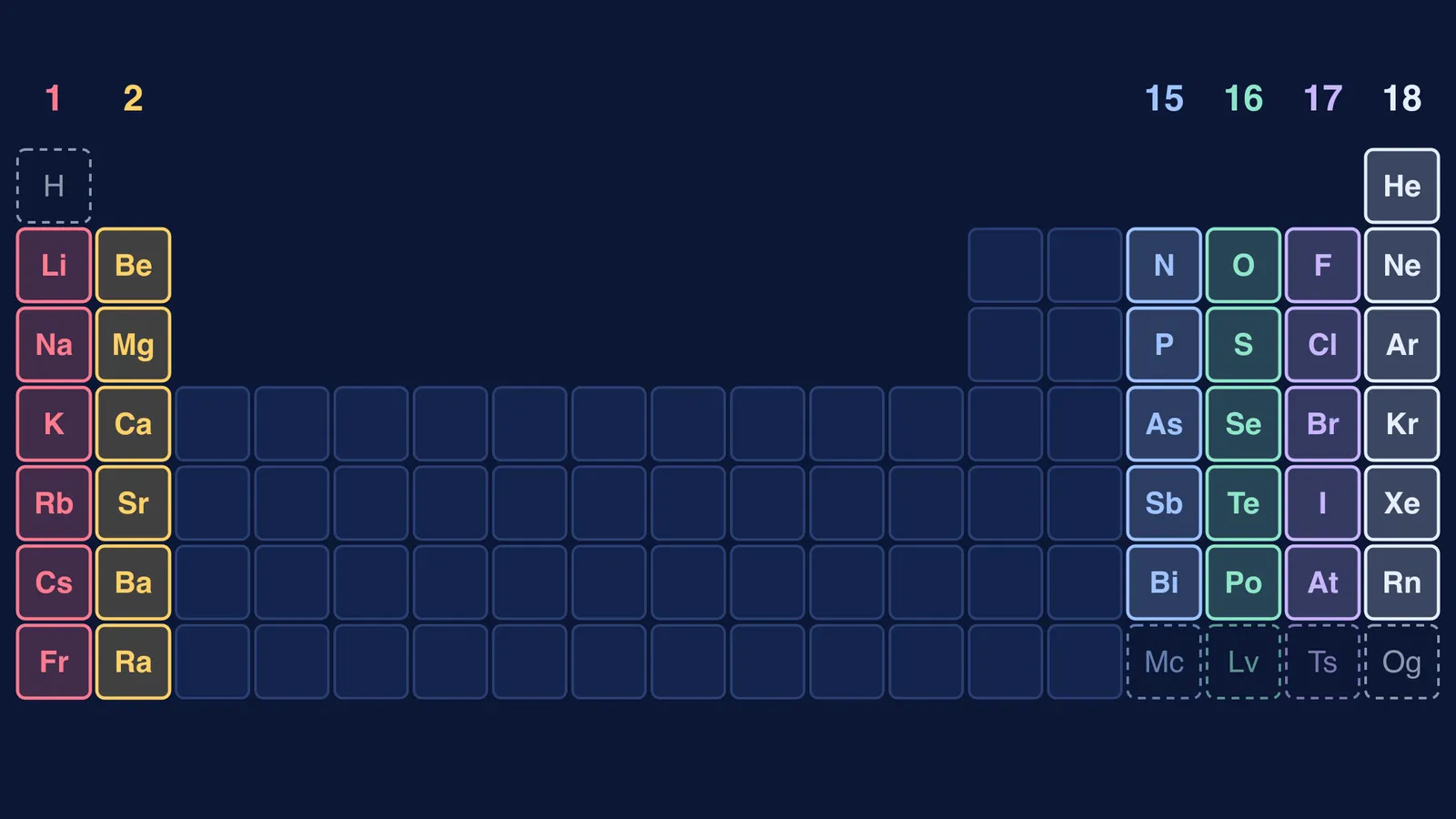
Only six columns of the periodic table have family names approved by IUPAC, the body that sets chemistry's naming rules: groups 1, 2, 15, 16, 17 and 18. Learn each name, number and member list, and you can answer "which family?" questions in Class 11 chemistry and JEE Main without guessing.
What are the names of the groups in the periodic table?
IUPAC has recommended since 1988 that the columns simply be numbered 1 to 18 (IUPAC periodic table). Its 2005 nomenclature recommendations, known as the Red Book, list the approved family names in section IR-3.5 (IUPAC Red Book 2005, PDF):
Group 1, alkali metals: lithium (Li), sodium (Na), potassium (K), rubidium (Rb), caesium (Cs), francium (Fr).
Group 2, alkaline earth metals: beryllium (Be), magnesium (Mg), calcium (Ca), strontium (Sr), barium (Ba), radium (Ra).
Group 15, pnictogens: nitrogen (N), phosphorus (P), arsenic (As), antimony (Sb), bismuth (Bi).
Group 16, chalcogens: oxygen (O), sulfur (S), selenium (Se), tellurium (Te), polonium (Po).
Group 17, halogens: fluorine (F), chlorine (Cl), bromine (Br), iodine (I), astatine (At).
Group 18, noble gases: helium (He), neon (Ne), argon (Ar), krypton (Kr), xenon (Xe), radon (Rn).
The same section says compounds of these elements are called pnictides, chalcogenides and halides (or halogenides).
The lists for groups 15 to 18 stop at period 6. Moscovium (115), tennessine (117) and oganesson (118) only received their approved names on 28 November 2016 (IUPAC), more than ten years after the 2005 Red Book.
Where do the names pnictogen and chalcogen come from?
Chemist Gregory Girolami traced these words in a 2009 paper in the Journal of Chemical Education (Girolami, 2009). His findings, in brief:
Halogen means "salt-former". Johann Schweigger proposed the word in 1811 as another name for chlorine. In 1825 Jöns Jacob Berzelius used it for the group of elements instead.
Chalcogen was first proposed in 1932 by Werner Fischer, who in 2001 traced it to *chalcos*, old Greek for "ore".
Pnictogen comes from the Greek *pnigo*, "to choke", echoing nitrogen's German name, Stickstoff ("suffocating substance"). The Dutch chemist A. E. van Arkel suggested it, first spelled pnigogen, in lectures in Ottawa in 1952-1953. It first appeared in print in 1961.
In 1970 IUPAC declared the names pnicogen and pnictide not approved. Its 2005 Red Book endorsed pnictogen.
What are groups 3 to 14 called?
They have no IUPAC-approved family name. The Red Book allows a group to be named after its first element, such as the boron group (B, Al, Ga, In, Tl) or the titanium group (Ti, Zr, Hf, Rf) (IUPAC Red Book 2005). Groups 3 to 12 are the d-block elements, commonly called transition elements, though group 12 is not always included. Lanthanoids, actinoids and rare earth metals are also approved names, but not for single groups. In 1970 IUPAC suggested triels, tetrels and pentels for groups 13 to 15; in 2009 Girolami found them in fewer than 10 papers a year (Girolami, 2009).
How do you remember the group names, numbers and members?
Here is a 10-minute drill. Run it once today and again tomorrow.
Draw the skeleton. Write 1, 2, then 15, 16, 17, 18. The named groups are the two left-hand columns and the four right-hand ones.
Add one hook per name. Pnictogen "choke" goes with nitrogen at the top of group 15. Chalcogen "ore" goes with oxygen at the top of group 16. Halogen "salt" goes with chlorine in common salt, NaCl.
Read each column downwards out loud, symbol then name: "N nitrogen, P phosphorus, As arsenic..."
Test yourself with atomic numbers. Write the electron configuration, find the group, then name the family (worked examples below).
Next day, cover everything and write out all six lists from memory. Start the next session with any element you missed.
Worked examples, from atomic number to family:
Z = 34: [Ar] 3d¹⁰ 4s² 4p⁴, so period 4, group 16. Selenium, a chalcogen.
Z = 38: [Kr] 5s², so period 5, group 2. Strontium, an alkaline earth metal.
Z = 51: [Kr] 4d¹⁰ 5s² 5p³, so period 5, group 15. Antimony, a pnictogen.
Z = 55: [Xe] 6s¹, so period 6, group 1. Caesium, an alkali metal.
Z = 85: [Xe] 4f¹⁴ 5d¹⁰ 6s² 6p⁵, so period 6, group 17. Astatine, a halogen.
If this step is slow, our guide on finding the period, group and block from the atomic number walks through the method.
Then read our post on trends and anomalies in p-block groups 15 to 17. If an idea such as electron configuration is still shaky, the Fermi Concept Library gives every chemistry concept its own lesson and its place in the map. For practice, the Fermi Problem Library has worked problems with a step-by-step solver that explains the reasoning rather than printing an answer.