On this page
Test and measurement in sports has not been moved or dropped. In CBSE's Physical Education curriculum for Classes XI-XII, 2026-27, it is still Unit 6 of Class XII and carries 8 of the 70 theory marks; practicals carry the other 30. Check the CBSE curriculum page again before your exam in case a revision is posted.
What is in Unit 6, test and measurement in sports?
The same curriculum lists five topics:
The SAI Khelo India Fitness Test in school, for two age groups.
Measurement of cardiovascular fitness with the Harvard step test.
Computing basal metabolic rate (BMR).
The Rikli and Jones senior citizen fitness test.
The Johnsen-Methney test of motor educability (the textbook spells it Johnson-Metheny and lists front roll, back roll, jumping half-turns and jumping full-turns).
Class XI Unit 6 is different: it covers BMI, waist-hip ratio, skinfolds and somatotypes. For the Class XI fitness basics, see our Class 11 guide to physical fitness, wellness and lifestyle.
What are the SAI Khelo India fitness test items?
In the 2026-27 curriculum, for ages 5-8 (Classes 1-3) it is BMI, the flamingo balance test and the plate tapping test. For ages 9-18 (Classes 4-12) it is BMI, a 50 m speed test, a 600 m run/walk, the sit and reach flexibility test, and strength tests: partial abdominal curl-ups, push-ups for boys and modified push-ups for girls.
A Sports Authority of India press release names what each 9-18 item measures: speed (50 m standing start), endurance (600 m run or walk), flexibility (sit and reach), core (partial curl-up in 30 seconds) and muscular endurance (push-ups).
In the practical exam, the fitness test is worth 6 of the 30 marks and names the SAI Khelo India test alongside the Brockport Physical Fitness Test, which is covered in our Class 12 guide to physical education and sports for CWSN.
How do you calculate BMI, the step test index and BMR?
The worked examples below use made-up figures for a 17-year-old.
BMI. The WHO fact sheet on obesity and overweight gives BMI as weight (kg) divided by height squared (m²). For 58 kg and 1.65 m: 1.65 × 1.65 = 2.7225, and 58 ÷ 2.7225 = 21.3 kg/m².
Note that WHO's adult cut-offs (overweight at 25 or more, obesity at 30 or more) are for adults. For ages 5-19, WHO uses BMI-for-age against its growth reference, so a 17-year-old's 21.3 is not read against 25.
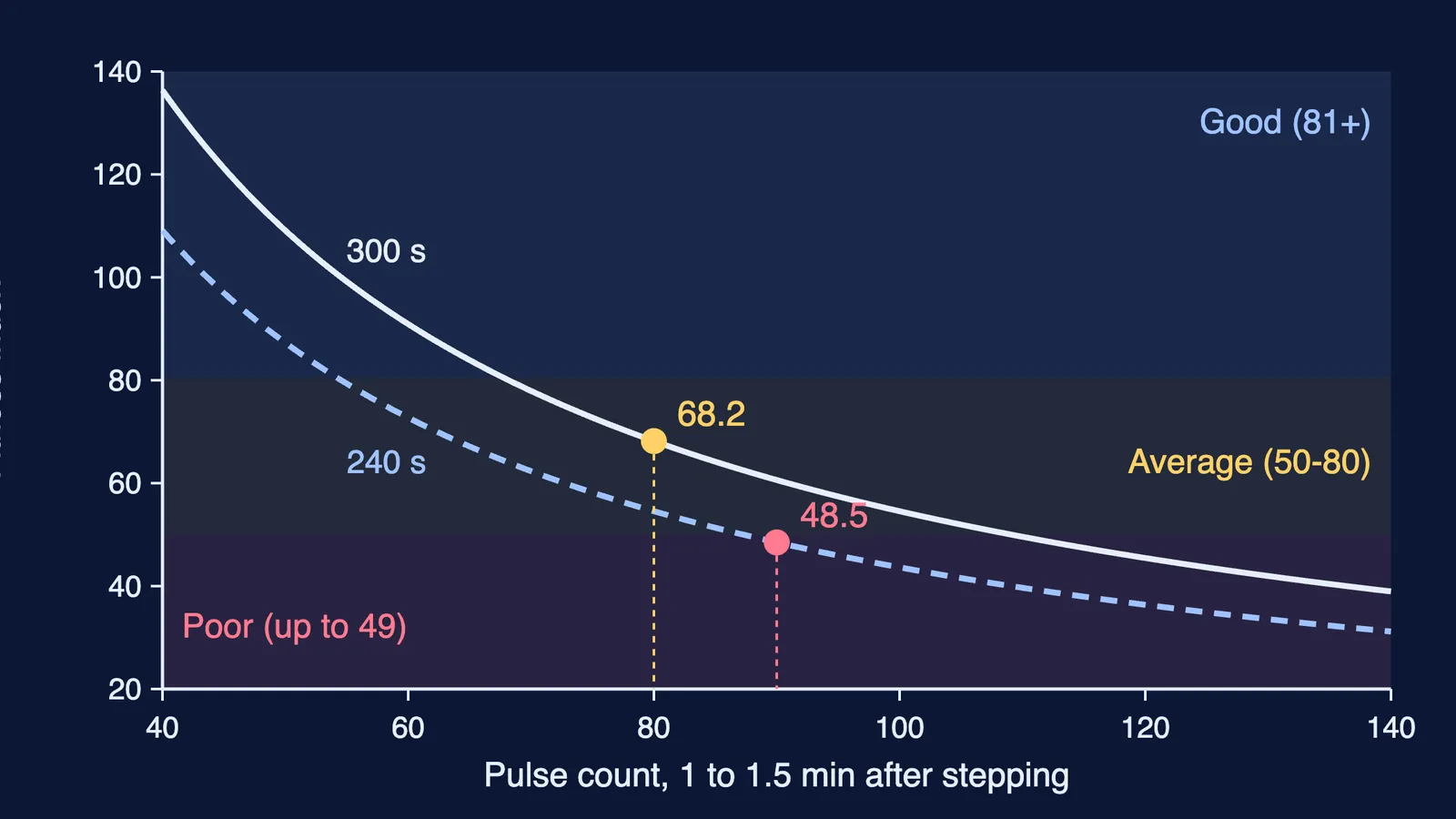
Harvard step test. The CBSE Class XII textbook describes stepping on a 20-inch bench at 30 steps per minute for 5 minutes, or until exhausted, then counting the pulse from 1 to 1.5 minutes after stopping. The short formula is:
Fitness index = (duration in seconds × 100) ÷ (5.5 × pulse count)
Full 300 seconds, pulse count 80: 30,000 ÷ 440 = 68.2, which is "average" on the textbook's norms (up to 49 poor, 50-80 average, 81 or above good).
Stopped at 240 seconds, pulse count 90: 24,000 ÷ 495 = 48.5, which is "poor".
BMR. The same textbook uses the Mifflin-St Jeor equation: for males, (10 × weight in kg) + (6.25 × height in cm) − (5 × age) + 5; for females, the same terms − 161. For a boy of 58 kg, 165 cm and 17 years: 580 + 1,031.25 − 85 + 5 = 1,531.25 kcal. For a girl with the same figures: 1,365.25 kcal.
In the exam, write the formula first, substitute with units, round only at the end, and name the category. If the arithmetic is where you slip, the Fermi Problem Library has worked problems with a step-by-step solver that explains the reasoning rather than printing an answer.
What are the six Rikli and Jones senior fitness test items?
Roberta Rikli and Jessie Jones described the battery in a 1999 paper in the Journal of Aging and Physical Activity: six items, plus one alternative, to assess lower and upper body strength, aerobic endurance, lower and upper body flexibility, and agility and dynamic balance in older adults. The CBSE textbook says it was built for people aged 60 to 94:
Chair stand test (30 seconds): lower body strength.
Arm curl test (30 seconds; textbook dumbbell 8 pounds for men, 5 pounds for women): upper body strength.
Chair sit and reach test: lower body flexibility.
Back scratch test: upper body flexibility.
Eight foot up and go test: agility.
Six-minute walk test: aerobic endurance (the two-minute step test is the textbook's alternative).
How should you revise Unit 6 in one week?
Day 1: write the five topics and both Khelo India lists from memory.
Day 2: redo the BMI and BMR sums with your own figures.
Day 3: do three step test sums with new durations and pulse counts.
Day 4: match each Rikli and Jones item to what it measures.
Day 5: write one test procedure in full, with equipment and scoring.
Days 6-7: answer past questions under time, then fix the gaps.
Next, for Unit 10, our Class 12 guide to training in sports covers how strength, speed and endurance are trained.