On this page
Theory base of accounting explains why every Class 11 entry is made the way it is. Learn it through one business.
This guide uses the CBSE Accountancy curriculum for 2026-27 and the NCERT chapter Theory Base of Accounting (Reprint 2026-27). Every example below is our own.
What does the 2026-27 syllabus include in theory base of accounting?
In the CBSE 2026-27 curriculum, the marks table prints "Unit-1: Theoretical Framework 12", out of 80 theory marks.
Under "Theory Base of Accounting", the curriculum lists:
Fundamental accounting assumptions and the concept of GAAP
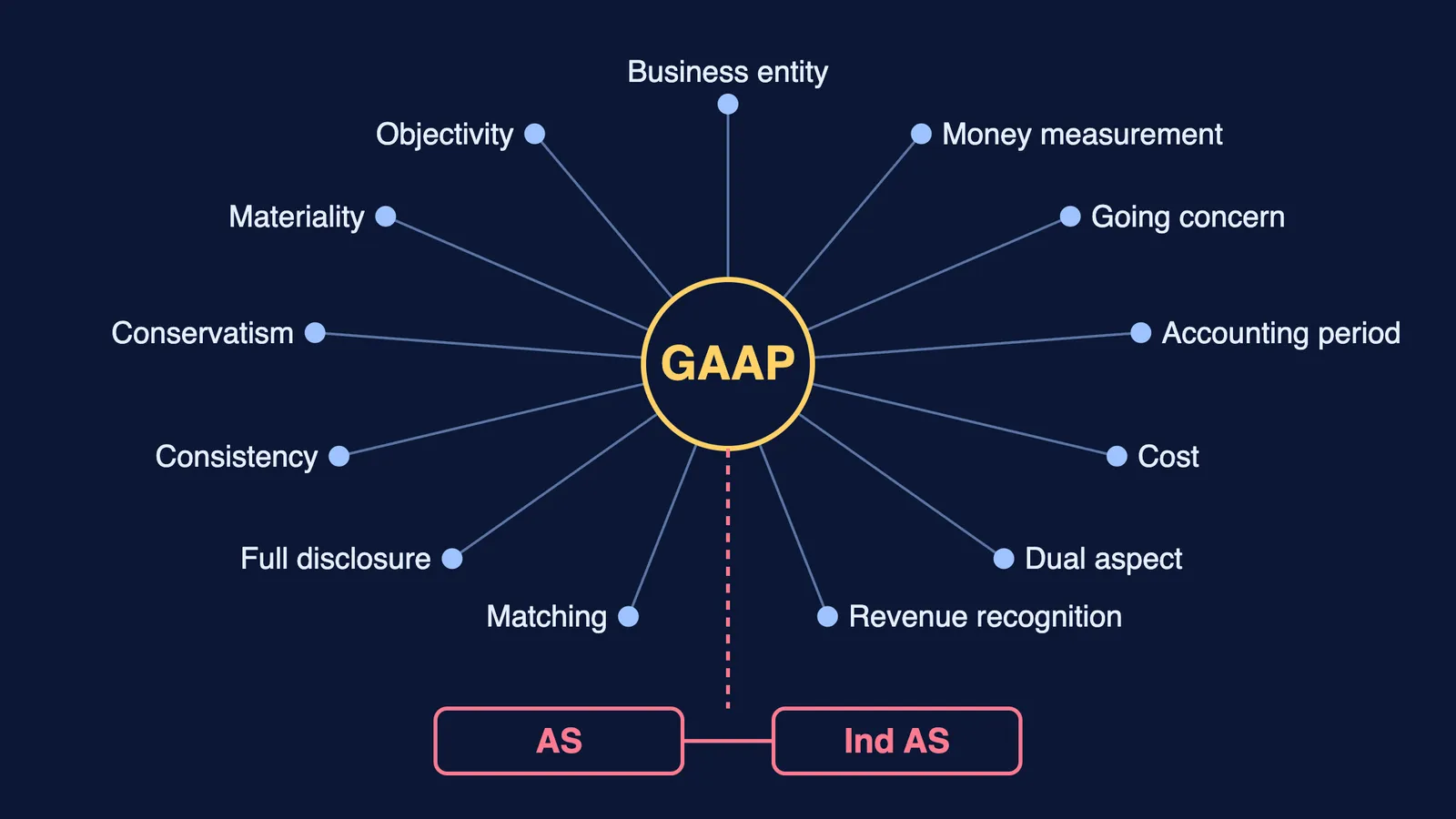
Thirteen basic concepts, from business entity to objectivity (all thirteen below)
Systems of accounting, and the cash and accrual bases
Applicability of Accounting Standards (AS) and Indian Accounting Standards (Ind AS)
Goods and Services Tax (GST): characteristics and advantages
IFRS is not named in it.
What is GAAP in accounting?
NCERT defines Generally Accepted Accounting Principles (GAAP) as the rules or guidelines adopted for recording and reporting business transactions, so that financial statements are prepared and presented uniformly.
A concept is a basic assumption; a convention is a custom that guides how statements are prepared. NCERT treats the labels as interchangeable and calls all thirteen "basic accounting concepts".
What are the basic accounting concepts, with examples?
Meet Imran, who runs a cycle repair shop. Definitions follow the NCERT chapter.
Business entity: the business is separate from its owner. ₹18,000 of his son's school fees paid from the shop's account is drawings, not a shop expense.
Money measurement: only what can be expressed in money is recorded. His 40 tyres at ₹350 each go in as ₹14,000; his mechanic's skill does not.
Going concern: the business is assumed to keep running, so an asset's cost is spread over its life. His ₹32,000 air compressor should last 5 years, so ₹6,400 is charged each year, not ₹32,000 in year one.
Accounting period: statements are prepared at regular intervals, normally a year. His year runs from 1 April 2026 to 31 March 2027.
Cost: assets are recorded at purchase price, including transport and installation. The compressor's ₹30,000 price plus ₹1,200 transport and ₹800 installation gives ₹32,000 and stays there even if prices rise.
Dual aspect: every transaction has two effects. Imran starts with ₹2,00,000 cash and buys spare parts worth ₹25,000 on credit. Assets ₹2,25,000 = Liabilities ₹25,000 + Capital ₹2,00,000.
Revenue recognition: revenue is recorded when goods are sold or a service is rendered. He services a school's cycles in March 2027 for ₹8,000 and is paid in April 2027. The ₹8,000 belongs to 2026-27.
Matching: expenses are matched with the revenue of the same period. The ₹3,000 of brake cables used on that job goes in the same year as the ₹8,000.
Full disclosure: all material and relevant facts go in the statements and their notes. A customer claims ₹15,000 for a fall after a repair, which Imran disputes; the claim is disclosed in the notes to the accounts.
Consistency: the same methods are used from one period to the next. He keeps the straight line method for the compressor instead of switching to show more profit; any change is disclosed.
Conservatism: provide for losses, but record no profit until realised. If the market price of his tyres falls to ₹300, stock is shown at ₹12,000. If it rises to ₹400, it stays at cost, ₹14,000.
Materiality: amounts too small to influence an informed user need not follow strict rules. A ₹150 tyre pressure gauge that may last years is simply treated as an expense of the year.
Objectivity: records must be free from bias and backed by verifiable documents. The compressor is recorded at ₹32,000, as its bills show, not at a friend's guess that it is "worth ₹40,000".
Double entry, built on dual aspect, records both sides of every transaction. To practise, see how to check AI-made journal entries with the golden rules.
What are accounting standards, Ind AS and IFRS?
NCERT describes accounting standards as written policy documents, issued by the Institute of Chartered Accountants of India (ICAI), covering recognition, measurement, treatment, presentation and disclosure of transactions (NCERT). They make statements comparable, but NCERT notes limits: they are rigid and cannot override the law.
The curriculum also asks about the applicability of AS and Ind AS, which the NCERT reprint does not explain. The IFRS Foundation's profile of India (last updated October 2019) says India has not adopted IFRS Standards; it issues Ind AS, which are based on and substantially converged with IFRS. Listed companies (except banks, insurers and SME-exchange companies) and large unlisted companies, judged by net worth, must use Ind AS; other companies apply local accounting standards.
How should you revise this unit?
Pair the concepts students mix up: cost and objectivity, revenue recognition and matching.
Write one line each on AS and Ind AS applicability.
Spot the concepts again when you prepare final accounts with adjustments.
Balancing this with other subjects? Fermi's AI tutor can work out what you already know and build a plan for the session, so you sit down to a clear next step.