

On this page
NCERT Class 11 Biology covers plant growth and development in Chapter 13 (Reprint 2026-27). The NEET (UG) 2026 syllabus places it under Unit 4, Plant Physiology.
These 12 questions are original practice, not from any exam paper, and each answer has a one-line NCERT reason.
How do you attack two-statement questions on plant growth?
Judge each statement alone first. A false one usually swaps a single word, such as primary for secondary or promoter for inhibitor.
For Q1 to Q4: (1) Both correct (2) Both incorrect (3) I correct, II incorrect (4) I incorrect, II correct.
I: Plant growth is open because meristems keep adding new cells. II: Vascular cambium and cork cambium drive primary growth along the axis.
I: Meristematic cells have thick, lignified secondary walls. II: Meristematic cells have large, conspicuous nuclei and many plasmodesmata.
I: In W1 = W0e^rt, r is the relative growth rate, also called the efficiency index. II: In this equation, the final size W1 does not depend on the initial size W0.
I: Buttercup leaves formed in air and in water differ in shape due to environment. II: Cotton and coriander have juvenile leaves shaped unlike mature ones.
Answers. 1: (3). Lateral meristems cause secondary growth, the increase in girth. 2: (4). Meristematic walls are thin, primary and cellulosic. 3: (3). NCERT says W1 depends on W0. 4: (1). Both are NCERT's examples of heterophylly.
How do you handle "which of these are correct" questions?
Mark each statement T or F, then strike any option that includes an F or omits a T.
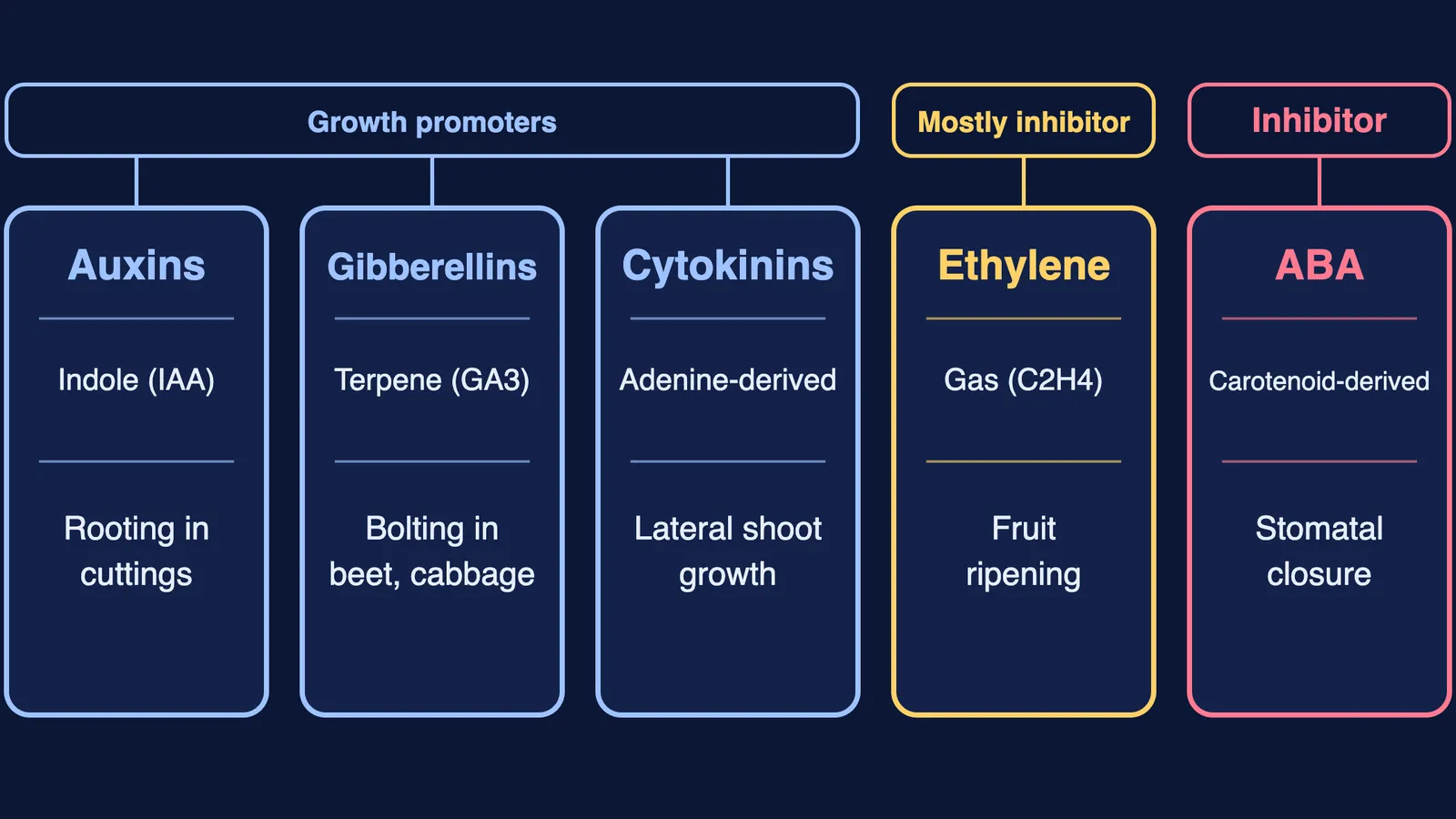
Which statements about ethylene are correct? A. It causes horizontal growth of seedlings. B. It induces flowering in mango. C. Ethephon, a source of ethylene, promotes female flowers in cucumbers. D. It inhibits the sprouting of potato tubers. E. It is largely a promoter of growth activities. (1) A, B and C only (2) A, C and E only (3) B, D and E only (4) A, B, C and D only
Which statements about auxins are correct? A. Auxin was first isolated from human urine. B. Auxins speed up the shedding of older, mature leaves and fruits. C. 2,4-D is used on lawns to kill mature monocot plants. D. Auxin controls xylem differentiation. (1) A and C only (2) B, C and D only (3) A, B and D only (4) A, B, C and D
Answers. 5: (1). Ethylene starts potato sprouting, and NCERT calls it largely an inhibitor. 6: (3). 2,4-D removes dicot weeds and leaves mature monocots unharmed.
How do you solve match-the-list questions fast?
Lock your surest pair, cut every option that disagrees, then compare only where the survivors differ.
List-I: A. F.W. Went B. E. Kurosawa C. Miller et al. D. H.H. Cousins. List-II: I. Orange volatile hastened banana ripening II. Auxin from oat coleoptile tips III. Crystallised kinetin IV. Bakanae symptoms from sterile fungal filtrates. (1) A-IV, B-II, C-III, D-I (2) A-II, B-IV, C-III, D-I (3) A-II, B-IV, C-I, D-III (4) A-III, B-IV, C-II, D-I
List-I: A. Maize root apical meristem B. Watermelon C. Pollen tube D. Dorsiventral leaf. List-II (how growth is expressed): I. Surface area II. Length III. Cell size IV. Cell number. (1) A-III, B-IV, C-II, D-I (2) A-IV, B-III, C-I, D-II (3) A-IV, B-II, C-III, D-I (4) A-IV, B-III, C-II, D-I
List-I: A. Thinning of cotton, cherry and walnut B. Speeding up malting in brewing C. Parthenocarpy in tomatoes D. Tolerance to stresses. List-II: I. Auxin II. ABA III. Ethephon IV. GA3. (1) A-III, B-I, C-IV, D-II (2) A-II, B-IV, C-I, D-III (3) A-III, B-IV, C-I, D-II (4) A-III, B-IV, C-II, D-I
Answers. 7: (2). See NCERT section 13.4.2 on discovery. 8: (4). NCERT gives cell number for the meristem and cell size for watermelon. 9: (3). ABA is called the stress hormone; GA3 speeds up malting.
Which single-correct questions test the same ideas?
Predict the answer before reading the options.
Pruning a tea bush's shoot tip makes lateral buds grow. Which PGR's effect was removed, and which PGR also promotes lateral shoots? (1) Cytokinin; auxin (2) Auxin; cytokinin (3) Gibberellin; ABA (4) Ethylene; auxin
Cells in culture grow slowly, then fast, then level off as nutrients run short. Name the phases in order. (1) Log, lag, stationary (2) Lag, stationary, log (3) Stationary, log, lag (4) Lag, log, stationary
Which is an example of dedifferentiation? (1) Formation of a tracheary element (2) Root-cap cells forming from cells pushed away from the meristem (3) Expansion of a leaf (4) Interfascicular cambium arising from parenchyma
Answers. 10: (2). NCERT treats apical dominance under auxins, and cytokinins help overcome it. 11: (4). These are the three parts of NCERT's sigmoid curve. 12: (4). Mature parenchyma regains the power to divide; option (2) is open differentiation.
What should you do after this set?
Count an answer only if your reason matched too. For method, see our guides to statement-based NEET questions and match-the-list questions in NEET, or revise with the full chapter guide to plant growth and development.
Not sure which of the five regulators you keep mixing up? Fermi's AI tutor works out what you already know and builds a plan for the session.


