On this page
A house in India gets 230 V. A small factory down the same street gets a three-phase supply rated at 400 V. It is the same transformer and the same wires on the pole, so where does the extra voltage come from? Nothing is stepped up. 400 V is simply what you measure between two of the 230 V phases, because their voltages peak at different times. The factor that links the two numbers is √3, and it comes straight out of phasor geometry.
What is a three-phase supply?
A generator in a power station has three sets of coils spaced 120° apart around its axis. As the rotor turns, each coil produces its own sinusoidal emf, and each emf reaches its peak one-third of a cycle after the one before. At 50 Hz a full cycle takes 20 ms, so the peaks are 6.67 ms apart.
In the local distribution network you get four wires: three phase wires (often called R, Y and B) and a neutral. This is the star connection. Each phase voltage, measured from a phase wire to the neutral, is 230 V rms. A home normally takes one phase and the neutral. A workshop with motors takes all three.
How Dolivo-Dobrovolsky first sent three-phase power over a long line, and why the three balanced currents add to zero, is told in Dolivo-Dobrovolsky's 175 km three-phase transmission. Here we look at the voltages and currents you would calculate.
Why is the line voltage √3 times the phase voltage?
The voltage between two phase wires, say R and Y, is the difference of their two phase voltages: V_RY = V_R − V_Y. Because both are sinusoids at the same frequency, you can subtract them as phasors (rotating vectors), which is the same method used for series LCR circuits.
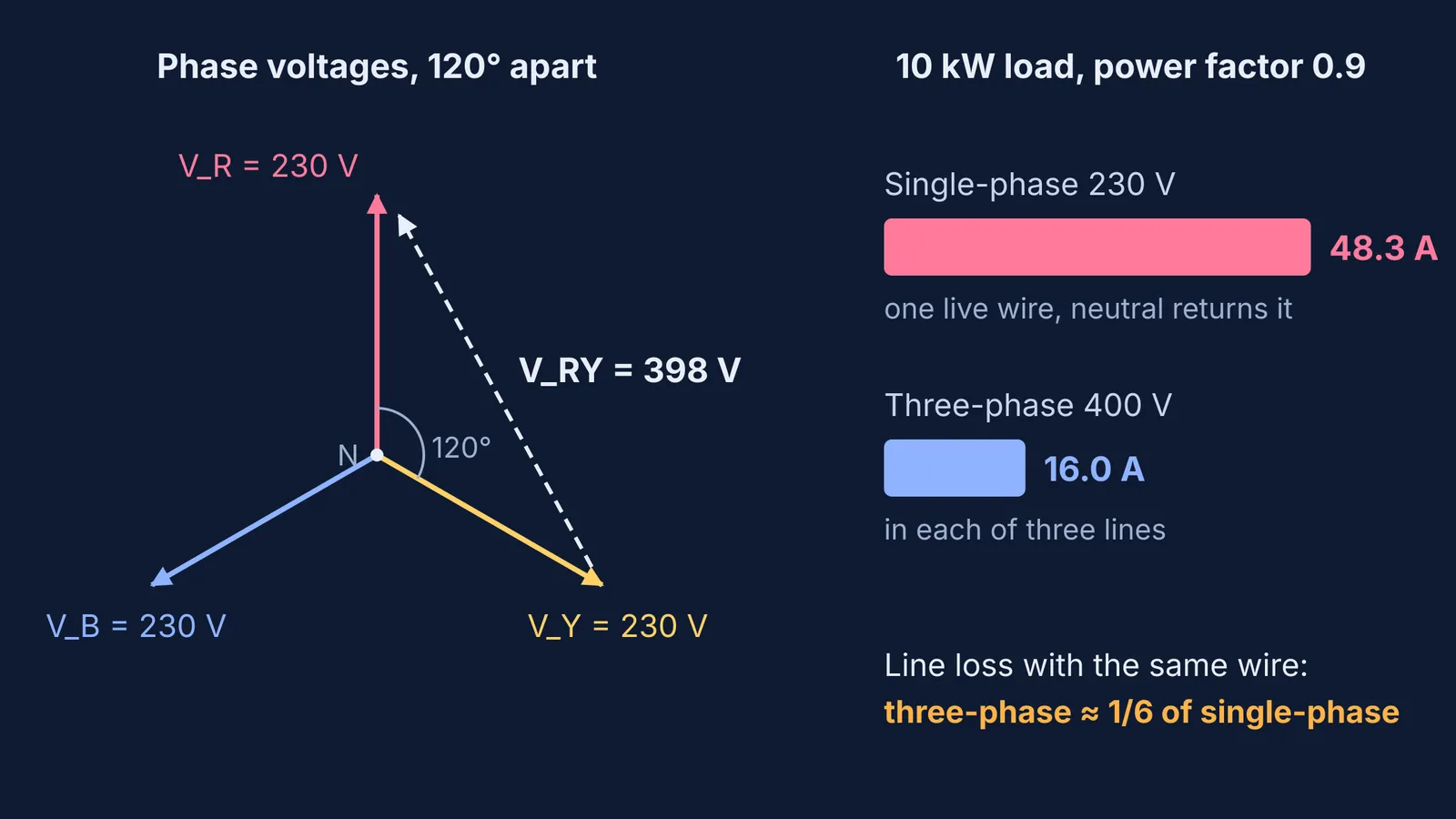
Draw V_R and V_Y from a common point (the neutral), each 230 V long, with 120° between them.
V_R − V_Y is the vector from the tip of V_Y to the tip of V_R.
The two phasors and this difference form an isosceles triangle with two sides of 230 V and an included angle of 120°.
Drop a perpendicular from the neutral onto the third side. It cuts the 120° angle into two 60° angles, so each half of the third side is 230 × sin 60°.
The full third side is 2 × 230 × sin 60° = 2 × 230 × (√3/2) = √3 × 230.
√3 × 230 = 398.4 V, quoted as 400 V. The same argument gives √3 × 240 = 415.7 V, the older figure of 415 V.
Is India's supply 230/400 V or 240/415 V?
Both figures appear in Indian books and on equipment labels, and the reason is in the standard itself. India's Bureau of Indian Standards publishes IS 12360, the standard for voltage bands and preferred voltages. Its original 1988 table listed 240 V single-phase and 415 V three-phase. Amendment No. 1 (2000) to IS 12360 replaced these with 230 V single-phase and 230/400 V three-phase, with a ±10% band (207 V to 253 V for a single phase), to align with the IEC standard. A later amendment in 2011 states that the changeover from 240/415 to 230/400 "shall be kept in abeyance for the time being". So 230/400 V is the IEC-aligned value used in most exam problems, and 240/415 V is still common in practice. Either way, the ratio is √3.
How much current does a 10 kW workshop draw on three phases?
Take a 10 kW load with power factor 0.9, supplied first as three-phase at 400 V, then as single-phase at 230 V. Use rms values throughout.
Step 1: three-phase power formula. For a balanced load, P = √3 · V_L · I_L · cos φ. Not 3 · V_L · I_L · cos φ: the 3 belongs with the phase voltage, P = 3 · V_ph · I_ph · cos φ, and in star √3 · V_L = 3 · V_ph.
Step 2: line current. I_L = P / (√3 · V_L · cos φ) = 10 000 / (1.732 × 400 × 0.9) = 16.0 A in each line.
Step 3: single-phase current. I = P / (V · cos φ) = 10 000 / (230 × 0.9) = 48.3 A.
Step 4: compare wiring losses. Suppose every wire has the same resistance R. Single-phase current flows out and back, through two wires: loss = 2 × 48.3² × R = 4668R. Three-phase, with a balanced load and no neutral current, the loss is in three lines: 3 × 16.0² × R = 772R. The ratio is 772/4668 = 0.165, about one-sixth.
Step 5: check units. V × A = W. 1.732 × 400 × 16.0 × 0.9 = 10.0 kW. The numbers close.
The exact one-sixth comes out if you take V_L as exactly √3 × 230; with the rounded 400 V you get 16.5%. Three-phase delivers the same power with one more wire but a third of the current in each, which is why it is used for any large load.
What does the neutral carry when the phases are unequal?
In a perfectly balanced load the three phase currents, 120° apart, add to zero, so the neutral carries nothing. Real homes are not balanced: each house is on one phase, and they switch things on at different times. Add the phase currents as phasors, just like the voltages. For resistive loads:
10 A, 10 A, 10 A: neutral current 0 A.
10 A, 10 A, 0 A: neutral current 10 A, since two equal phasors 120° apart add to one of the same size.
20 A, 10 A, 10 A: neutral current 10 A. The balanced 10 A part cancels; only the extra 10 A on one phase returns.
This is why the neutral in a street supply is a full conductor and is not left out.
Why do three-phase motors start without a capacitor?
Feed three coils spaced 120° apart with three currents 120° apart in time, and their combined magnetic field has constant strength and rotates at the supply frequency. A rotor placed in that field is dragged round from rest. A single phase gives only a pulsating field, which is why a single-phase fan needs a capacitor to fake a second phase, as explained in why ceiling fans need a capacitor to start. Three-phase line voltages are also what a car alternator rectifies, as shown in how a car alternator turns three-phase AC into 14 V DC.
One safety point follows from the geometry. Anything connected between two phases sees about 400 V, not 230 V, so an appliance rated for 230 V would be badly overloaded. Leave every connection to a licensed electrician.
If phasors still feel shaky, the Concept Library covers every concept in physics, including phasor addition.
Quick checklist
Phase voltage: line to neutral, 230 V rms. Line voltage: line to line.
Star: V_L = 2 V_ph sin 60° = √3 V_ph, so 230 V gives 398 V, quoted as 400 V.
Delta: V_L = V_ph and I_L = √3 I_ph.
Power: P = √3 V_L I_L cos φ. 10 kW at 0.9 power factor takes 16.0 A per line.
Balanced load: no neutral current. Unbalanced: add phase currents as phasors.