On this page
Look at the label on an angle-grinder disc and you will find two speed limits: a maximum in revolutions per minute (rpm) and a maximum rim speed in metres per second, often 80 m/s. The m/s figure is the deeper one. A spinning ring is pulled apart by the force needed to keep its own material moving in a circle, and that stress depends on the rim speed alone, not on the size of the ring. This post derives σ = ρv² and applies it to grinder discs and flywheels.
Why does a spinning ring need tension at all?
Every bit of a spinning ring moves in a circle, so every bit needs a centripetal force towards the centre. Nothing pushes from the middle of a thin ring: there are no spokes. The only thing that can pull each bit inwards is its neighbours, through tension around the ring. This tension is called hoop tension, and the stress it causes is the hoop stress.
If the speed rises, each bit needs more centripetal force, so the tension rises. When the stress reaches the ultimate tensile strength of the material, the ring tears and the pieces fly off along tangents. A torn steel flywheel was mentioned without a formula in how to calculate the energy stored in a rotating flywheel. Here is the formula.
How do you derive the hoop stress σ = ρv²?
Take a thin ring of radius R, cross-sectional area A and density ρ, spinning so that its rim moves at speed v.
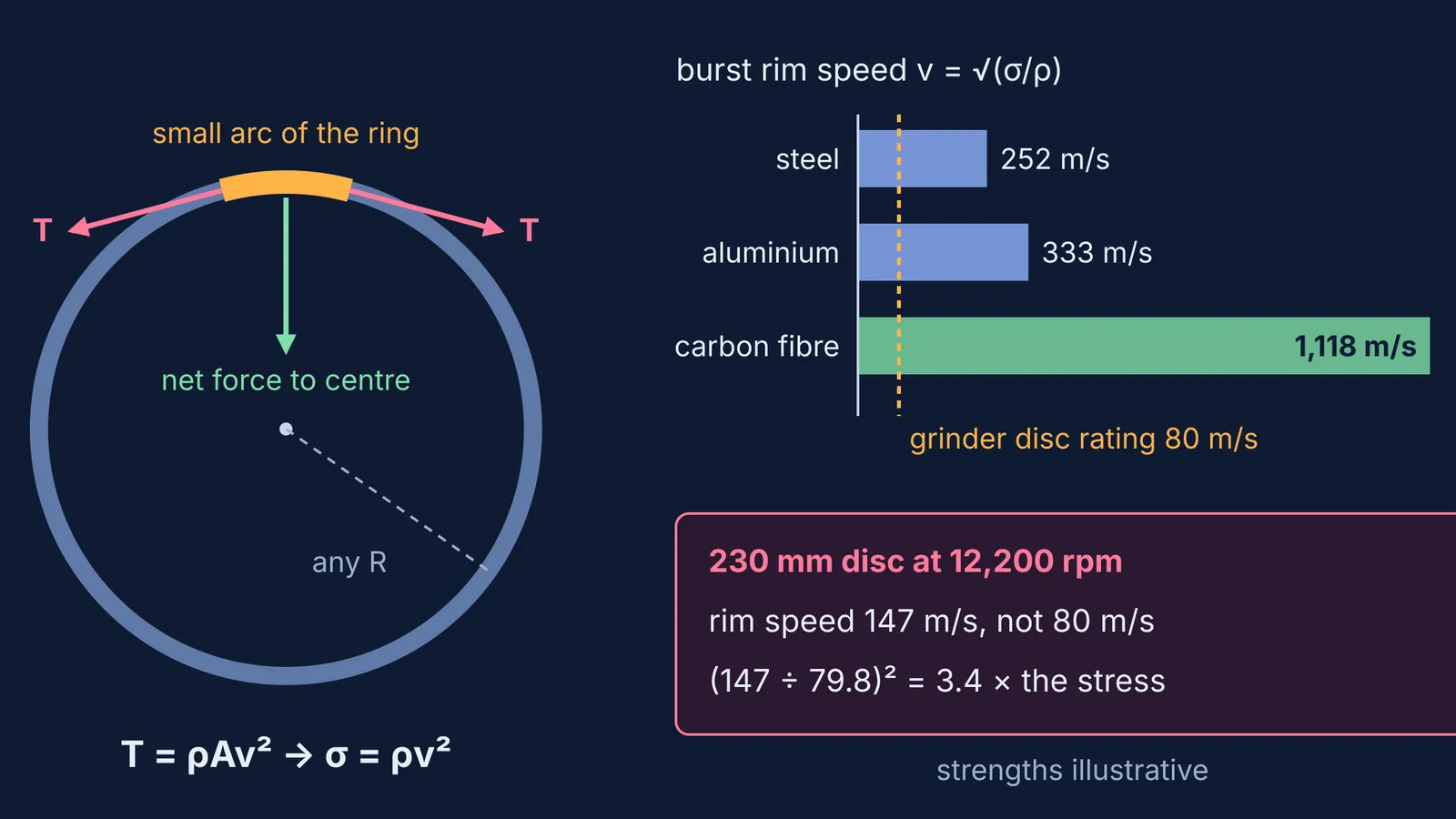
Cut out a small arc. The arc subtends a small angle Δθ at the centre. Its length is RΔθ, so its mass is Δm = ρARΔθ.
Find the force it needs. Centripetal force = Δm v²/R = ρARΔθ × v²/R = ρAv²Δθ.
Find the force it gets. Each cut end is pulled by the tension T, along the ring. The two pulls are each tilted inwards by Δθ/2, so their inward components add to 2T sin(Δθ/2). For a small angle, sin(Δθ/2) ≈ Δθ/2, which gives TΔθ.
Equate. TΔθ = ρAv²Δθ, so T = ρAv².
Divide by area. σ = T/A = ρv².
Check the units: kg/m³ × m²/s² = kg/(m s²) = N/m² = Pa. That is a stress, as it should be.
R has cancelled, and so has A. A ring of any size and any thickness made of the same material bursts at the same rim speed:
v(burst) = √(σ_UTS / ρ)
Mass has cancelled too. A heavier disc is not a stronger disc, because the extra mass needs extra centripetal force in exactly the same proportion.
Why is a grinder disc rated in m/s as well as rpm?
Because σ = ρv² depends only on the rim speed, a single m/s rating covers every disc size made from the same recipe. The rpm limit then follows from the diameter D:
rpm(max) = v(max) × 60 / (πD)
Klingspor's guide to maximum operating speed says the speed is given in m/s, under standards such as DIN EN 12413 for bonded abrasive wheels, and lists 80 m/s for many hand-held discs. It also gives the optional colour stripe code: a red stripe means 80 m/s. A Flexovit speed table following EN 12413 lists 12,250 rpm for a 125 mm wheel at 80 m/s and 6,650 rpm for a 230 mm wheel.
Check those with the formula:
125 mm disc at 80 m/s. rpm = 80 × 60 / (π × 0.125) = 12,223 rpm. The table rounds this to 12,250.
230 mm disc at 80 m/s. rpm = 80 × 60 / (π × 0.230) = 6,643 rpm. The table gives 6,650.
So a 125 mm grinder that runs at about 12,200 rpm (a round illustrative figure) has a rim speed of π × 0.125 × 12,200 / 60 = 79.8 m/s, right at an 80 m/s rating. A mixer blade's smaller tip speed is worked in how a mixer grinder motor works.
What happens to the stress if a bigger disc runs at the same rpm?
Put a 230 mm disc on the same 12,200 rpm spindle and its rim speed becomes π × 0.230 × 12,200 / 60 = 147 m/s. The stress scales as v², so it is (147 / 79.8)² = 3.4 times the stress of the 125 mm disc. Its 80 m/s rating is good only up to about 6,640 rpm, roughly half the speed of the small grinder. Grinder guards and spindle sizes are designed around one disc size for this reason. Never remove a guard or fit a larger disc than the tool is made for.
Why are storage flywheels made of carbon fibre?
Use the burst-speed formula with illustrative round strengths. Real values vary a lot with alloy, heat treatment and fibre layup, so treat these as classroom numbers only.
Steel. ρ = 7,850 kg/m³, σ = 500 MPa. v = √(500 × 10⁶ / 7,850) = 252 m/s.
Aluminium alloy. ρ = 2,700 kg/m³, σ = 300 MPa. v = √(300 × 10⁶ / 2,700) = 333 m/s.
Carbon-fibre composite. ρ = 1,600 kg/m³, σ = 2,000 MPa. v = √(2,000 × 10⁶ / 1,600) = 1,118 m/s.
The useful ratio is strength divided by density. Carbon fibre is both strong and light, so it can spin far faster. Energy stored per kilogram scales with v², so at its burst limit the composite ring holds about (1,118 / 252)² = 20 times more energy per kilogram than steel. That is why modern storage flywheels use composite rims.
For comparison, a steel ring at 80 m/s carries σ = 7,850 × 80² = 50 MPa, about a tenth of the 500 MPa assumed above.
How accurate is σ = ρv² for a real disc?
It is exact for a thin ring and an estimate for anything else. A solid disc is helped by the material inside it. With Poisson's ratio 0.3, standard elasticity results give a peak stress of about (3 + 0.3)/8 = 0.41ρv² at the centre of a solid disc, and about (3 + 0.3)/4 = 0.83ρv² at the edge of a small central hole. A grinder disc has a hole, so it sits closer to the ring result than to the solid disc.
Real abrasive discs are also not steel. They are abrasive grit held in a bond and reinforced with glass-fibre mesh, so this post quotes no burst speed for any real disc. The physics only explains why the rating is a speed: whatever the recipe, the stress is set by ρv².
If centripetal force or stress still feels shaky, the Concept Library explains each idea in physics one concept at a time. For a rotating frame where the same ω²r appears as artificial gravity, see how a rotating space station creates artificial gravity.
Quick checklist
Hoop stress in a thin spinning ring: σ = ρv², with v the rim speed.
Radius, thickness and mass all cancel; only material and rim speed matter.
Burst speed: v = √(σ_UTS / ρ). Compare materials by strength over density.
rpm(max) = v(max) × 60 / (πD): a bigger disc has a lower rpm limit.
Same rpm, twice the diameter: twice the rim speed, four times the stress.
A solid disc peaks near 0.41ρv² and a disc with a small hole near 0.83ρv².