On this page
A scuba cylinder that would feed a resting diver for about an hour and a half at the surface empties in under half an hour at 30 m. The tank has not changed and the diver's lungs have not changed. What changes is the pressure of every breath. This post uses Boyle's law to turn depth into air use, works the numbers for a standard 12 L cylinder, and explains why the same law is behind the first rule taught to every diver: never hold your breath on the way up.
These are physics estimates with round illustrative numbers. Real dives are planned with formal training, dive tables or a dive computer, and a buddy, never from a calculation like this one.
Why does a diver use more air at depth?
The pressure around a diver grows with depth. Water pushes on the chest, so the lungs can only fill if the air inside them is at the same pressure as the water outside. The regulator, the demand valve invented for the aqualung (see how Cousteau and Gagnan's demand valve made scuba diving practical), does exactly this. It delivers air at the surrounding absolute pressure whenever the diver inhales.
A relaxed diver breathes roughly the same volume per minute at any depth, because the lungs and the body's needs are the same. But at higher pressure, each litre of breath holds more gas. By Boyle's law (pV constant at fixed temperature), the gas in a breath at pressure P would fill P/P₀ times that volume at the surface, where P₀ = 1.013 bar. So:
consumption at depth = surface consumption × (P(absolute) / P₀)
Use absolute pressure here. At 10 m the gauge pressure of the water is about 1 bar, but the absolute pressure is about 2 bar, and it is the absolute pressure that sets the density of the air in the lungs.
How much air is in a scuba tank?
Take a 12 L cylinder filled to 200 bar on its gauge. A gauge reads pressure above the atmosphere, so 200 bar gauge is the excess that can flow out. Treating air as an ideal gas, the free air it can release at the surface is:
V(free) = 12 L × 200 bar / 1.013 bar = 2,370 L (to 3 significant figures)
Two corrections matter at this level:
Real gas. At 200 bar, gas molecules are close enough that the ideal-gas law is off by a few percent. In the NIST Chemistry WebBook fluid tables, nitrogen at 20 °C is 1.1496 kg/m³ at 1 bar and 218.54 kg/m³ at 200 bar: a ratio of 190, not 200. So a cylinder of nitrogen, the main part of air, holds about 5% less than the ideal estimate. Call 2,370 L an upper estimate.
Reserve. Divers are trained to surface with gas still in the tank. Using 50 bar as an illustrative reserve leaves 150 bar to breathe: 12 × 150 / 1.013 = 1,780 L.
The air has mass, too. At about 1.2 g/L for surface air, 2,370 L is about 2.8 kg, so a diver gets slightly lighter as the tank empties.
How long does a scuba tank last at different depths?
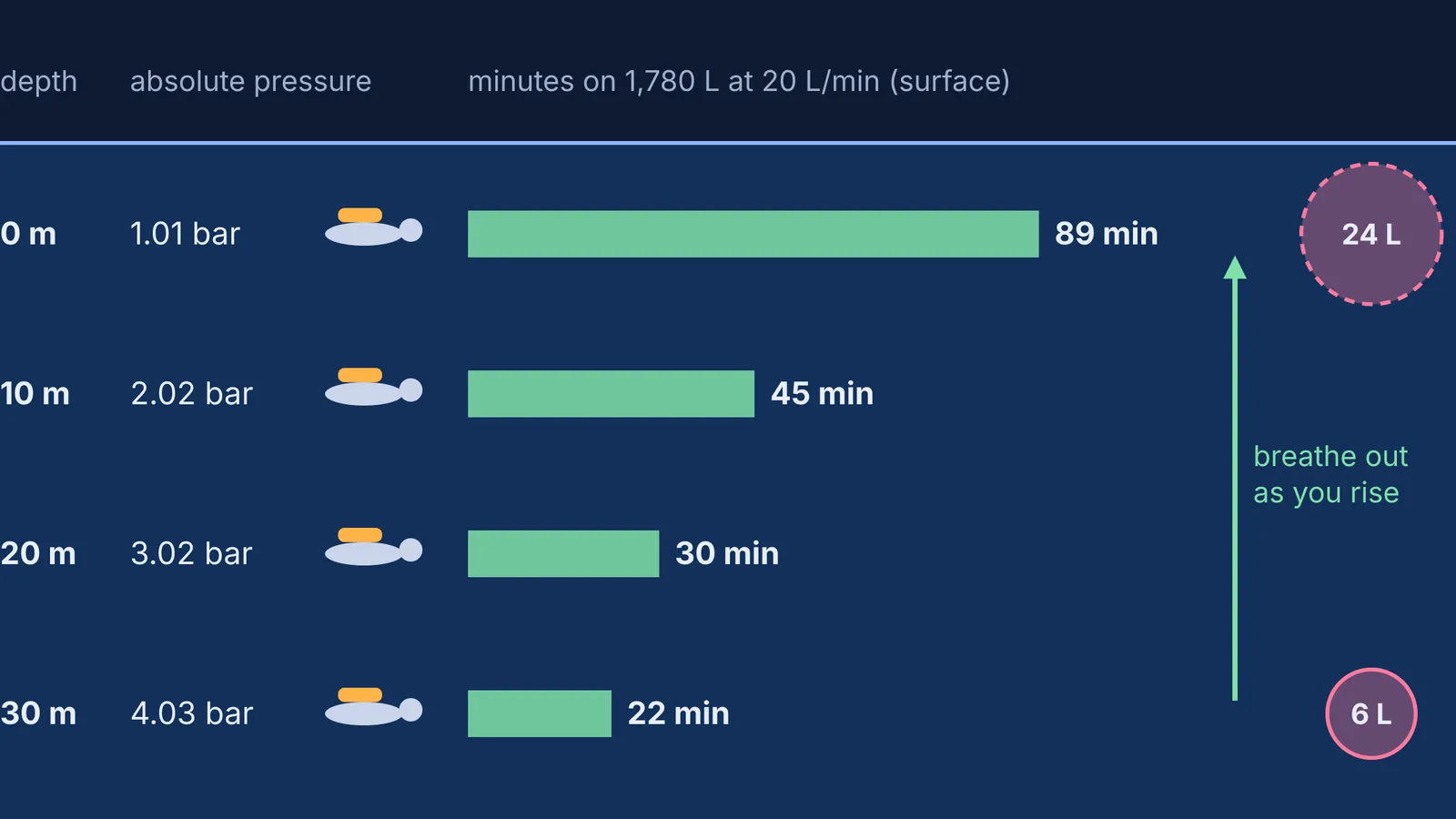
A fully worked example. The figures are illustrative: 20 L/min is a round surface consumption for a relaxed diver, and real rates vary a lot with effort, cold, stress and body size. For scale, a DAN worked example uses 22 L/min at the surface, which it multiplies by 4 atmospheres to get 88 L/min at 30 m.
Pressure per metre. In seawater of density 1,025 kg/m³, Δp = ρgh = 1,025 × 9.81 × 1 = 10,055 Pa per metre, which is 0.1006 bar/m. That is close to the one-atmosphere-per-10-metres rule explained in why every 10 metres of water adds one atmosphere.
Absolute pressure at each depth. P = 1.013 + 0.1006 × depth, giving 1.013 bar at 0 m, 2.019 bar at 10 m, 3.024 bar at 20 m and 4.030 bar at 30 m.
Pressure ratio P/P₀. 1.00, 1.99, 2.99 and 3.98.
Consumption. 20 L/min × ratio = 20, 40, 60 and 80 L/min of surface-equivalent air.
Time on 1,780 L. 1,780 / 20 = 89 min; 1,780 / 40 = 45 min; 1,780 / 60 = 30 min; 1,780 / 80 = 22 min.
So the same tank lasts 89 minutes at the surface and about 22 minutes at 30 m: four times the pressure, a quarter of the time. Units check: litres divided by litres per minute leaves minutes.
Why must a diver never hold their breath while rising?
Run Boyle's law the other way. Suppose a diver at 30 m (4.03 bar) takes a full 6 L lungful from the regulator and then rises to the surface holding it. If the gas could expand freely:
V(surface) = 6 L × 4.03 / 1.013 = 24 L
The lungs cannot hold four times their volume. The expanding gas would over-stretch them, which is why divers are taught to breathe continuously and let air out as they rise. The largest change happens nearest the surface: going from 10 m to 0 m nearly doubles a volume, while going from 30 m to 20 m increases it by only a third. Your ears feel the same pressure change on the way down, as covered in why your ears hurt when you dive deep in a pool.
Why do these numbers not work as a dive plan?
The physics is simple, but real diving adds things this post leaves out on purpose:
Consumption changes with workload, temperature and stress, sometimes by a large factor.
Time on the way down and back up uses air at changing depths.
Breathing compressed gas at depth affects the body in ways that limit depth and time, which this post does not cover.
Those limits come from training, dive tables and dive computers. Treat this post as a Boyle's law example, not as guidance for any dive.
If you want more gas-law problems with mixed gauge and absolute pressures, the Fermi Problem Library has a step-by-step solver that explains the reasoning at each step. How much gas leaves a fixed cylinder as its pressure falls is worked separately in oxygen cylinder from 15 to 11 atm.
Quick checklist
The regulator delivers air at the surrounding absolute pressure.
Air used per minute (surface-equivalent) = surface rate × P(absolute) / P₀.
Seawater adds about 0.1006 bar per metre; fresh water about 0.098 bar per metre.
Free air in a cylinder ≈ volume × gauge pressure / P₀; real gas holds a few percent less at 200 bar.
Four times the pressure means a quarter of the time on the same tank.
A held breath at 30 m would swell about four times by the surface, so divers breathe out as they rise.