On this page
A city water main can carry hundreds of cubic metres an hour, and the utility needs to know exactly how much. One common way to measure it has no propeller, no paddle and nothing in the water at all. Two coils put a magnetic field across the pipe, two small electrodes sit flush with the inside wall, and a voltmeter reads a few millivolts. That voltage is the flow. The instrument is the electromagnetic flowmeter, often called a mag meter, and it runs on the motional emf formula you already know from JEE: E = Blv.
How does a magnetic flowmeter measure flow?
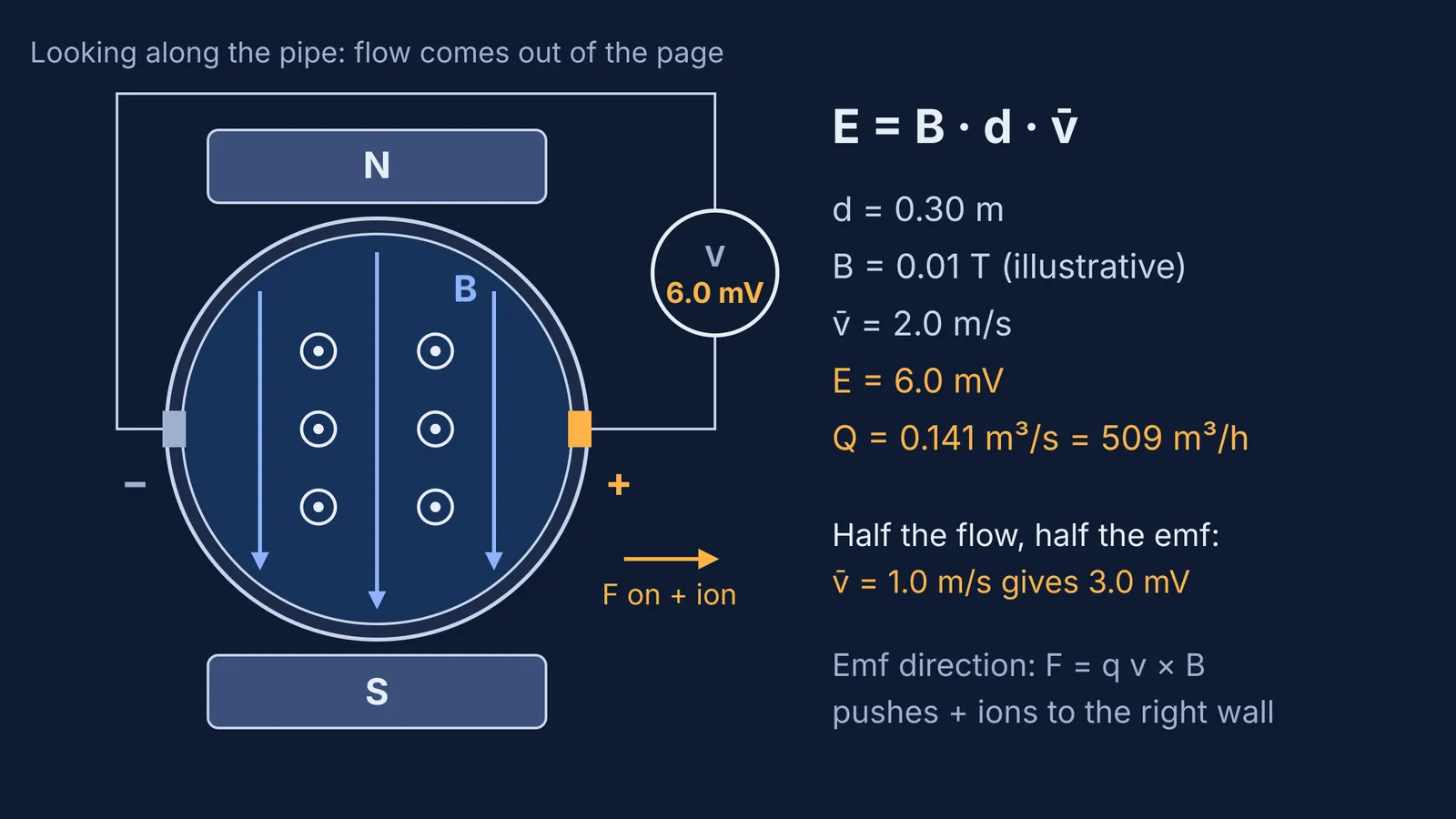
Think of the water as a stack of thin conducting rods, each one stretching from wall to wall across the pipe and moving along it.
Coils above and below the pipe set up a magnetic field B across it.
Tap water contains dissolved ions, so it conducts, weakly.
As the water moves with velocity v along the pipe, every ion feels a force F = q v × B, perpendicular to both the flow and the field.
Positive ions are pushed towards one wall and negative ions towards the other, until the electric field from the separated charge balances the magnetic push.
The two electrodes, placed on the walls along that direction, pick up the resulting emf.
The water is the rod, the pipe diameter d is the rod's length, and the flow speed is the rod's speed. You have seen the same formula worked for a metal conductor in the emf between an aeroplane's wing tips. The q v × B push on moving charges is also the one behind the voltage across a current-carrying strip in Edwin Hall's discovery of the Hall effect; here the charges are ions carried along by the water, not electrons drifting through a metal.
Why does the reading give the average speed, not the speed at the centre?
Water in a pipe does not all move at one speed. It is fastest at the centre and nearly still at the walls. So which v goes into E = Bdv?
For a uniform field and a velocity profile that is symmetric about the pipe's axis, the answer is exact: the emf equals B·d·v̄, where v̄ is the mean speed over the cross-section. Each part of the flow contributes with a different weight, and the weights work out so that the average speed is what you read. The condition is stated plainly in flowmeter patents such as US4434666: the voltage is proportional to the mean velocity provided the field is uniform and the profile is axisymmetric.
That gives a direct link to the volume flow rate Q. Since Q = (πd²/4) v̄:
E = B·d·v̄ = 4BQ / (πd)
So the emf is proportional to Q, and the meter can be calibrated in cubic metres per hour.
How much voltage does a water main produce?
Take a main of diameter d = 0.30 m, a field B = 0.01 T (an illustrative round value; real meters vary) and a mean speed v̄ = 2.0 m/s.
Step 1: the emf. E = B·d·v̄ = 0.01 × 0.30 × 2.0 = 6.0 × 10⁻³ V = 6.0 mV.
Step 2: the cross-section. A = πd²/4 = π × 0.09 / 4 = 0.0707 m².
Step 3: the flow rate. Q = A·v̄ = 0.0707 × 2.0 = 0.141 m³/s. Multiply by 3600 s/h to get 509 m³/h.
Step 4: check with the Q form. 4BQ/(πd) = 4 × 0.01 × 0.141 / (π × 0.30) = 6.0 mV. The two forms agree.
Step 5: units. T × m × m/s = (V s m⁻²) × m × m s⁻¹ = V. Good.
Now run it backwards. If the meter reads 4.5 mV, then v̄ = E/(Bd) = 4.5 × 10⁻³ / (0.01 × 0.30) = 1.5 m/s, and Q = 0.0707 × 1.5 = 0.106 m³/s, or 382 m³/h. Halve the flow and the emf halves: 1.0 m/s gives 3.0 mV. The reading is linear.
What can a magnetic flowmeter not measure?
The fluid must conduct. The ideal open-circuit emf does not depend on the conductivity at all, since it comes from B, d and v̄ only. But the electrodes must draw a tiny current to read that emf, and a very poor conductor has too high an internal resistance for the meter to read it. A practical guide by Azbil North America gives a typical minimum of about 3 µS/cm for four-wire meters and 10 µS/cm for two-wire ones. The same guide lists tap water, wastewater and seawater as measurable, and petrol, vegetable oils, distilled and deionised water as not.
Some other practical points from that guide:
There are no moving parts, so sewage and slurries do not jam the meter, and it causes essentially no pressure drop.
The pipe must run full; trapped air spoils the reading.
A bend or valve just upstream makes the flow lopsided and breaks the symmetry condition. The guide recommends about 3 to 5 pipe diameters of straight run upstream.
Real meters also do not use a steady field. A steady field would drive a small one-way current that slowly builds up charge layers on the electrodes, called polarisation. Meters reverse or pulse the field so that this does not accumulate, as described in patents such as US3965738A. The physics of the emf is the same; only the electronics that read it are cleverer.
Speed can be measured by induction in other ways too, as in how a vehicle speedometer measures speed.
Did Faraday try to measure the Thames this way?
He did. In January 1832, Faraday ran a long copper wire along Waterloo Bridge with metal plates dipped into the Thames on each side, hoping the river flowing through Earth's magnetic field would drive a current. He saw no clear effect, as described in a Physics Special Topics paper from the University of Leicester.
You can see why with an illustrative estimate. Take a river 250 m wide flowing at 1 m/s, and a vertical component of Earth's field of 40 µT. E = 40 × 10⁻⁶ × 250 × 1 = 0.010 V, or 10 mV. A modern meter would read that easily. Faraday put the small deflections he did see down to the metal plates and to differences in the river water, not to the flow.
The same idea, made small, was applied to blood flow by Alexander Kolin in 1936, as cited in this review chapter on electromagnetic flowmeters. With illustrative values of B = 0.05 T, a 2.5 cm vessel and 0.2 m/s, E = 0.05 × 0.025 × 0.2 = 0.25 mV.
If you want to practise more motional emf problems with liquids, rods and loops, the Fermi Problem Library has a step-by-step solver that explains the reasoning.
Quick checklist
Conducting liquid moving across B behaves like a moving rod: E = B·d·v̄.
For uniform B and an axisymmetric profile, v̄ is the mean speed, so E = 4BQ/(πd).
0.30 m main, 0.01 T, 2 m/s: 6.0 mV and 509 m³/h.
The liquid must conduct; oils and petrol cannot be measured.
Meters need full pipes, straight upstream runs and a reversing field.