

On this page
A vehicle speedometer measures speed by counting how fast the transmission or wheels rotate, and multiplying that by the tyre's circumference. By law under UNECE Regulation No. 39, a car's speedometer must never read less than its true speed, but may over-read by up to 10% plus 4 km/h (Wikipedia).
How does a mechanical speedometer use eddy currents?
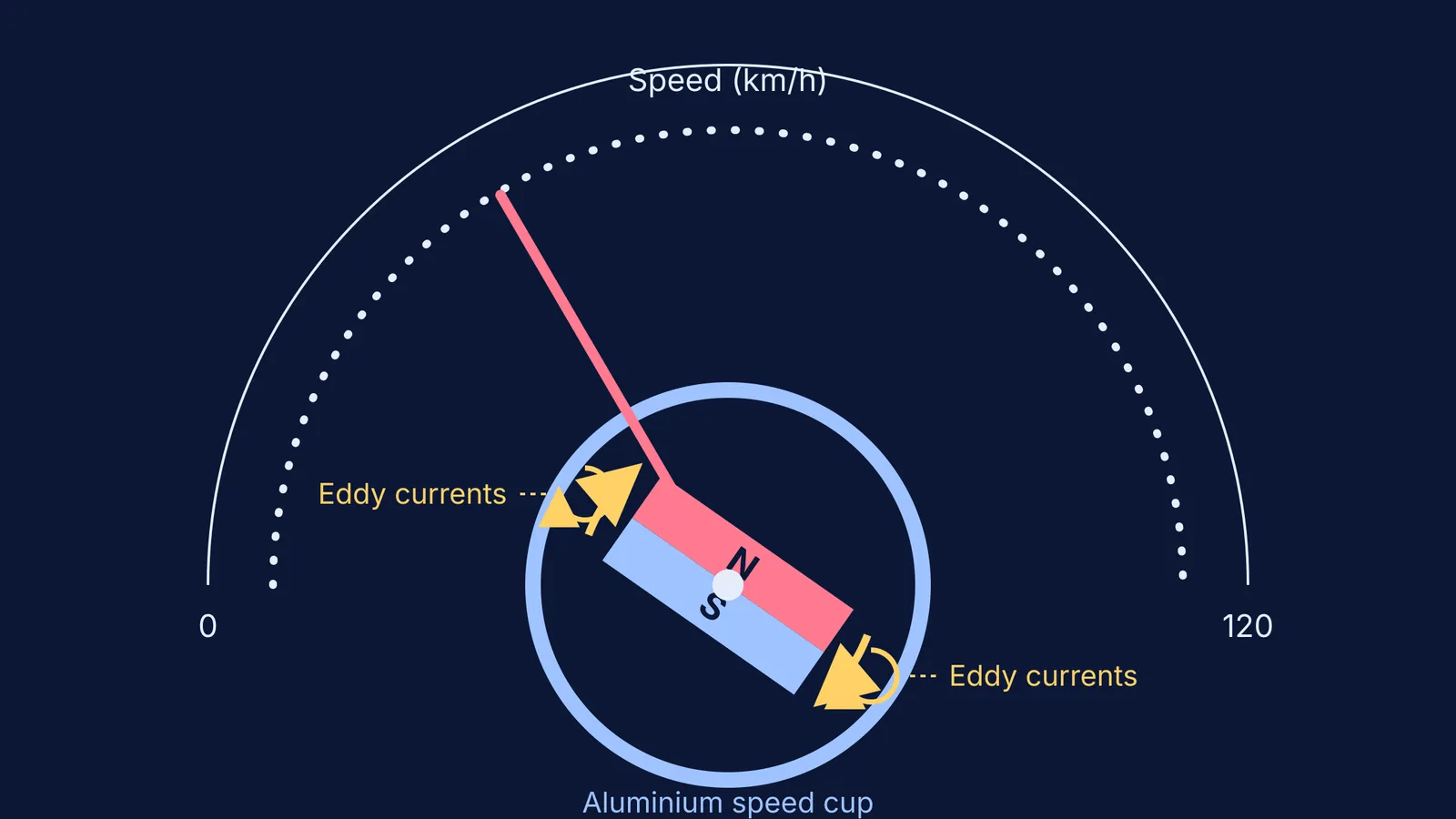
Before cars had engine control units, speedometers relied on a mechanical link. A flexible drive cable connects a gear on the transmission output shaft to the back of the dashboard dial. As the car moves, the transmission turns the cable, which spins a permanent magnet inside the speedometer.
This magnet sits inside a small, non-magnetic aluminium cylinder called the speed cup, but it does not touch the metal. As the magnet spins, it creates a rotating magnetic field. According to Faraday's law for a changing magnetic field, the changing magnetic flux induces small, circular electric currents within the aluminium, known as eddy currents (Explain That Stuff).
Because these eddy currents are moving charges, they create their own magnetic field like a spinning charged ring. This secondary field opposes the primary one, exerting a magnetic drag (a torque) on the cup that tries to pull it along in the same direction.
Picturing how invisible fields and currents interact in three dimensions is difficult from a textbook. This is where the Fermi Simulation Lab helps, offering interactive simulations for ideas that are easier to see than to read, such as electromagnetic induction.
How do electronic sensors and the Hall effect measure speed?
Modern vehicles replace the spinning cable with a solid-state electronic sensor, usually a Hall effect sensor mounted on the transmission or the wheel hub.
Instead of a continuous cable, the sensor faces a metal ring with teeth. Every time a tooth passes the sensor, the magnetic field shifts, and the sensor sends a digital electrical pulse to the car's computer. The computer counts the number of pulses per second to find the rotational speed of the wheels.
To convert this rotational frequency into a linear speed, the computer uses the tyre's circumference. For example, a tyre with a diameter of 60 cm has a circumference of about 1.88 metres (ResearchGate). If the wheels rotate 10 times a second, the car travels 18.8 metres every second, which translates to a speed of 67.7 km/h.
This calculation relies completely on the physical size of the tyres. If you fit larger tyres than the factory standard, your car travels further per rotation than the computer expects, making the speedometer under-read your true speed.
How accurate is a GPS speedometer?
While dashboard speedometers count wheel rotations, the speedometer apps on modern smartphones use the Global Positioning System (GPS) to calculate speed (Wikipedia). A GPS receiver does not know how fast your wheels are turning; instead, it communicates with multiple satellites to track your exact latitude and longitude.
By measuring the straight-line distance between two location pings and dividing it by the fraction of a second between them, the device calculates your true speed across the ground. Because this method is completely independent of tyre size, inflation, or wear, it is often more accurate than a car's built-in sensors when travelling at a steady speed on a clear highway.
However, GPS speed calculation has limits. It can lag during rapid acceleration or heavy braking because it relies on discrete location updates. It also loses accuracy if the signal drops out in tunnels, dense forests, or deep urban canyons.
Does tyre pressure affect your speedometer reading?
Because both mechanical and electronic speedometers measure rotations rather than true ground speed, any change to the physical diameter of the tyre alters the reading.
As a tyre's tread wears down over thousands of kilometres, its overall diameter shrinks slightly. A smaller tyre has a shorter circumference, meaning it must complete more rotations to cover the same distance along the road. Consequently, the sensor counts more pulses per kilometre, causing the speedometer to read slightly higher than your actual speed.
Under-inflated tyres produce a similar effect. When tyre pressure drops by even a few psi, the sidewall bulges and the effective rolling radius decreases (Explain That Stuff). The wheel centre sits closer to the ground, so the tyre covers less distance per revolution. The computer, unaware of the low pressure, applies the original factory circumference to its math, resulting in an artificially high speed reading.
Why does a vehicle speedometer always over-read?
You might have noticed that GPS speedometers on your phone often read slightly lower than the needle on your dashboard. This is an intentional design choice mandated by international safety standards.
Under the United Nations Economic Commission for Europe (UNECE) Regulation No. 39, a vehicle's indicated speed must never be less than its actual speed (Wikipedia). To ensure they never break this rule despite variations in tyre wear or pressure, manufacturers build in a positive error.
During type approval, the regulation allows a speedometer to over-read by up to 10% of the true speed, plus an extra 4 km/h (Wikipedia). This means if you are truly travelling at 100 km/h, your speedometer is legally allowed to display anywhere between 100 km/h and 114 km/h, but it can never show 99 km/h.


