On this page
A cool-mist humidifier makes a cloud without boiling anything. At the bottom of its water tank sits a small ceramic disc that vibrates more than a million times a second. The water above it heaps up into a little fountain and a fine, cold mist pours out. The size of each droplet is set by surface tension, density and frequency, and you can estimate it with dimensional analysis and one measured constant: about 3 µm for a typical disc.
How does an ultrasonic humidifier make mist?
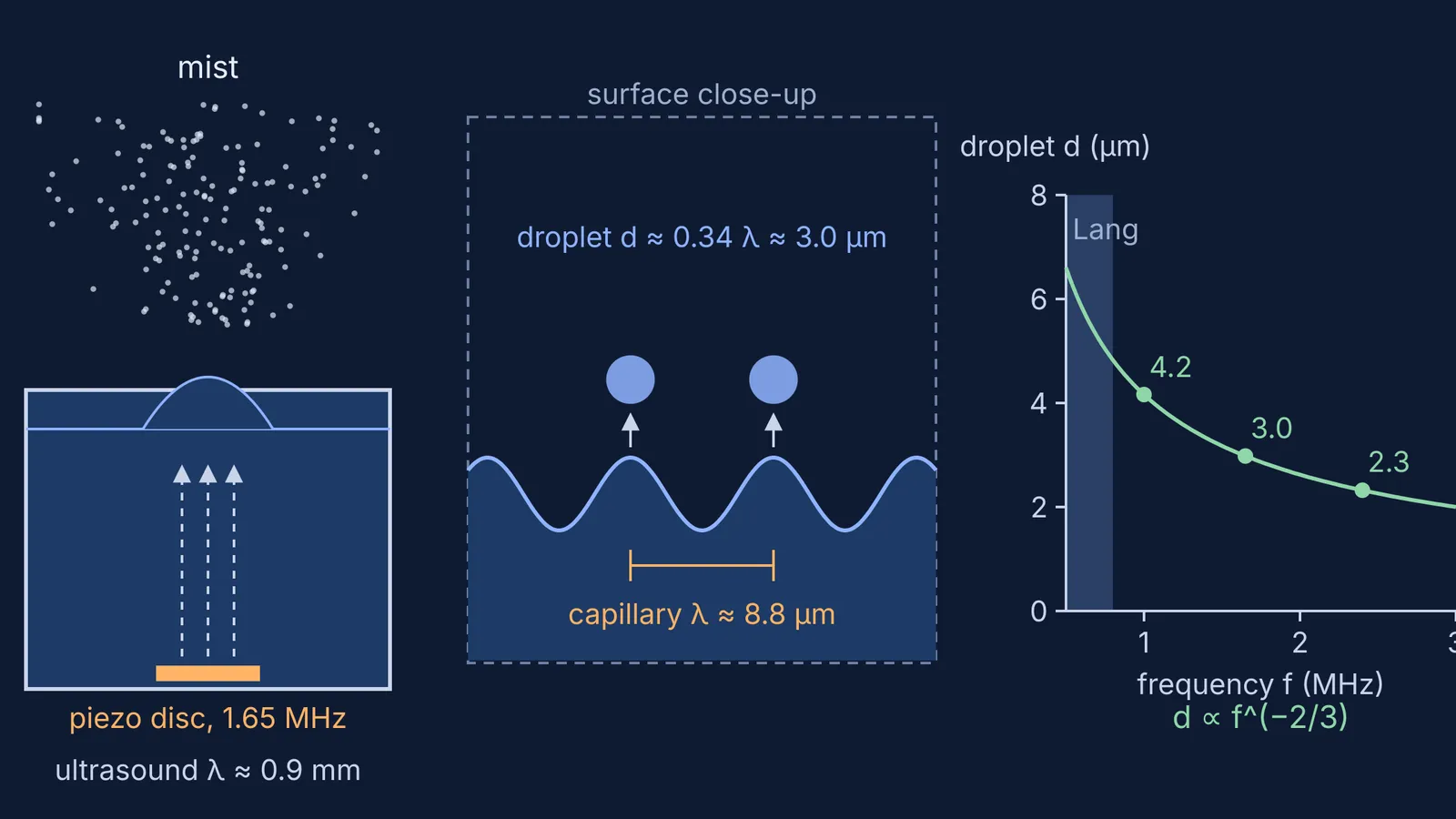
The disc is a piezoelectric transducer. An alternating voltage makes the ceramic expand and contract at its resonant frequency. One maker's atomiser disc, the M165D25-2 datasheet, lists a resonance of 1.65 MHz ± 0.05 MHz, an atomising rate of 400 cc per hour and a maximum input of 30 W. We will use those values.
The vibration sends ultrasound up through the water, which you can read about in general terms in the uses of infrasonic and ultrasonic sound. Where that sound reaches the surface, it shakes the surface so hard that tiny ripples called capillary waves form all over it. Their crests grow, pinch off and fly away as droplets. That is the mist.
Why are the droplets set by capillary waves, not the ultrasound wavelength?
This is the point most people get wrong. The speed of sound in water is about 1,480 m/s, so at 1.65 MHz the ultrasound wavelength is
λ_sound = v/f = 1,480 ÷ 1.65 × 10⁶ ≈ 0.90 mm.
That is about 300 times larger than a mist droplet. The droplets come from a different wave: the ripples on the surface. For ripples this small, the restoring force is surface tension, not gravity. Their wavelength depends on surface tension σ, density ρ and frequency, and it is about 100 times shorter than the sound wave.
In 1962 Robert Lang observed these crossed ripple patterns on vibrating liquids and measured the droplets. His paper, Ultrasonic atomization of liquids in the Journal of the Acoustical Society of America, found that the number-median droplet diameter was a constant fraction, 0.34, of the capillary wavelength.
How do you estimate the droplet size from σ, ρ and f?
Start with dimensional analysis, the JEE way. Suppose the capillary wavelength λ depends only on σ, ρ and f.
[σ] = M T⁻² (force per length)
[ρ] = M L⁻³
[f] = T⁻¹
Write λ = k σᵃ ρᵇ fᶜ. Matching powers: M gives a + b = 0, L gives 1 = −3b, and T gives 0 = −2a − c. So b = −1/3, a = 1/3 and c = −2/3. Hence
λ ∝ (σ / ρf²)^(1/3).
Dimensional analysis cannot give the number in front. The full theory (Kelvin's ripple relation, ω² = σk³/ρ) fills it in. The ripples oscillate at half the drive frequency, a point also made in a 2021 conference paper on ultrasonic sprays. Put ω = 2π(f/2) and k = 2π/λ, and you get
λ = (8πσ / ρf²)^(1/3), and Lang's droplet diameter d ≈ 0.34 λ.
Worked example: the droplet size at 1.65 MHz
Take water at about 20 °C: σ = 0.0728 N/m and ρ = 998 kg/m³.
Compute 8πσ. 8 × 3.1416 × 0.0728 = 1.83 N/m.
Compute ρf². 998 × (1.65 × 10⁶)² = 2.72 × 10¹⁵ kg m⁻³ s⁻².
Divide. 1.83 ÷ 2.72 × 10¹⁵ = 6.73 × 10⁻¹⁶ m³. Check the units: (N/m) ÷ (kg m⁻³ s⁻²) = (kg s⁻²) ÷ (kg m⁻³ s⁻²) = m³. Good.
Cube root. λ = (6.73 × 10⁻¹⁶)^(1/3) = 8.8 × 10⁻⁶ m = 8.8 µm.
Droplet diameter. d ≈ 0.34 × 8.8 µm ≈ 3.0 µm.
So a 1.65 MHz disc throws off droplets around 3 µm across, far too small to see one by one. That is why the mist looks like smoke.
Because d ∝ f^(−2/3), doubling the frequency shrinks the droplets by a factor of 2^(−2/3) ≈ 0.63. The same formula gives 4.2 µm at 1.0 MHz and 2.3 µm at 2.4 MHz.
Why does mist need so little energy compared with steam?
Making droplets only costs the energy of the new surface. One millilitre of water split into 3.0 µm drops gives about 7.2 × 10¹⁰ droplets. Their total area is 6V/d ≈ 2.0 m², so the surface energy is σA ≈ 0.0728 × 2.0 ≈ 0.15 J.
At 400 mL per hour, that is only about 0.016 W of surface energy. Almost none of the electrical input goes into the droplet surfaces; nearly all of it ends up as heat.
Now compare a steam humidifier delivering the same 400 mL per hour, starting from 25 °C water:
Heat to 100 °C: 0.4 kg × 4,186 J/(kg K) × 75 K = 0.126 MJ.
Boil it: 0.4 kg × 2.257 MJ/kg = 0.903 MJ.
Total about 1.03 MJ per hour, or about 286 W.
The datasheet's maximum input is 30 W, about a tenth of that. The latent heat is not avoided, though. It is paid later, when the droplets evaporate in the room. Evaporating 400 mL per hour at room temperature takes about 2.44 MJ/kg × 0.4 kg ÷ 3,600 s ≈ 270 W, drawn from the room air. So a cool-mist humidifier takes heat from the room as its mist evaporates, the same latent-heat effect described in how a clay pot matka keeps water cool.
Why does an ultrasonic humidifier leave white dust?
The droplets carry whatever is dissolved in the water. When a droplet evaporates, the minerals are left behind as a fine dust. The US Environmental Protection Agency's guide to the use and care of home humidifiers notes that ultrasonic and impeller humidifiers are very efficient at dispersing tap-water minerals into the air, and suggests using water with low mineral content. A steam humidifier leaves the minerals behind in the tank instead.
For waves and other ideas that are easier to see than read, the Fermi Simulation Lab has interactive simulations.
Quick checklist
A piezo disc vibrates at about 1.65 MHz and raises capillary ripples on the water surface.
Droplets come from the ripples, not from the 0.9 mm ultrasound wavelength.
Dimensional analysis gives λ ∝ (σ/ρf²)^(1/3); Kelvin's relation gives λ = (8πσ/ρf²)^(1/3).
Lang's rule: number-median droplet diameter ≈ 0.34λ, about 3 µm at 1.65 MHz.
d ∝ f^(−2/3): higher frequency, finer mist.
Surface energy of the mist is tiny; the latent heat is paid later by the room air.
Dissolved minerals come out as white dust.