On this page
Watch the Sun set over a flat sea on a very clear evening and you may see something odd. As the last sliver of red disappears, the very top of it turns green for about a second. This is the green flash. It is not a trick of tired eyes; it has been photographed. It comes from two ideas you already know from Class 10, refraction and scattering, working together near the horizon.
Safety first. Never look at the Sun while it is still above the horizon. Look only when it is right at the horizon and just a thin sliver is left. Never look at the Sun through binoculars, a telescope or a camera viewfinder, even at sunset: NASA's eye-safety guidance warns that viewing the Sun through such optics without a proper solar filter will instantly cause severe eye injury.
Why does air bend sunlight most near the horizon?
Light from the Sun enters the atmosphere from near-vacuum. The air gets denser as the light travels down, so its refractive index rises slowly, and the ray bends gradually towards the ground. Near the horizon the ray crosses the most air at the shallowest angle, so the bending is largest there.
The standard value used for sunrise and sunset tables is about 34 arcminutes of refraction at the horizon. The US Naval Observatory adds this to the Sun's 16 arcminute radius to define sunset (USNO sunrise and sunset definitions). That is slightly more than the Sun's whole width of about 32 arcminutes. So when you see the Sun's lower edge touch the sea, the geometric Sun is already just below the horizon. The two-minute early sunrise and the twinkling of stars are worked out in atmospheric refraction: why stars twinkle and planets don't. Here we need one extra detail that post leaves out: the bending depends on colour.
Why does the atmosphere act like a weak prism?
The refractive index of air, like that of glass, is a little larger for shorter wavelengths. This is dispersion, the same effect that splits white light in a glass prism, which you meet in the Class 10 chapter on the human eye and the colourful world. In air the effect is tiny, because n is so close to 1. But near the horizon the total bending is large, so even a small difference matters.
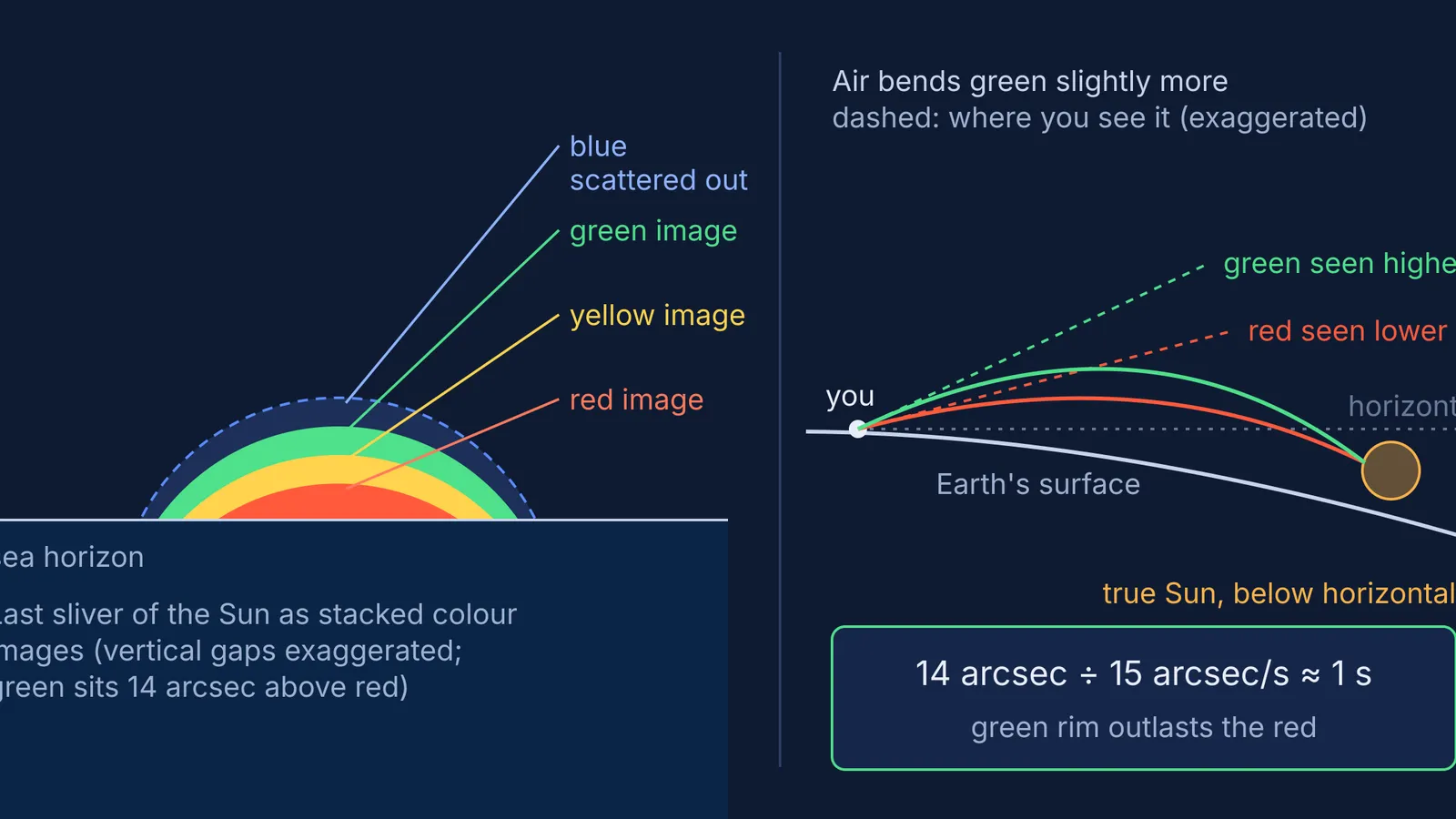
The result is that the setting Sun is really a stack of slightly shifted coloured images. Violet and blue are lifted the most, then green, then yellow, then red. Most of each disc overlaps and looks white or orange. Only at the top edge does the higher green and blue image stick out as a thin coloured rim (Andrew Young's green flash pages, San Diego State University).
Why is the flash green and not blue?
By the stack-of-images argument, the very last colour should be violet or blue. It usually is not, because the light from a setting Sun crosses a very long path through air. Rayleigh scattering removes short wavelengths most strongly, which is exactly why the setting Sun looks red; see why sunsets are red. Along that long path most of the blue and violet is scattered out of the beam. Green is the shortest colour that still gets through in useful amounts, so the top rim usually looks green. On exceptionally clean air, blue flashes have been recorded, but they are rarer.
How long does the green flash last? A worked example
Let us estimate how far the green image sits above the red one, and how long the green rim stays visible after the red has set. Assume standard air and the usual 34 arcminute horizon refraction.
Refractivity at two colours. Edlén's formula for the refractive index of standard dry air (15 °C, 1 atm) gives (n − 1) = 278.24 × 10⁻⁶ at 530 nm (green) and 276.31 × 10⁻⁶ at 650 nm (red). The NIST refractive index of air documentation describes this formula and its updates.
Relative difference. (278.24 − 276.31) ÷ 276.31 = 0.0070, so green is bent about 0.70% more than red.
Extra lift of the green image. The total refraction is 34 arcminutes = 34 × 60 = 2,040 arcseconds. The green image sits 0.0070 × 2,040 ≈ 14.2 arcseconds above the red one.
How fast the Sun sinks. The sky turns 360° in 24 hours, which is 15 arcseconds per second of time. Near the equinoxes, the Sun's vertical speed at the horizon is 15 × cos(latitude) arcseconds per second. At the equator that is 15 arcsec/s.
Time for the green rim. Time = 14.2 ÷ 15 ≈ 0.95 s at the equator. At latitude 20° (most of India), 15 × cos 20° = 14.1 arcsec/s, so the time is about 1.0 s. At 50°, 15 × cos 50° = 9.6 arcsec/s, giving about 1.5 s.
Check the units: arcseconds divided by arcseconds per second gives seconds. The answer, about one second, matches what observers report: a flash lasting "a second or two" (UNSW Physclips on mirages and the green flash). Since 34 arcminutes is only a typical value and real refraction changes with temperature and pressure, treat these times as estimates.
Why do most people never see it?
A 14 arcsecond rim is far too thin for the eye to pick out on its own. Even a sharp eye resolves only about 60 arcseconds. So an ordinary sunset rarely shows a flash. Observers who see it regularly almost always have extra help:
A clear, distant horizon. A sea horizon is ideal. Hills, buildings and haze near the horizon hide the last moments.
Very clear air, so that enough green survives the long path.
A mirage. Layers of warm and cool air near the surface bend light unevenly and can magnify the thin rim into a visible green segment. Andrew Young's work shows that almost every kind of green flash comes with a mirage of some kind.
So the flash depends on the weather in the lowest part of the atmosphere, not only on the simple dispersion estimate above. If you want to see how refraction and dispersion separate colours before you go looking, the Fermi Simulation Lab has interactive simulations for ideas that are easier to see than read.
What mistakes cost marks on this topic?
Saying the green flash is an after-image in the eye. Photographs and video record it, so it is in the light itself.
Using scattering alone. Scattering removes blue; only refraction with dispersion lifts the green image above the red.
Saying air refracts red more. As in glass, shorter wavelengths have the larger refractive index.
Forgetting that the timing depends on latitude: the Sun sets more steeply near the equator, so the flash is shorter there.
Quick checklist
Horizon refraction is about 34 arcminutes, slightly more than the Sun's width.
Air has slightly higher n for green than red, so the green image sits about 14 arcseconds higher.
Rayleigh scattering removes most blue and violet, so the last rim is usually green.
Time ≈ 14.2 ÷ (15 cos latitude) s: about 1 s in India.
A clear sea horizon and a mirage layer make the flash visible.
Look only when the Sun is a thin sliver at the horizon, and never through binoculars or a telescope.