On this page
Take a tank of water, a T-shaped pipe, two metal rings and two metal cans. Let two streams of drops fall through the rings into the cans, and in under a minute a spark can jump between the cans. Nothing is rubbed, there is no battery, and nobody turns a handle. This is Kelvin's water dropper, described by William Thomson (later Lord Kelvin) in a paper to the Royal Society in 1867 (Thomson, Proc. R. Soc. Lond. 16, 67–72). It is a neat lesson in induction, feedback and energy conservation.
How does Kelvin's water dropper work?
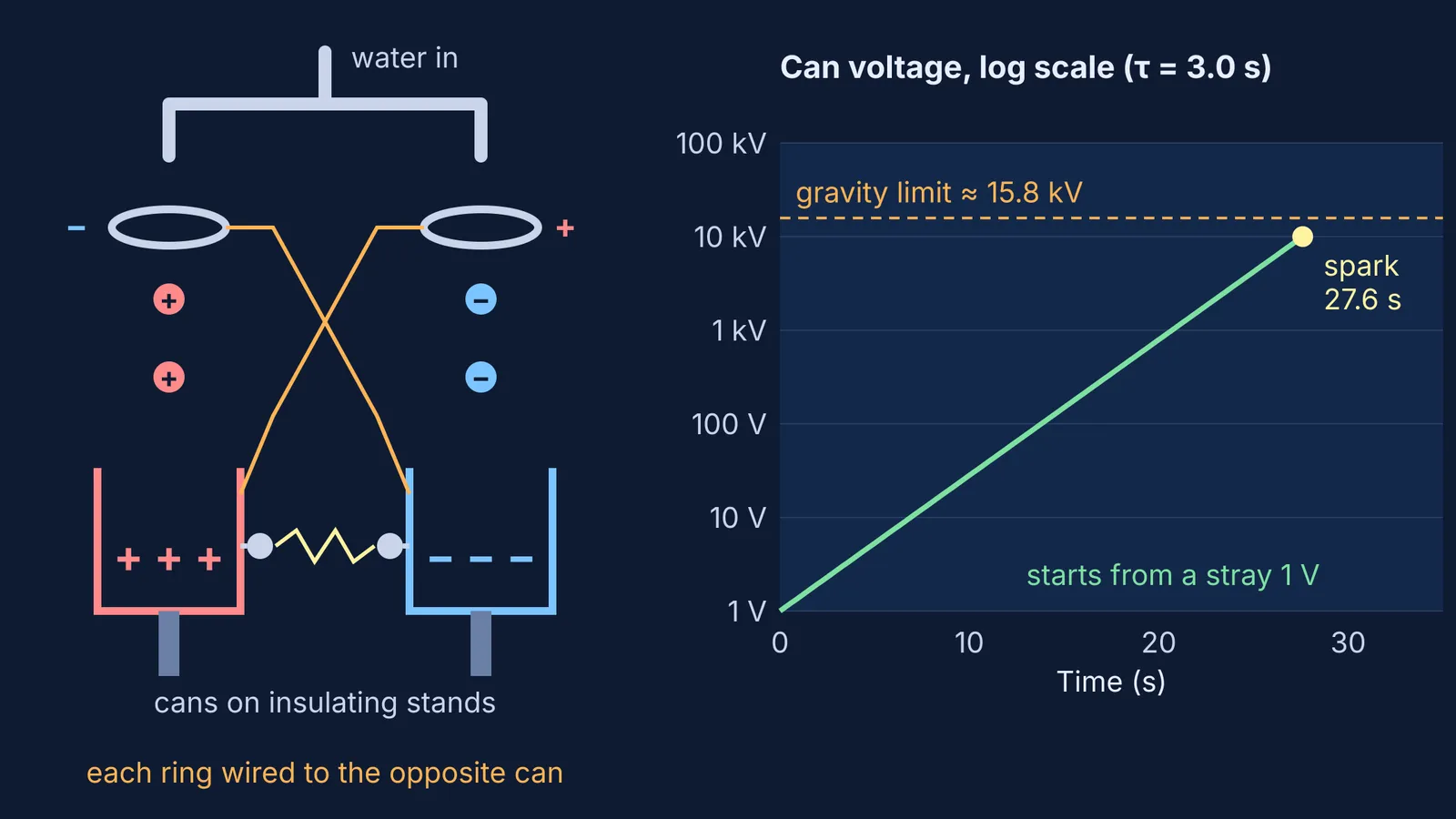
The two streams come from the same water supply, so the water in both nozzles is connected. Each stream breaks into drops inside a metal ring and then falls into a metal can below. The cans stand on insulators. The key is the wiring: the left ring is connected to the right can, and the right ring is connected to the left can.
Follow one cycle.
By chance, the left ring is very slightly negative, say by 1 V. The cans are never exactly equal, so some small imbalance is always there.
A drop forming inside the negative left ring is still joined to the water column. Negative charge on the ring repels electrons up the stream, so the drop is left slightly positive when it breaks off. This is charging by induction, the same process you use to charge a sphere with a nearby rod.
The positive drop falls into the left can. The left can becomes more positive.
The left can is wired to the right ring, so the right ring becomes positive too. Drops forming inside it are induced negative and fall into the right can.
The right can becomes more negative. It is wired to the left ring, which becomes more negative, which makes the left drops more positive.
Each can's charge pushes up the other's. That is positive feedback, and it makes the voltage grow exponentially. The sign of the first imbalance is random, so the left can is positive on one run and negative on the next.
The Van de Graaff generator also carries charge mechanically onto a conductor, but it has a fixed charging source and no feedback loop. The Wimshurst machine is the closest cousin: another influence machine that multiplies a small seed charge, using rotating discs instead of falling drops.
How much charge does one drop carry?
A drop that leaves the nozzle while its ring is at potential difference V from the water picks up a charge set by its capacitance. A rough model treats the drop as an isolated sphere of radius r, with capacitance 4πε₀r, as in the 27 merging drops problem. Then:
q ≈ 4πε₀rV
The real factor depends on the shape and spacing of the ring and nozzle, so treat every number below as an estimate.
For a drop of radius 1.5 mm:
C_drop = 4π × 8.854 × 10⁻¹² × 1.5 × 10⁻³ = 1.67 × 10⁻¹³ F = 0.167 pF
mass = 1,000 × (4/3)π(1.5 × 10⁻³)³ = 1.41 × 10⁻⁵ kg = 14.1 mg
How fast does the voltage grow?
Worked example. Each can has capacitance C = 10 pF (an illustrative value for a small can and its wiring). Each stream delivers n = 20 drops a second. The cans start 1 V apart by chance. How long until the voltage reaches 10 kV?
Charge per second into one can. Each drop brings q = C_drop V, so the current is I = n C_drop V.
Rate of change of the can's voltage. C dV/dt = n C_drop V, so dV/dt = V/τ with τ = C/(n C_drop).
Time constant. τ = (10 × 10⁻¹²)/(20 × 1.67 × 10⁻¹³) = 3.0 s.
Solve. V = V₀ e^(t/τ). The voltage grows by a factor of e every 3.0 s, and by 10 times every 3.0 × ln 10 = 6.9 s.
Time to 10 kV. t = τ ln(10,000/1) = 3.0 × 9.21 = 27.6 s.
Energy stored. U = ½CV² = ½ × 10 × 10⁻¹² × (10⁴)² = 5.0 × 10⁻⁴ J, or 0.50 mJ.
Spark length. Air breaks down at roughly 3 × 10⁶ V/m (the exact value depends on the gap shape and humidity). So 10 kV can jump about 10⁴/(3 × 10⁶) = 3.3 mm.
Units in step 3: F ÷ (s⁻¹ × F) = s. Check the current at 10 kV: 20 × 1.67 × 10⁻¹³ × 10⁴ = 3.3 × 10⁻⁸ A, about 33 nA.
Where does the energy come from?
Not from nowhere. A positive drop falling into a positive can is repelled. To get in, it has to do work against the can's field, roughly qV for a drop of charge q entering a can at potential V. That work comes from the drop's fall through height h, which supplies mgh.
For h = 0.30 m:
mgh = 1.41 × 10⁻⁵ × 9.8 × 0.30 = 4.2 × 10⁻⁵ J per drop
At 10 kV, qV = C_drop V² = 1.67 × 10⁻¹³ × 10⁸ = 1.7 × 10⁻⁵ J, so the drop still gets in.
The drop's charge also grows with V, so qV = C_drop V² rises as V². The drops stop entering when C_drop V² = mgh:
V_max = √(mgh / 4πε₀r) = √(4.2 × 10⁻⁵ / 1.67 × 10⁻¹³) ≈ 15.8 kV
Above this, drops are pushed back or sprayed sideways. Leakage across damp surfaces and into humid air usually stops the rise even earlier. So the electrical energy in the cans is gravitational potential energy of the falling water.
Is a water dropper safe to build at school?
A small dropper is a classic classroom demonstration, but 10 kV deserves respect.
Do not touch the cans or wires while it runs. The 0.5 mJ spark is a sharp sting, and a reflex jerk near glassware or a stand can hurt you more than the shock.
Discharge before touching. Short the cans together and to earth with a wire on an insulated handle after every run.
Keep it small. Do not add extra capacitors, Leyden jars or bigger cans to get a bigger spark. Stored energy rises with capacitance, and a larger store can give a dangerous shock.
Keep sparks away from phones, laptops and other electronics, and from anything flammable.
Anyone with a pacemaker or other implanted device should not handle it.
Work under a teacher's supervision, and never connect any part of it to mains power.
Want to see the feedback loop build up step by step? The Simulation Lab has interactive simulations for ideas that are easier to see than read.
Quick checklist
Kelvin's dropper charges by induction, not friction.
Each ring is wired to the opposite can, so the imbalance feeds itself.
dV/dt = V/τ with τ = C/(n·4πε₀r): about 3.0 s for 10 pF cans and 20 drops a second.
From 1 V to 10 kV takes τ ln 10⁴ ≈ 27.6 s.
10 kV on 10 pF stores 0.50 mJ and jumps about 3 mm of air.
The energy comes from gravity; V cannot pass √(mgh/4πε₀r) ≈ 15.8 kV here.
Discharge before touching, and never scale it up.