On this page
Watch a modern wind farm and the blades seem to turn lazily, one slow sweep every few seconds. The bigger the turbine, the slower it looks. That is not because big rotors are weak. It is because the tip of a long blade moves very fast even at low rpm, and designers have to keep that tip speed under a limit. Two formulas from circular motion, v = ωR and a = v²/R, explain the whole pattern.
Why do bigger wind turbines spin more slowly?
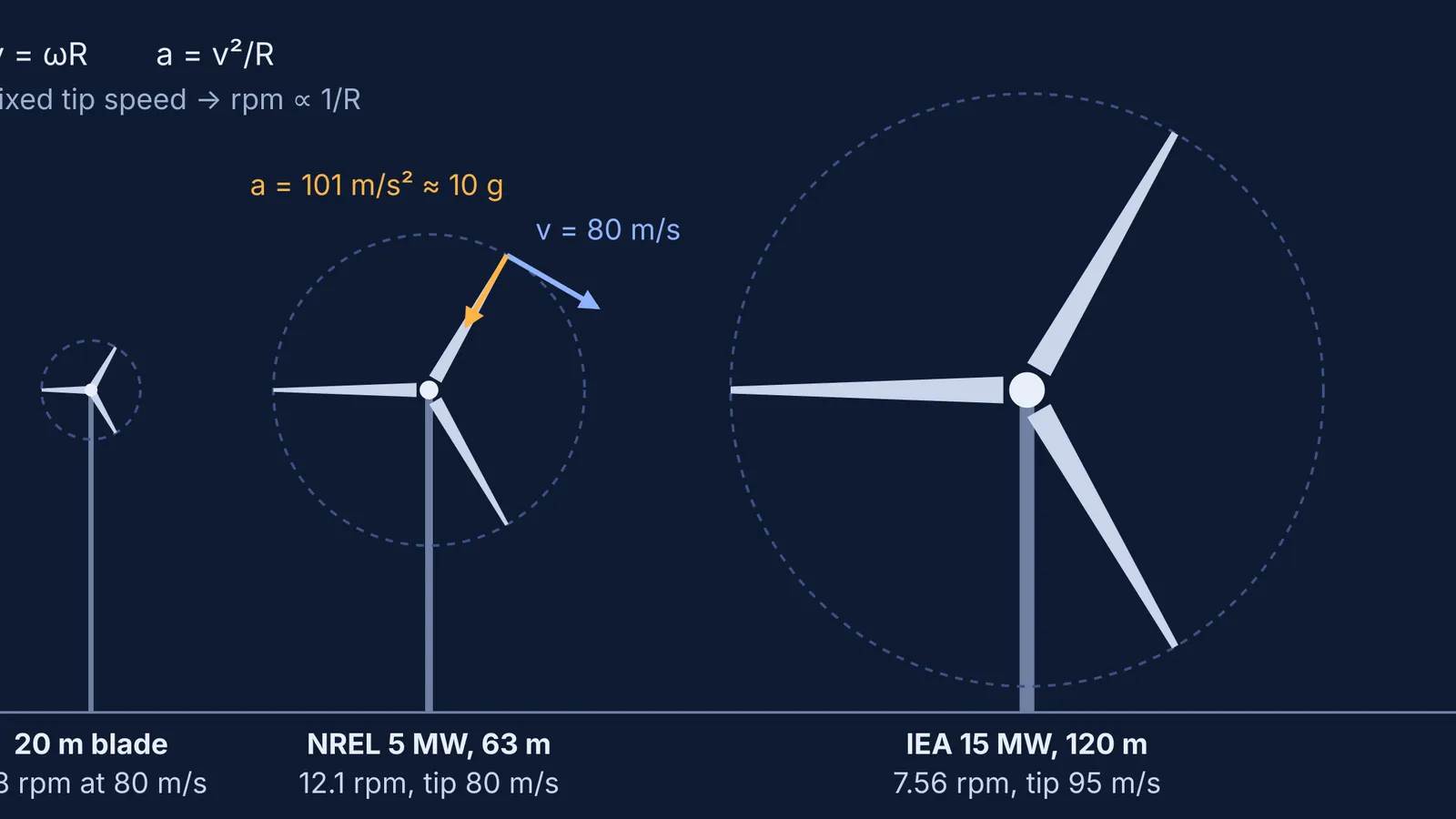
Every point on a rotating blade has the same angular speed ω, but its linear speed is v = ωR, where R is its distance from the hub. The tip has the largest R, so it moves fastest. If you keep the rpm fixed and make the blade longer, the tip speed rises in proportion.
Wind turbine designers do the opposite. They fix a maximum tip speed and then choose the rpm to match. Rearranging v = ωR gives ω = v/R, so at a fixed tip speed, the rpm falls as 1/R. Double the blade length and the rotor must turn at half the rpm.
Taking 80 m/s as an illustrative tip limit:
a 20 m blade turns at 38.2 rpm;
a 40 m blade turns at 19.1 rpm;
a 63 m blade turns at 12.1 rpm;
a 120 m blade turns at 6.4 rpm.
The rpm range of real turbines and the gearbox that steps the shaft speed up for the generator are covered in how wind turbines make electricity from moving air. Here we look at why the rpm has to be that low.
How fast does the tip of a wind turbine blade move?
Take a real design. NREL's widely used 5-MW reference wind turbine has a 126 m rotor and a rated rotor speed of 12.1 rpm, and its specification lists a rated tip speed of 80 m/s. Check that with circular motion:
Radius. R = 126 ÷ 2 = 63 m.
Angular speed. ω = 2π × 12.1 ÷ 60 = 1.267 rad/s.
Tip speed. v = ωR = 1.267 × 63 = 79.8 m/s, which rounds to the listed 80 m/s. That is about 287 km/h.
Period. T = 60 ÷ 12.1 = 4.96 s per revolution.
Centripetal acceleration. a = v²/R = 79.8² ÷ 63 = 101 m/s², or about 10.3 g.
Force per kilogram. Each kilogram of blade at the tip needs an inward pull of 101 N from the blade itself, about ten times its weight.
Units. ω in rad/s times R in m gives m/s; (m/s)² ÷ m gives m/s². Good.
So a rotor that looks slow from the ground has tips moving at nearly 300 km/h. At 12 rpm a blade takes 5 s to go round, but its tip covers 2π × 63 ≈ 396 m in that time.
What limits the tip speed of a wind turbine?
The limit is not mainly about the blade flying apart. The main reasons are:
Noise. Faster tips are louder. The NREL 5-MW report describes how the control system holds back the rotor speed near rated power "to limit tip speed (and hence noise emissions)". This matters most on land, where homes may be nearby.
Rain erosion. A blade tip at 80 to 95 m/s slams into raindrops, dust and sand. Sandia National Laboratories lists rain drop impacts and rain-induced fatigue among the causes of erosion of the blade's front edge, with impact velocity set by the tip speed. Sandia also notes that a heavily eroded blade can cut a utility-scale turbine's annual energy output by up to 5%.
Offshore, noise matters less, so designers allow faster tips. The IEA 15-MW offshore reference turbine has a 240 m rotor, a maximum tip speed of 95 m/s and a maximum rotor speed of 7.56 rpm. Check: ω = 95 ÷ 120 = 0.792 rad/s, which is 7.56 rpm. One turn takes 7.9 s.
Stress does still set an upper bound, as it does for any spinning ring. That idea, worked for a grinding disc, is in why a grinder disc says 80 m/s.
What is the tip-speed ratio, and why does it matter?
The tip-speed ratio compares the tip speed with the wind speed: λ = ωR/U, where U is the wind speed far upstream. It is a pure number. A rotor extracts the most power at one particular λ, set by the shape and angle of its blades.
For modern three-blade rotors that optimum is high. The NREL 5-MW turbine reaches its peak power coefficient at λ = 7.55, and the IEA 15-MW turbine is designed for λ = 9.0. Compare la Cour's 1890s sails, which ran near a tip-speed ratio of 2.4, described in Poul la Cour's wind turbine tests.
This gives a second reason big rotors turn slowly, separate from the tip limit. Below rated power, the controller holds λ near its optimum, so ω = λU/R. For the same wind, a longer blade means a lower ω. In an 8 m/s wind:
the 5-MW rotor at λ = 7.55: ω = 7.55 × 8 ÷ 63 = 0.959 rad/s, or 9.2 rpm;
the 15-MW rotor at λ = 9.0: ω = 9.0 × 8 ÷ 120 = 0.600 rad/s, or 5.7 rpm.
The two ideas meet at rated wind speed. With λ fixed, the tip speed is λU, so it rises with the wind until it hits the limit. For the IEA 15-MW turbine, 95 m/s ÷ 9.0 = 10.6 m/s, which matches the rated wind speed of 10.59 m/s given in its report. Above that, the blades pitch to hold the rpm at its maximum.
How big is the centripetal acceleration at the blade tip?
Large, but here is a result that surprises many students. At a fixed tip speed, a = v²/R, so a longer blade has a smaller tip acceleration. At the same 80 m/s:
a 20 m blade: a = 80² ÷ 20 = 320 m/s², about 33 g;
a 63 m blade: a = 80² ÷ 63 = 102 m/s², about 10 g;
a 120 m blade: a = 80² ÷ 120 = 53 m/s², about 5.4 g.
At its own 95 m/s, the IEA 15-MW tip pulls 75 m/s², about 7.7 g. This is the acceleration per kilogram at the tip, not the total force at the blade root, which depends on how the blade's mass is spread along its length.
If circular motion formulas still feel shaky, the Concept Library covers angular speed, tangential speed and centripetal acceleration with worked examples.
Quick checklist
v = ωR: the tip moves fastest, and v grows with blade length at fixed rpm.
Designers cap the tip speed (about 80 m/s on the NREL 5-MW turbine, 95 m/s on the offshore IEA 15-MW), so rpm ∝ 1/R.
The cap comes mainly from noise and rain erosion, not only from stress.
Tip-speed ratio λ = ωR/U; modern rotors are most efficient near 7.5 to 9.
Holding λ fixed also forces ω = λU/R to fall as R grows.
At a fixed tip speed, tip acceleration v²/R falls as the blade gets longer.
Always convert rpm to rad/s and use the radius, not the diameter.