On this page
Connect a long undersea power cable to a 400 kV AC grid, leave the far end open, and a large current still flows into it. The cable is simply charging and discharging itself 50 times a second, because a cable is a long capacitor. Over about 100 km this charging current fills the cable's whole current rating, and no room is left for useful power. That is the main reason long undersea links use direct current (DC).
Why does a power cable behave like a capacitor?
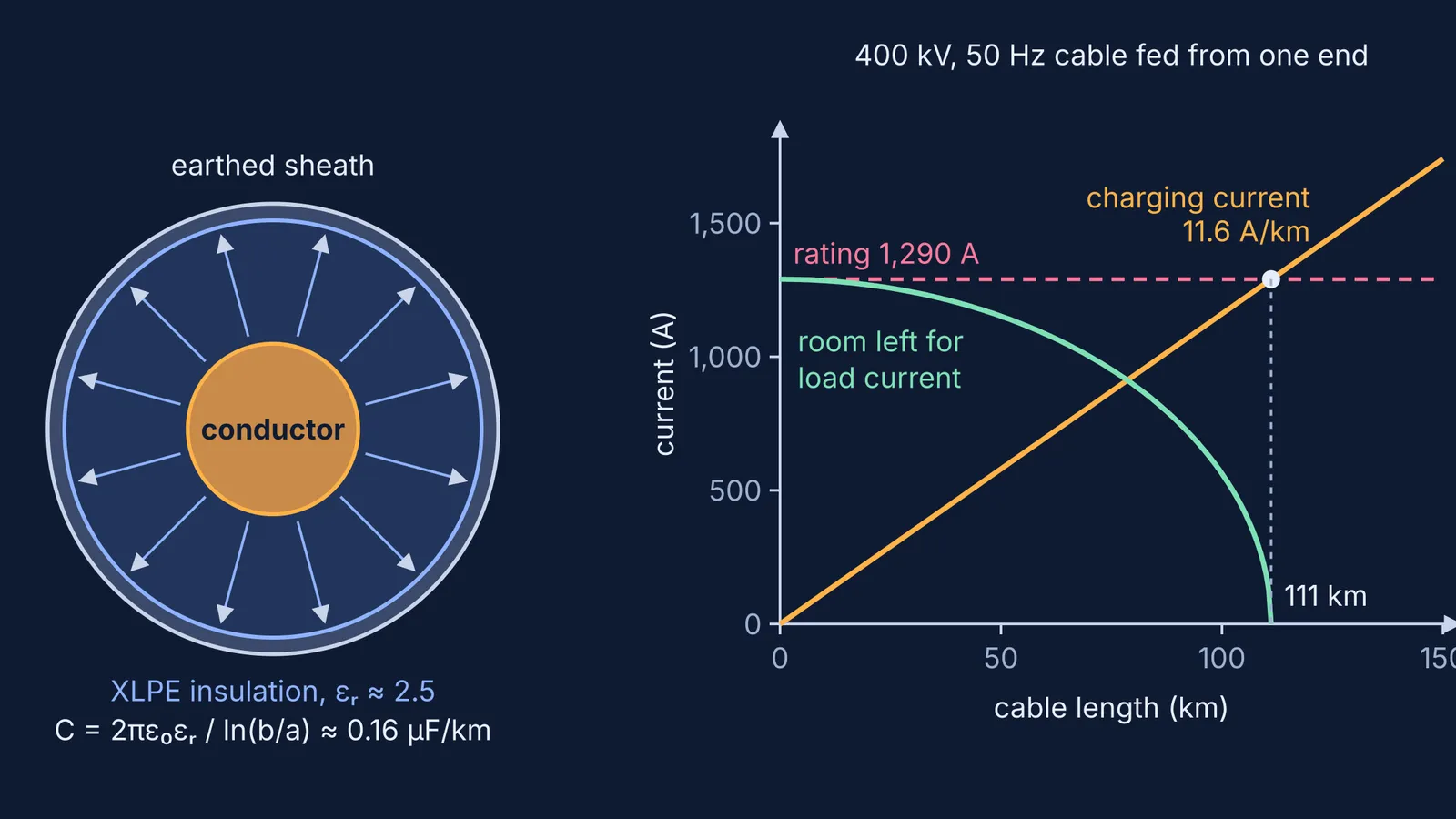
A high-voltage cable has a copper or aluminium conductor in the middle, a thick layer of insulation (usually cross-linked polyethylene, XLPE) around it, and an earthed metal sheath outside. Two conductors separated by an insulator: that is a cylindrical capacitor. Its capacitance per unit length is:
C = 2πε₀εᵣ / ln(b/a)
where a is the radius of the inner conductor, b is the radius over the insulation, and εᵣ is the relative permittivity of the insulation.
Check it against real data. ABB's cable guide lists a 400 kV submarine cable with a 1,000 mm² copper conductor, insulation 29 mm thick, a diameter over the insulation of 100.3 mm and a capacitance of 0.16 µF/km. XLPE has εᵣ ≈ 2.5 (values of 2.3 to 2.5 are quoted). Take b = 50.15 mm and a ≈ 20.5 mm (the conductor plus its thin semiconducting screen; an approximate value). Then C = 2π × 8.854 × 10⁻¹² × 2.5 / ln(50.15/20.5) = 0.155 µF/km. The simple formula lands within a few per cent.
The insulation is thin compared with the spacing of overhead wires, and its εᵣ is above 1, so a cable has far more capacitance per kilometre than an overhead line. Lord Kelvin met the same capacitance in the first Atlantic cable, where it smeared out telegraph pulses; see the physics of the Atlantic telegraph cable.
What is charging current in an AC cable?
On AC, a capacitor charges and discharges every cycle, so current flows even when no load is connected. For a capacitor on an AC voltage of rms value V, the rms current is:
I = ωCV, with ω = 2πf
This current leads the voltage by 90°. It is reactive, or wattless: over a cycle it delivers no net energy. The same idea is used in why a choke coil is used in AC circuits, there for an inductor. Wattless does not mean harmless. The charging current still flows through the conductor and heats it by I²R, and it takes up the cable's current rating.
How much charging current does a 400 kV cable draw?
Use the ABB cable above: C = 0.16 µF/km on a 50 Hz, 400 kV three-phase system.
Use the phase-to-earth voltage. Each conductor sees the voltage between itself and its earthed sheath, not the 400 kV line voltage. So V = 400/√3 = 230.9 kV.
Angular frequency. ω = 2π × 50 = 314.2 rad/s.
Charging current per km. I = ωCV = 314.2 × 0.16 × 10⁻⁶ × 230,940 = 11.6 A per km. ABB's table lists 11.7 A/km, the small difference coming from rounding of C.
Over 100 km. I = 100 × 11.6 = 1,161 A, at the sending end, with nothing connected at the far end.
Compare with the rating. ABB gives this cable a continuous rating of about 1,290 A when the three cables are laid far apart on the seabed, and less when they are close together.
Critical length. The charging current alone reaches 1,290 A after 1,290/11.6 = 111 km. Beyond that, fed from one end and without compensation, the cable cannot carry any real power at all.
Room left at 100 km. Real (load) current and charging current are 90° apart, so they add as phasors: I_rated² = I_load² + I_charge². The room left is √(1,290² − 1,161²) = 563 A. The cable could carry about √3 × 400 kV × 1,290 A = 894 MW on its own, but after 100 km only about 390 MW.
Reactive power. Q = 3 × V × I = 3 × 230.9 kV × 11.6 A = 8.04 MVAr per km, so 804 MVAr for 100 km. You get the same answer from Q = ωCV_L² with the line voltage.
Feeding the cable from both ends halves the charging current each end must supply, which roughly doubles the critical length to about 222 km. Real projects also add shunt reactors to cancel the charging current, which is why all these figures say "without compensation".
Why can overhead AC lines run so much farther?
An overhead conductor sits metres from its neighbours and from the earth, in air. For a single-phase-equivalent line, C ≈ 2πε₀ / ln(D/r). With round illustrative values, an equivalent spacing D = 12 m and an equivalent bundle radius r = 0.15 m, C = 2π × 8.854 × 10⁻¹² / ln(80) = 12.7 nF/km, or 0.0127 µF/km.
That is about 12.6 times less than the cable. The charging current is only 0.92 A/km, so on this measure alone an overhead line could run over 1,000 km. Other limits, such as voltage drop and stability, step in long before that, which is why very long overhead links are also often built for DC. The ±800 kV Raigarh–Pugalur link carries 6,000 MW over about 1,800 km, which is 6,000 MW/(2 × 800 kV) = 3,750 A per pole. Why high voltage cuts losses in the first place is worked out in why electricity is transmitted at high voltage.
Why does DC solve the cable problem?
On DC the voltage does not change, so I = C dV/dt = 0 once the cable is charged. The cable charges once when it is switched on and then draws no charging current however long it is. The whole current rating is free for real power.
There is a second, smaller advantage. On AC the insulation must withstand the peak voltage, √2 times the rms value: 230.9 × 1.414 = 326.6 kV for a 400 kV system. Power is set by the rms value, so the insulation is fully stressed only at the peaks. A DC cable can run near its working voltage all the time (a simplified picture, since insulation behaves differently under DC).
The cost is at the ends. An HVDC link needs a converter station at each end to turn AC into DC and back, and these are expensive. So DC wins only when the link is long or under the sea, where AC cables run out of capacity.
If phasor addition of currents at 90° is where you get stuck, the Fermi Problem Library has AC circuit problems with a step-by-step solver that explains the reasoning.
Quick checklist
A cable is a cylindrical capacitor: C = 2πε₀εᵣ/ln(b/a), about 0.16 µF/km for a 400 kV cable.
Charging current I = ωCV with the phase-to-earth voltage: 11.6 A/km at 400 kV and 50 Hz.
It is reactive and adds to load current at 90°, but it still heats the cable.
Uncompensated, fed from one end, this cable's 1,290 A rating is used up after about 111 km.
An overhead line has roughly a twelfth of the capacitance, so AC overhead lines run much farther.
On DC, dV/dt = 0, so no charging current flows after switch-on.