On this page
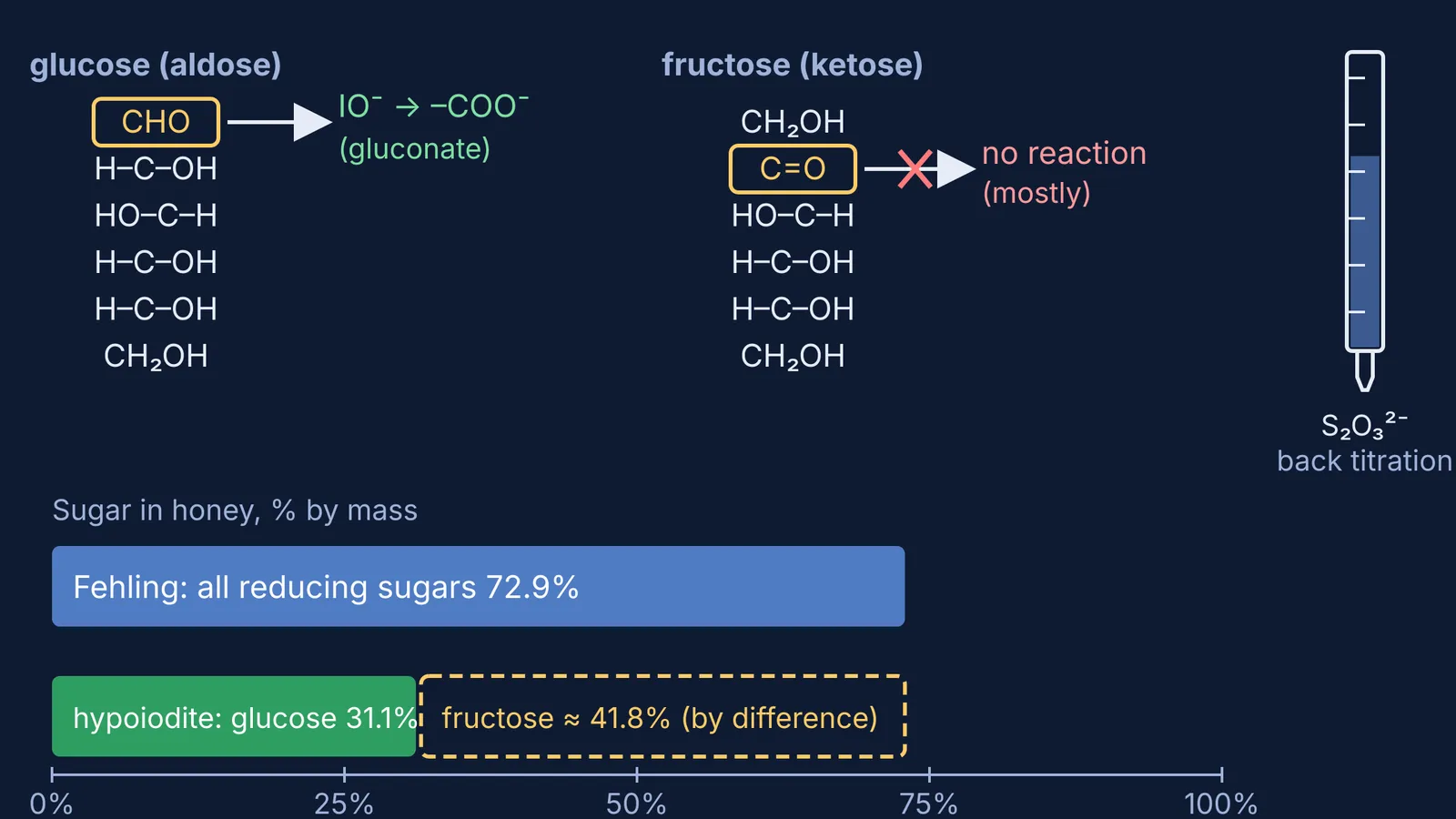
NCERT shows that glucose is an aldose with one simple test: bromine water oxidises it to gluconic acid, while fructose, a ketose, is left alone. That is a yes-or-no result. In 1918 Richard Willstätter and his co-worker Schudel turned the same selectivity into a number. They oxidised glucose with iodine in alkali and measured how much iodine was used up. The method counts aldoses and largely ignores fructose, which is exactly what a Fehling titration cannot do. Here is the chemistry, the mole ratio, and a full calculation for honey.
Why can Fehling's titration not tell glucose from fructose?
Fehling's solution is hot and strongly alkaline. Under those conditions fructose isomerises and reduces Cu²⁺ just as glucose does, so the Lane–Eynon Fehling titration of honey gives total reducing sugar, glucose and fructose together. That post ends on an open question: food standards ask for the fructose to glucose ratio of honey, and copper alone cannot give it. You need a second method that sees only one of the two sugars. Hypoiodite is one such method.
How does iodine in alkali oxidise glucose?
When iodine meets hydroxide, it disproportionates into iodide and hypoiodite. These are the same conditions as the iodoform test:
I₂ + 2OH⁻ → IO⁻ + I⁻ + H₂O
Hypoiodite then oxidises the aldehyde group to a carboxylate:
RCHO + IO⁻ + OH⁻ → RCOO⁻ + I⁻ + H₂O
Add the two and the hypoiodite cancels. For glucose the overall equation is:
C₆H₁₂O₆ + I₂ + 3OH⁻ → C₆H₁₁O₇⁻ + 2I⁻ + 2H₂O
Check it: 6 C, 15 H and 9 O on each side, and a charge of 3− on both sides. The product is gluconate, the same gluconic acid you meet in the bromine-water test. The key ratio is 1 glucose : 1 I₂. The aldehyde carbon goes from +1 to +3, a two-electron oxidation, and one I₂ takes exactly two electrons.
Fructose has no aldehyde group. Its C=O is a ketone at C-2, and it is not a methyl ketone, so it gives no iodoform reaction either. Under mild alkali it stays mostly unoxidised.
Why is fructose only "largely" ignored?
This is where textbooks oversimplify. Fructose is not perfectly inert to hypoiodite. Bailey and Hopkins devoted a whole paper to the oxidation of fructose by hypoiodite in 1933. Two things cause the error:
Alkali slowly interconverts glucose, fructose and mannose through an enediol, the reaction in our post on the Lobry de Bruyn–van Ekenstein rearrangement. Any fructose that becomes an aldose is then oxidised.
Excess hypoiodite can attack fructose directly, slowly.
Both errors grow with stronger alkali, warmer solutions and longer waiting. So the method fixes all three. Willstätter and Schudel added the alkali slowly to excess iodine at room temperature and kept the standing time short. Later analysts, such as Hinton and Macara (1924), studied the conditions for sugar products, and many versions use a milder alkali such as sodium carbonate in place of plain NaOH. The honest summary: hypoiodite oxidises aldoses quickly and fructose slowly, and the method works because it stops before the slow reaction matters much.
How is the unused iodine measured?
This is a back titration. You add a known excess of iodine, let the sugar use some of it, then titrate what is left with sodium thiosulphate. If the difference between iodimetry and iodometry is fuzzy, see our post on iodometric and iodimetric titrations.
One more complication. While the flask stands, some hypoiodite disproportionates further into iodate:
3IO⁻ → IO₃⁻ + 2I⁻
That looks like lost iodine, but it is not. When you acidify, both hypoiodite and iodate react with the iodide in the flask and give iodine back:
IO⁻ + I⁻ + 2H⁺ → I₂ + H₂O
IO₃⁻ + 5I⁻ + 6H⁺ → 3I₂ + 3H₂O
Three IO⁻ made one IO₃⁻, and one IO₃⁻ returns three I₂, the same as three IO⁻ would. So every iodine not used by the sugar comes back, and the thiosulphate sees it:
I₂ + 2S₂O₃²⁻ → 2I⁻ + S₄O₆²⁻
A blank (the same iodine and alkali with no sugar) is run beside the sample. The difference between the two titres measures the iodine the sugar consumed, and it also cancels small losses common to both flasks.
Worked example: how much glucose is in this honey?
Sample numbers, chosen to sit beside the Lane–Eynon example.
2.00 g of honey is dissolved and made up to 250 mL. A 50.0 mL aliquot is taken. To it you add 25.0 mL of 0.0500 M iodine (dissolved in KI), then the alkali. After 10 minutes the solution is acidified. The free iodine needs 11.2 mL of 0.100 M thiosulphate. The blank needs 25.0 mL.
Honey in the aliquot = 2.00 × 50.0 ÷ 250 = 0.400 g = 400 mg.
Check the blank: iodine added = 25.0 × 0.0500 = 1.25 mmol, which needs 2.50 mmol thiosulphate, that is 25.0 mL of 0.100 M. The blank agrees.
Thiosulphate difference = (25.0 − 11.2) × 0.100 = 1.38 mmol.
Iodine used by sugar = 1.38 ÷ 2 = 0.690 mmol.
Glucose = 0.690 mmol (1 : 1 with I₂). Mass = 0.690 × 180.16 = 124 mg.
Glucose in honey = 124 ÷ 400 × 100 = 31.1%.
Notice that only about 55% of the added iodine was used. A real excess is needed, or the oxidation would not finish in the fixed time.
Now combine this with the Fehling result. The Lane–Eynon post found 72.9% total reducing sugar for its sample. If this is the same honey:
Fructose ≈ 72.9 − 31.1 = 41.8%
Fructose to glucose ratio ≈ 41.8 ÷ 31.1 = 1.34
That lies inside the 0.95 to 1.50 range FSSAI sets for most honeys, as quoted in the Lane–Eynon post, and fructose is the larger sugar, as it usually is in honey.
Treat the fructose figure as approximate. The Fehling result is reported as invert sugar, and glucose and fructose do not reduce exactly the same amount of copper. Small fructose oxidation in the hypoiodite step also pushes glucose slightly high and fructose slightly low. Labs that need exact numbers today often use chromatography instead.
Which other sugars does hypoiodite oxidise?
Any sugar with a free aldehyde (hemiacetal) end reacts, one I₂ per molecule:
Maltose and lactose react: each has a free glucose end.
Sucrose does not react: both anomeric carbons are tied up in the glycosidic bond, which is why it is non-reducing.
Galactose, mannose and other aldoses react like glucose.
So in a sample with maltose or lactose, hypoiodite measures total aldose, not glucose alone. Honey has little of these, which is one reason the method suits it.
If the back-titration arithmetic is where you slip, the Fermi Problem Library has worked problems with a step-by-step solver that explains the reasoning.
Quick checklist
I₂ + 2OH⁻ gives IO⁻, which oxidises –CHO to –COO⁻.
Overall: 1 glucose uses 1 I₂, and 1 I₂ uses 2 S₂O₃²⁻.
Iodate formed on standing gives the same iodine back on acidification.
Fructose is oxidised only slightly, so fix alkali, temperature and time.
Glucose from (blank − sample) titre; fructose by difference from Fehling, approximately.
Maltose and lactose react; sucrose does not.