On this page
A satellite pointing a camera at a city, or an antenna at a ground station, has to turn in space. It has nothing to push against, and firing thrusters for every small turn would use up fuel. Most spacecraft turn with reaction wheels instead: heavy flywheels inside the body, each spun by an electric motor. Spin the wheel one way and the spacecraft turns the other way. It is conservation of angular momentum, the same idea as a JEE rotation problem, with numbers you can work out yourself.
How does a reaction wheel turn a spacecraft?
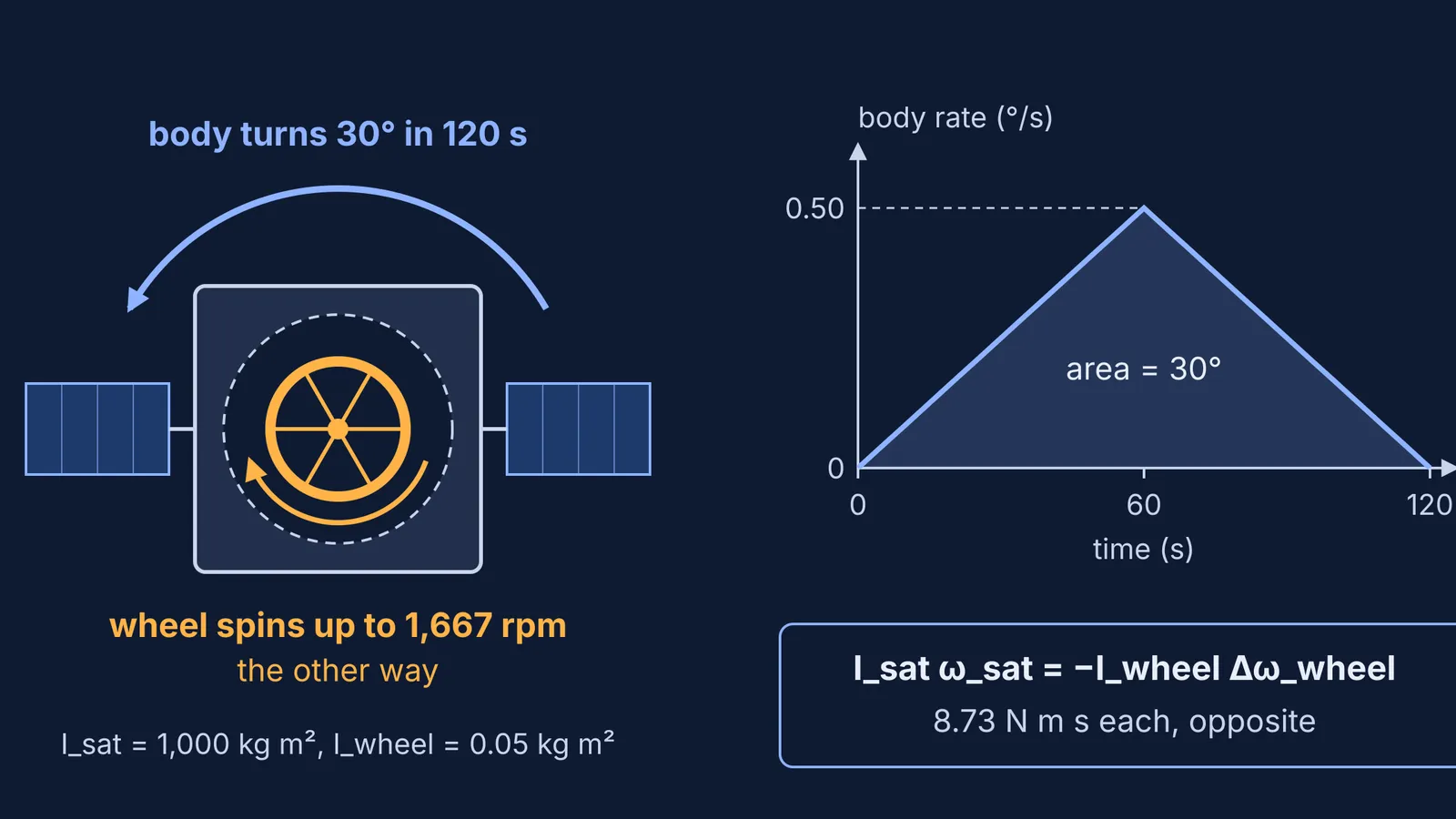
Take the spacecraft and its wheel together as one system. The motor's torque on the wheel and the wheel's torque back on the spacecraft are an action–reaction pair, equal and opposite. They are internal, so they cannot change the total angular momentum. If the system starts at rest, its total angular momentum stays zero:
I_sat ω_sat + I_wheel ω_wheel = 0
So when the motor spins the wheel up, the spacecraft must turn the opposite way, at a much smaller rate because its moment of inertia is much larger. When the motor brakes the wheel, the spacecraft slows down too. Stop the wheel and the spacecraft stops, now pointing in a new direction.
The spinning skater uses the same law in one body that changes shape. Here two bodies share angular momentum through a motor, much like the bullet that sticks in a rotating disc, except the sharing is controlled and can be reversed.
How many reaction wheels does a satellite need?
One wheel controls rotation about one axis. To point in any direction, a spacecraft needs control about three axes. NASA's guide to small spacecraft guidance, navigation and control states that a fully three-axis controlled spacecraft needs three wheels mounted at right angles, and that a four-wheel arrangement is often used so that the spacecraft can keep working if one wheel fails.
Worked example: turning a spacecraft 30° in 2 minutes
All values are illustrative round numbers, not figures for any real satellite.
The spacecraft has I_sat = 1,000 kg m² about the turn axis. It must turn 30° in 120 s, speeding up for 60 s and then slowing down for 60 s at the same rate. The wheel has I_wheel = 0.05 kg m² and starts at rest.
Angle in radians. θ = 30° = π/6 = 0.5236 rad.
Angular acceleration. Speeding up for time t covers ½αt², and slowing down covers the same again, so θ = αt². With t = 60 s, α = 0.5236 ÷ 3,600 = 1.45 × 10⁻⁴ rad/s².
Peak turn rate. ω = αt = 8.73 × 10⁻³ rad/s, which is 0.50°/s.
Peak angular momentum. L = I_sat ω = 1,000 × 8.73 × 10⁻³ = 8.73 N m s.
Wheel speed. The wheel must carry −8.73 N m s, so its speed changes by 8.73 ÷ 0.05 = 174.5 rad/s, which is 1,667 rpm, in the opposite direction.
Motor torque. τ = I_sat α = 1,000 × 1.45 × 10⁻⁴ = 0.145 N m. The motor applies this to the wheel, and the wheel pushes back on the spacecraft with the same torque.
End of the turn. In the second minute the motor brakes the wheel back to zero, and the spacecraft's rate falls to zero with it. The spacecraft has turned 30° and the wheel has turned the other way through 20,000 times as many radians, about 1,667 revolutions.
Check the units: kg m² × rad/s = N m s, because 1 N m s = 1 kg m²/s. The ratio of the two angles equals the ratio of the moments of inertia, 1,000 ÷ 0.05 = 20,000.
Strictly, the wheel's speed in the formula is measured from a non-rotating frame. Its speed relative to the spacecraft differs by only 0.0087 rad/s out of 174.5 rad/s, so you can ignore it here.
Is kinetic energy conserved when a reaction wheel spins up?
No. The angular momentum is shared equally and oppositely, but the kinetic energy is not.
Wheel: ½ × 0.05 × 174.5² = 762 J.
Spacecraft: ½ × 1,000 × (8.73 × 10⁻³)² = 0.038 J.
For equal angular momentum L, kinetic energy is L²/2I, so the body with the smaller moment of inertia takes almost all of it. That energy comes from the battery, through the motor. At the peak the motor delivers τω = 0.145 × 174.5, about 25 W. When braking, the energy goes back out of the wheel as heat or back into the electrical system.
Why do reaction wheels need thrusters at all?
A wheel can only move angular momentum around inside the spacecraft. It cannot remove angular momentum that an outside torque has added. Small outside torques act all the time on a spacecraft in orbit. To hold the spacecraft still against them, the wheel must keep absorbing the extra angular momentum, so it spins faster and faster.
Suppose a steady outside torque of 10⁻⁵ N m acts (an illustrative value).
In one day it adds 10⁻⁵ × 86,400 = 0.864 N m s.
If the wheel's top speed is 6,000 rpm (628.3 rad/s), it can store 0.05 × 628.3 = 31.4 N m s.
It reaches that limit in 31.4 ÷ 0.864 = 36 days.
A wheel at its top speed is saturated and can no longer turn the spacecraft in that direction. NASA's guidance and control chapter says wheels must be periodically desaturated with an actuator that gives an external torque, thrusters or magnetic torquers. The thrusters fire to hold the spacecraft steady while the wheel is slowed down, and the stored spin leaves with the exhaust. This was the "momentum desaturation" in the story of why the Mars Climate Orbiter crashed: each thruster firing gave the spacecraft a small push, and the error was in the units used to report those pushes.
One more limit is worth knowing. Reaction wheels change where a spacecraft points, never its orbit; only a force from outside, such as a thruster, can do that.
If you want to see angular momentum shared between two bodies, the Simulation Lab has interactive simulations for ideas that are easier to see than read. For more rotation problems, the Fermi Problem Library has a step-by-step solver that explains the reasoning.
Quick checklist
System starts at rest: I_sat ω_sat + I_wheel ω_wheel = 0 at every moment.
The spacecraft turns opposite to the wheel, slower in the ratio of moments of inertia.
Angles turned are in the same ratio: 1,000 ÷ 0.05 gives 20,000.
Kinetic energy is not conserved; the motor supplies it, and the wheel holds almost all of it.
Wheels store angular momentum but cannot remove it; thrusters or magnetic torquers dump it.
Wheels turn a spacecraft but cannot change its orbit.