On this page
Vanaspati looks like ghee, costs less, and melted into real ghee it is hard to spot by eye or smell. Food labs catch it with a number called the Reichert–Meissl (RM) value. It rests on chemistry you already study: the solubility of carboxylic acids, steam distillation and an acid–base titration. India's food regulator, FSSAI, writes a minimum RM value into the legal standard for ghee.
What makes milk fat different from vegetable oil?
Fats are triglycerides: one glycerol joined to three fatty acid chains. In groundnut, cottonseed or soybean oil, and in the vanaspati made from them, almost every chain has 16 or 18 carbons. Milk fat is unusual. It also carries short chains, mainly butyric acid (C4) and caproic acid (C6).
FSSAI's own ghee standard (regulation 2.1.8, Version 3, May 2025) gives the fatty acid profile by mass: butyric acid 1–5% and caproic acid 0.5–2.2%. Butyric acid (88 g/mol) is light, so by count of molecules a 3.5% share by mass is roughly one chain in eleven. The FSSAI manual for oils and fats puts it plainly: no other fat contains butyric acid glycerides.
How is the Reichert–Meissl value measured?
The method in the FSSAI manual (which cites AOAC method 925.41) runs like this:
Weigh 5 g of fat into a distilling flask. Add 20 mL of glycerol and 2 mL of 50% NaOH and heat until the mixture turns perfectly clear. This is saponification: the fat becomes glycerol and sodium salts of its fatty acids.
Add 90 mL of boiled water, a little pumice, and 50 mL of dilute (about 1 N) H₂SO₄. The strong acid turns every carboxylate back into its free acid: RCOO⁻ + H⁺ → RCOOH.
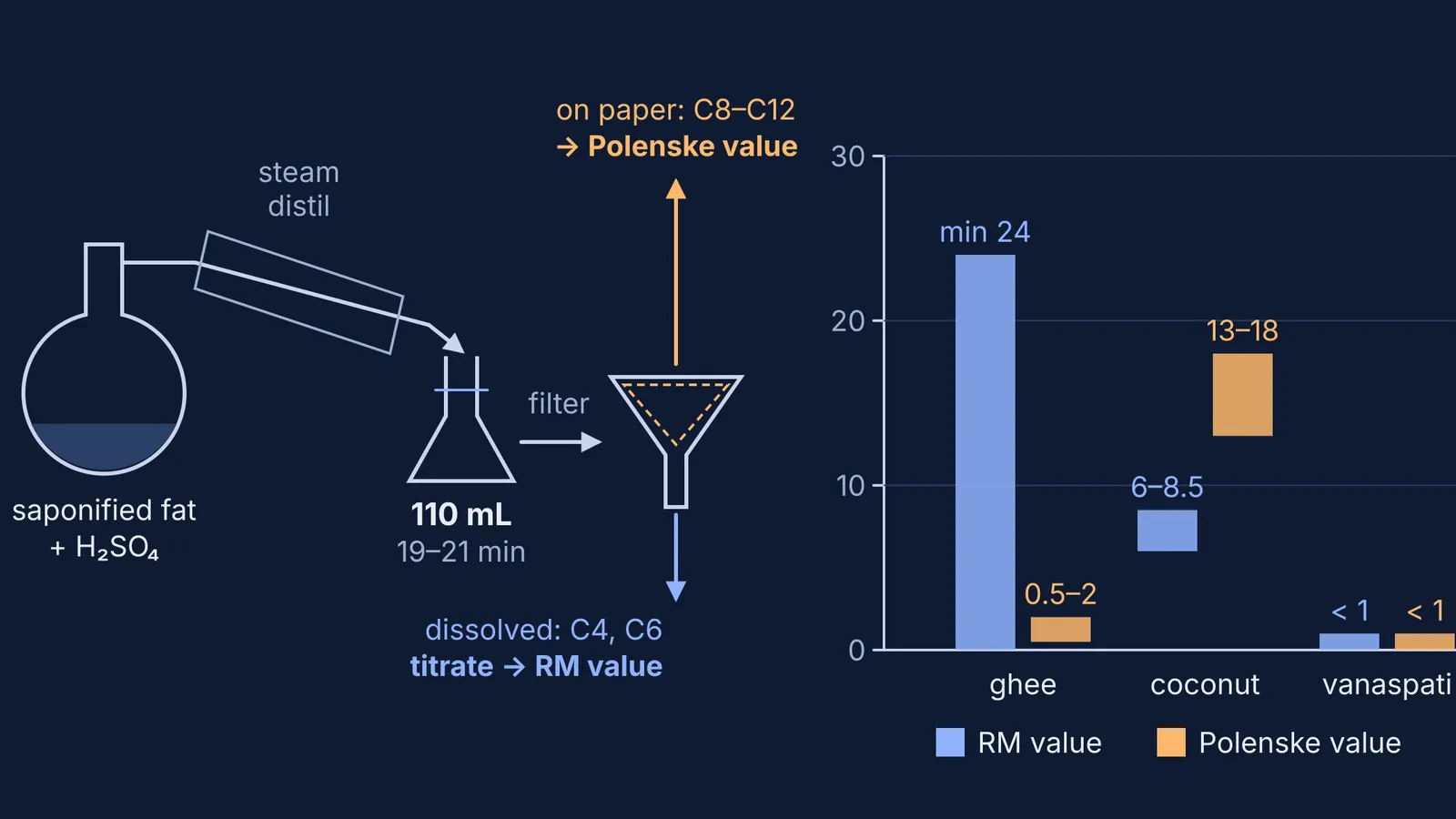
Steam-distil at once, setting the flame so that exactly 110 mL of distillate collects in 19 to 21 minutes.
Cool the distillate to 15 °C and filter it. Acids that came over but do not dissolve stay on the paper.
Titrate 100 mL of the clear filtrate with 0.1 N NaOH using phenolphthalein. Run a blank with the reagents alone.
The RM value is the volume of 0.1 N NaOH needed for the acids that are both steam-volatile and water-soluble from 5 g of fat, scaled to the full 110 mL. With 0.1 N alkali, RM = 1.1 × (titre − blank). The factor 1.1 is simply 110 mL ÷ 100 mL.
Why does the test count only butyric and caproic acid?
Two filters work together, and both come from your syllabus.
Volatility in steam. In steam distillation, a volatile substance is carried over with the steam well below its own boiling point, because its vapour pressure adds to that of water. Short and medium acids (C4 to about C12) come over in a fixed time. Palmitic and stearic acid, with their long chains, barely move.
Solubility in water. NCERT notes that the lower carboxylic acids are miscible with water and that solubility falls as the hydrocarbon chain grows. At the low concentrations in 110 mL of distillate, butyric and caproic acid stay dissolved. Caprylic (C8), capric (C10) and lauric (C12) acid come over but form an oily film that stays on the filter.
So the titration sees mainly C4 and C6. The acids held on the paper are washed off with alcohol and titrated separately to give the Polenske value.
What does a low RM value tell you about ghee?
FSSAI's current table for ghee sets the RM value at a minimum of 24.0, with a Polenske value of 0.5–2.0, a Baudouin test that must be negative, and no β-sitosterol. Older rules set different minimums for different regions, because the natural RM of ghee varies with what the cattle eat. The regulation that tied the limit to the area of sale (2.3.8 of the Prohibition and Restriction on Sales Regulations) is now marked omitted, and the product standard lists a single figure.
Vanaspati has no short chains, so its RM value is close to zero (under 1). Mixing it into ghee pulls the RM down roughly in proportion to how much was added.
Worked example: how much vanaspati is in the sample?
(a) Find the RM value. 5.00 g of ghee is run through the method. 100 mL of the 110 mL distillate needs 27.6 mL of 0.100 M NaOH. The blank needs 0.3 mL.
Net titre = 27.6 − 0.3 = 27.3 mL.
Scale to 110 mL: RM = 1.1 × 27.3 = 30.0.
Compare with the limit: 30.0 is above 24.0, so this sample passes.
(b) Estimate adulteration. Suppose pure ghee from the same dairy reads 30.0 and vanaspati about 0.5. A second sample reads 26.0. Treat RM as a weighted average by mass (a fair approximation):
Let x be the mass fraction of vanaspati: 26.0 = 30.0(1 − x) + 0.5x.
Rearranged: x = (30.0 − 26.0) ÷ (30.0 − 0.5) = 4.0 ÷ 29.5 ≈ 0.14, so about 14% vanaspati.
Run it forwards: a 20% blend reads 0.8 × 30.0 + 0.2 × 0.5 = 24.1.
So a 20% blend still scrapes past 24.0. RM alone cannot prove a ghee is pure, which is why the standard adds other checks. By law vanaspati must contain enough sesame oil to give a positive Baudouin test (FSSAI oils and fats standard), and ghee must give a negative one. β-sitosterol, a plant sterol, must be absent. Adulteration with animal body fat needs yet other tests.
(c) Why coconut oil needs the Polenske value. Coconut oil is rich in C8–C12 acids. A Codex draft standard for named vegetable oils gives coconut oil an RM value of about 6–8.5 and a Polenske value of 13–18. Take RM 7 and Polenske 15, and ghee with RM 30.0 and Polenske 1.5. A 20% coconut blend gives:
RM = 0.8 × 30.0 + 0.2 × 7 = 25.4, which passes the RM limit.
Polenske = 0.8 × 1.5 + 0.2 × 15 = 4.2, far above the 2.0 maximum.
A 20% vanaspati blend would give a Polenske value near 1.3. So a low RM with a normal Polenske value points to vanaspati, and a raised Polenske value points to coconut oil.
How does this connect to saponification and iodine values?
The saponification and iodine values count all the ester groups or all the C=C bonds in a fat. Neither can pick out a few short chains among many long ones. The RM test does, by using volatility and solubility to separate one group of acids before counting them. FSSAI's ghee table lists all of them side by side (iodine value 25–38, saponification value 205–235).
To practise titration back-calculations like these, the Fermi Problem Library has a step-by-step solver that explains the reasoning at each stage.
Quick checklist
Milk fat carries butyric (C4) and caproic (C6) chains; vegetable oils and vanaspati do not.
RM = mL of 0.1 N NaOH for the steam-volatile, water-soluble acids from 5 g of fat; RM = 1.1 × (titre − blank).
Polenske value counts the volatile acids that do not dissolve (C8–C12), high in coconut oil.
FSSAI ghee standard (2025): RM minimum 24.0, Polenske 0.5–2.0, Baudouin test negative.
A blend can pass the RM limit, so labs pair it with the Polenske value, the Baudouin test and sterol tests.