On this page
Look up at a 765 kV line and you will see that each phase is not one wire but a ring of several, held apart by metal spacers along each span. India's newer 765 kV lines use six wires per phase. This is not mainly about carrying more current. It is about the electric field at the surface of the wire, and keeping it below the level at which air starts to break down.
What is corona on a power line?
When the electric field at a conductor's surface is strong enough, the air right next to it ionises. You get a faint glow, a hissing or crackling sound, ozone, radio noise and a steady loss of power. This partial breakdown is called corona. Why charge piles up and fields grow strongest at sharp, curved surfaces is explained in why charge collects at sharp points, so here we go straight to the numbers for a wire.
For a smooth sphere, the maximum charge a sphere can hold in air uses a breakdown field of about 3 MV/m. For a long wire, the onset field comes from Peek's empirical law:
E(onset) = 3.0 m δ (1 + 0.301/√(δ r)) MV/m, with r in cm
Here δ is the relative air density (1 at sea level and 25 °C) and m is a surface factor, about 0.83 to 0.87 for stranded conductors, as listed with the formula at Peek's law. Thin wires get a slightly higher onset field, but as you will see, their surface field rises much faster.
What is the electric field at the surface of a power line?
Treat one conductor as a long line of charge λ per metre at height h above flat ground. The ground acts like a mirror image charge −λ at depth h. The potential of the wire relative to the ground is then
V = (λ/2πε₀) ln(2h/r)
and the field at its surface, a distance r from the axis, is E = λ/(2πε₀r). Eliminate λ:
E = V / (r ln(2h/r))
Because ln(2h/r) changes slowly, the field goes roughly as 1/r. Halve the radius and you nearly double the surface field. This single-wire formula ignores the other two phases, so treat every number below as an estimate. Always compare the peak voltage with the breakdown field, because the air breaks down at the crest of each cycle, not at the rms value.
Why does splitting a phase into several wires lower the field?
Put n sub-conductors of radius r on a circle of radius R. From far away, the bundle looks like one conductor of equivalent radius
r(eq) = (n r R^(n−1))^(1/n)
which is far larger than r. The total charge needed to reach voltage V is set by ln(2h/r(eq)), and that charge is shared among n wires. The average surface field on each sub-conductor is
E(avg) = V / (n r ln(2h/r(eq)))
The neighbours push the field towards the outside of the ring, so the outer edge of each wire carries the peak field, about E(avg) × (1 + (n − 1) r/R).
Worked example: one wire against six on a 765 kV line
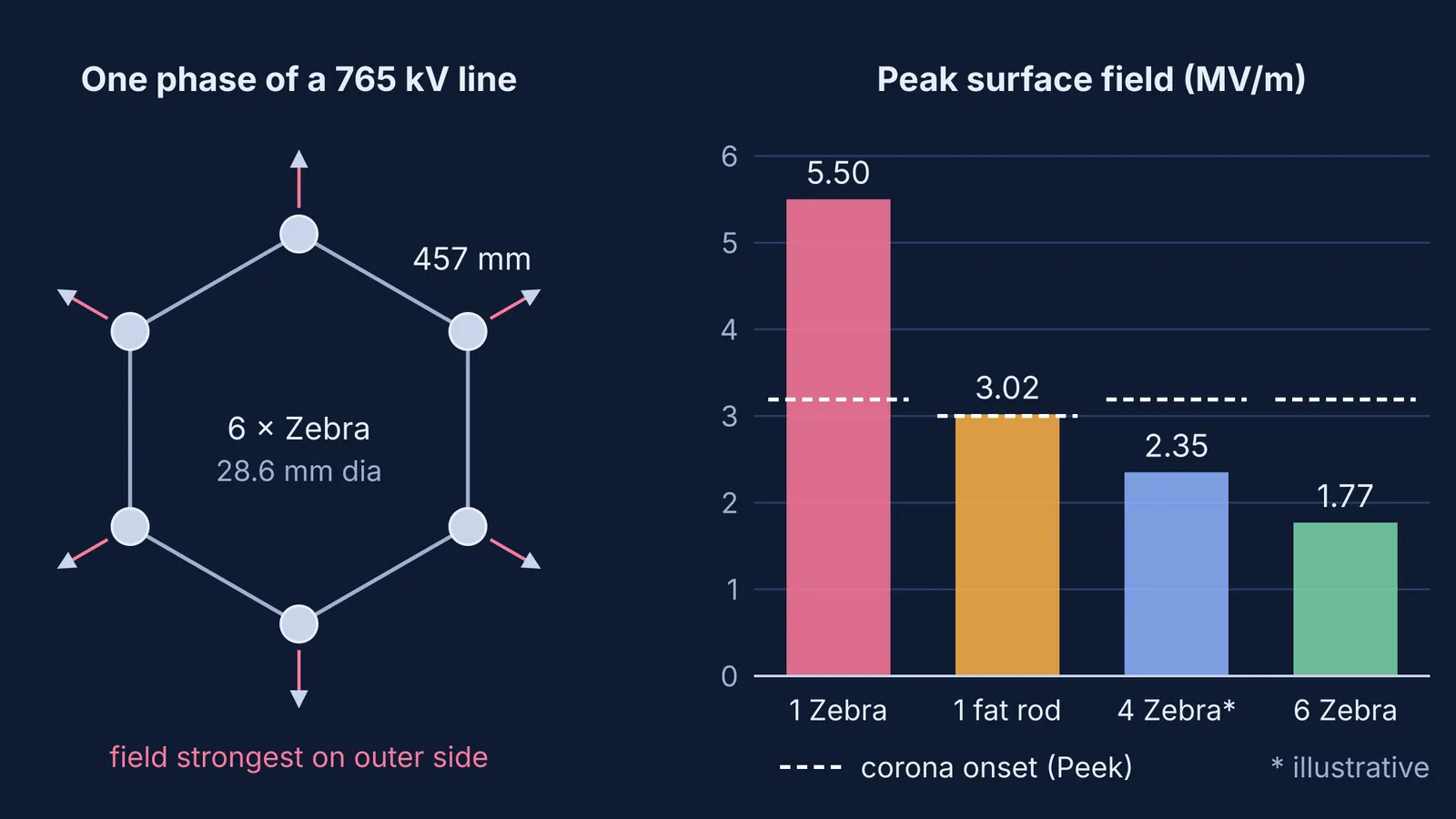
Current Indian bid specifications for 765 kV lines call for a hexa bundle of ACSR Zebra conductor, 28.62 mm in diameter, with a sub-conductor spacing of 457 mm (see this 2025 765 kV transmission tender specification). Take an average height of 20 m above ground (a round illustrative value) and Peek's factors m = 0.85, δ = 1.
Phase voltage. 765 kV is the line-to-line rms voltage. Phase to earth: 765 ÷ √3 = 441.7 kV rms. Peak: 441.7 × √2 = 624.6 kV.
Onset field for Zebra. r = 1.431 cm. E(onset) = 3.0 × 0.85 × (1 + 0.301 ÷ √1.431) = 2.55 × 1.252 = 3.19 MV/m.
One Zebra per phase. r = 0.01431 m, ln(40 ÷ 0.01431) = 7.94. E = 624.6 × 10³ ÷ (0.01431 × 7.94) = 5.50 MV/m. That is well above 3.19 MV/m: the wire would be wrapped in corona.
Six Zebra per phase. In a regular hexagon the circle radius equals the side, so R = 0.457 m. r(eq) = (6 × 0.01431 × 0.457⁵)^(1/6) = 0.346 m. ln(40 ÷ 0.346) = 4.75.
Average field. E(avg) = 624.6 × 10³ ÷ (6 × 0.01431 × 4.75) = 1.53 MV/m.
Peak field. E(max) = 1.53 × (1 + 5 × 0.01431 ÷ 0.457) = 1.53 × 1.157 = 1.77 MV/m, about 55% of the onset field. Fair weather corona is avoided with a margin.
Units check. V ÷ (m × pure number) = V/m. Good.
For comparison, four Zebra on a 457 mm square (an illustrative case) give a peak of about 2.35 MV/m. More wires per phase means a lower field.
Why not use one thick conductor instead?
A single conductor with the same aluminium as six Zebras (6 × 428 mm² = 2,568 mm²) would be a solid rod of radius 28.6 mm (ignoring the steel core). Its surface field would be 3.02 MV/m, and its own Peek onset is 3.00 MV/m. It sits right on the edge, and rain, dirt or a high-altitude route (lower δ) would push it over.
It would also waste metal. At 50 Hz, alternating current crowds towards the surface of aluminium within a skin depth of about 12 mm. A 57 mm thick rod would carry little current near its centre. Six thinner wires use their aluminium better and have more surface to shed heat.
What else does bundling change?
The larger equivalent radius raises the line's capacitance to ground, C = 2πε₀ / ln(2h/r(eq)), from about 7.0 nF/km for one Zebra to 11.7 nF/km for six, and it lowers the inductance per km. Together these raise the power a long line can carry naturally. The crackle you may hear near high-voltage lines in wet weather is corona on water drops on the wires. How high voltage cuts line losses in the first place is covered in why electricity is transmitted at high voltage.
If the image-charge step is new to you, look it up in the Concept Library, which covers every concept in physics, chemistry, biology, mathematics and computing.
Quick checklist
Surface field of a wire above ground: E = V / (r ln(2h/r)), roughly 1/r.
Use peak phase-to-earth voltage: 624.6 kV for a 765 kV line.
Corona onset for a stranded wire is about 3 MV/m (Peek's law, lower in rain and at altitude).
One Zebra at 765 kV: about 5.5 MV/m, heavy corona. Six Zebra on a 457 mm hexagon: about 1.8 MV/m.
A bundle acts like one wide conductor of radius r(eq) = (n r R^(n−1))^(1/n).
Bundling also raises capacitance and avoids wasting metal to the skin effect.