On this page
Oil goes rancid in two ways. Oxygen can attack the double bonds in the fatty-acid chains, which the peroxide value test for rancid oil measures. Or water can cut the fatty acids off the glycerol backbone, leaving free acid in the oil. That second kind is hydrolytic rancidity, and the number that tracks it is the acid value. It also explains why fresh rice bran must be treated within hours of milling.
What does the acid value of an oil measure?
The acid value (AV) is the number of milligrams of KOH needed to neutralise the free fatty acids in 1 g of oil or fat. That is the definition in the FSSAI manual of methods for oils and fats (FSSAI, 2016, method 11).
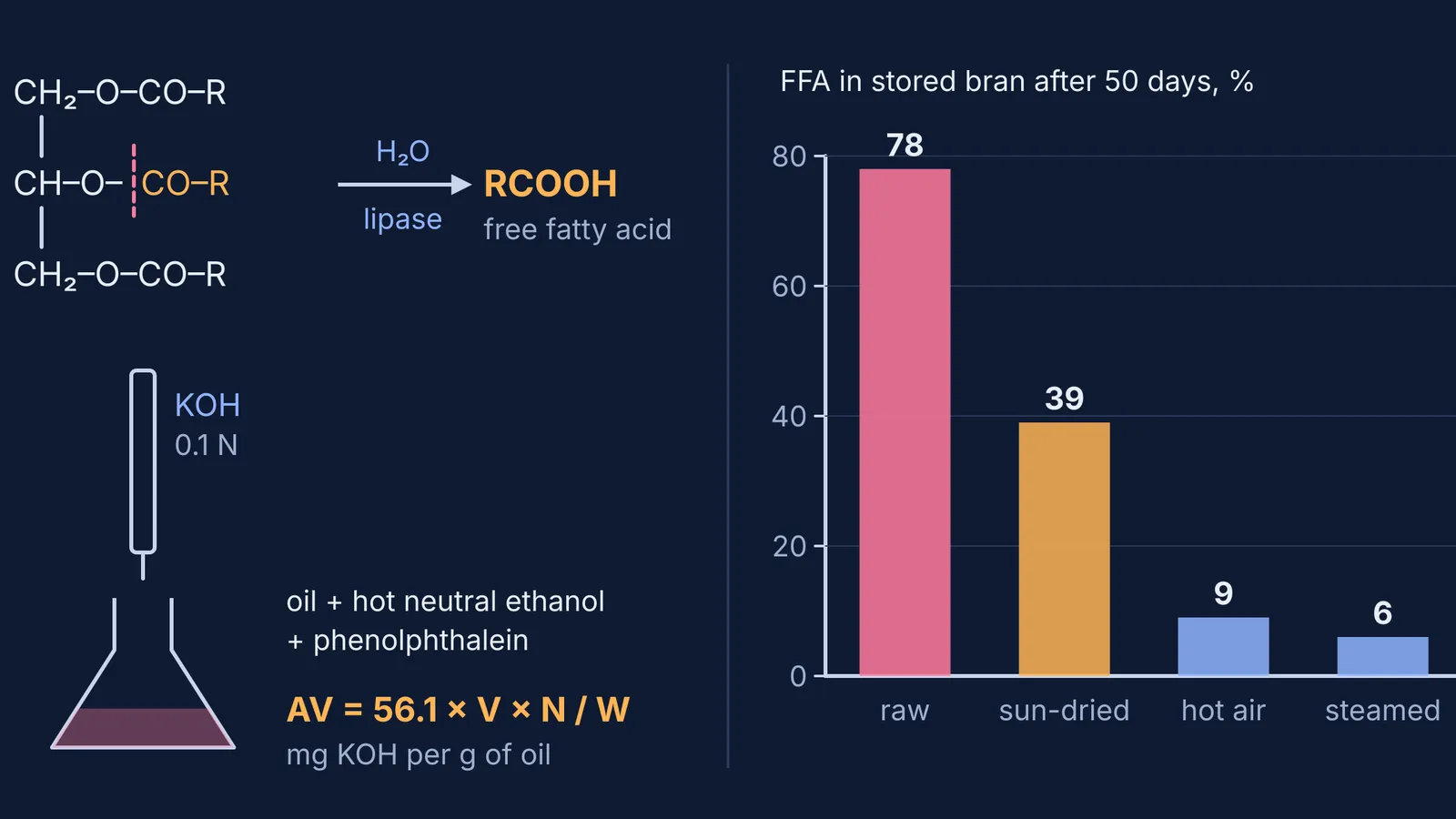
A fresh oil is almost all triglyceride: three fatty acids joined to glycerol by ester links. Triglycerides have no acidic hydrogen, so they do not react with alkali in a short titration. Free fatty acids, RCOOH, do. Each ester link that is hydrolysed releases one RCOOH:
triglyceride + H₂O → diglyceride + RCOOH
This is Class 12 ester hydrolysis, here usually catalysed by lipase, an enzyme in the seed or bran. Heat and water alone also do it, which is why reused frying oil gains free acid.
How is acid value measured in the lab?
The FSSAI method is a direct titration, with no back titration and no blank flask:
Weigh the oil: about 20 g if the AV is expected below 1, 10 g for 1 to 4, 2.5 g for 4 to 15, 0.5 g for 15 to 75, so the titre stays under 10 mL.
Add 50 to 100 mL of hot ethanol that has already been neutralised to phenolphthalein, plus about 1 mL of phenolphthalein.
Boil for about five minutes, then titrate while hot with standard KOH or NaOH (0.1 N for refined oils), shaking hard, to a faint pink.
AV = 56.1 × V × N / W
where V is the titre in mL, N the normality of the alkali and W the mass of oil in g. 56.1 is the molar mass of KOH, so V × N gives millimoles of alkali and 56.1 × V × N gives milligrams of KOH.
Each step has a chemical reason:
Why hot ethanol? Oil does not dissolve in water. Hot ethanol dissolves the oil, the acids and the soap formed, so the reaction is fast and the end point sharp.
Why neutralise the ethanol first? It can hold traces of acid. Neutralising it first makes its own titre zero, doing the job of the blank flask in the saponification and iodine value back titrations.
Why phenolphthalein? A weak acid against a strong base has its end point above pH 7, where phenolphthalein changes. Methyl orange would change far too early.
Why is the oil not saponified? The titration stops at the first lasting pink. Saponification needs an hour of boiling with excess alkali.
How do you convert acid value to percent free fatty acid?
Labs often report acidity as % free fatty acid (FFA), the grams of fatty acid per 100 g of oil, counted as if every free acid were oleic acid (282.5 g/mol). One millimole of KOH (56.1 mg) neutralises 282.5 mg of oleic acid, so:
AV = 1.99 × FFA% (as oleic)
The FSSAI manual uses this factor. "As oleic" is a convention, not a finding. Palm oil FFA is reported as palmitic acid (256.4 g/mol), factor 56.1 × 10 / 256.4 = 2.19; coconut and palm kernel oil often as lauric acid (200.3 g/mol), factor 2.80.
What are the FSSAI limits for acid value?
The limit depends on the oil and on refining. From the FSSAI food product standards, chapter 2.2 (FSSAI, version 2, 2023):
Mustard oil, including kachi ghani: AV not more than 6.0.
Coconut oil: not more than 6.0.
Any refined vegetable oil: not more than 0.6.
Refined rice bran oil: not more than 0.5, and rice bran oil may be sold for eating only after refining.
Raw palm oil may be sold as such only if its FFA, as palmitic acid, is not more than 3.0%.
Refining removes free acid, so refined oils get a limit about ten times lower.
Why does rice bran oil go acidic so fast?
Rice bran is the outer layer polished off the grain in milling. It holds oil and an active lipase, which milling brings together. A 2023 review in Foods notes that free fatty acid in freshly milled bran can reach 10% within hours, depending on conditions, and that bran with more than 10% FFA is generally considered unfit for food (Yılmaz Tuncel, 2023).
The cure is either to extract the oil quickly or to stabilise the bran: heat it to inactivate the lipase. In one study cited in that review, unstabilised bran stored for 50 days reached 78% FFA, while bran steamed at 100 °C for 30 minutes reached only 6% (Amarasinghe and co-workers, 2009). Denature the enzyme and the hydrolysis nearly stops.
Worked example: acid value of crude rice bran oil
Question. 2.500 g of crude rice bran oil, dissolved in hot neutral ethanol, needs 5.00 mL of 0.100 N KOH to reach the phenolphthalein end point. Find (a) the AV and FFA, (b) the FFA corrected for oryzanol, assuming the oil contains 1.6% oryzanol, and (c) the NaOH needed to neutralise the free acid in 1 tonne of this oil, and its ester value if the saponification value is 185.
(a) Acid value and FFA.
Millimoles of KOH: 5.00 × 0.100 = 0.500 mmol.
Milligrams of KOH: 0.500 × 56.1 = 28.05 mg.
Per gram of oil: 28.05 / 2.500 = 11.22, or 11.2 mg KOH/g. That is the AV.
FFA as oleic: 11.22 / 1.99 = 5.64, or about 5.6%.
(b) The oryzanol correction. Rice bran oil contains oryzanol, a mixture of ferulic acid esters with a weakly acidic phenolic –OH. Some of it reacts with alkali at the phenolphthalein end point, so the titre overstates the fatty acid. The FSSAI manual gives the correction:
Real FFA = observed FFA − 0.425 × (% oryzanol) = 5.64 − 0.425 × 1.6 = 4.96, or about 5.0%.
(c) Refining and ester value.
Free acid in 1 tonne: 5.0% of 1,000,000 g = 49,600 g of fatty acid, counted as oleic.
Moles: 49,600 / 282.5 = 176 mol, and since RCOOH + NaOH → RCOONa + H₂O is 1 : 1, that needs 176 mol of NaOH.
Mass of NaOH: 176 × 40.0 g ≈ 7.0 kg.
The soap formed drags neutral oil out with it, so high-FFA oils are often refined physically instead, distilling the free acid off with steam.
Ester value = SV − AV = 185 − 11.2 ≈ 174: the KOH used by triglycerides alone. It is a subtraction, not a separate test.
The Fermi Problem Library has more titration problems like this one, with a step-by-step solver that explains the reasoning.
Quick checklist
Acid value = mg KOH per g of oil for the free acid only. AV = 56.1 × V × N / W.
It measures hydrolytic rancidity. Peroxide value measures oxidative rancidity.
AV = 1.99 × FFA% as oleic; 2.19 as palmitic; 2.80 as lauric.
FSSAI: AV up to 6.0 for mustard and coconut oil, 0.6 for refined oils, 0.5 for refined rice bran oil.
Rice bran lipase acts within hours of milling; heat stabilisation or quick extraction stops it.
Correct rice bran oil FFA for oryzanol.