On this page
Turn over a toilet soap wrapper in India and you will usually find two short lines: "TFM 76%" (or some other figure) and a grade. They come from the Bureau of Indian Standards specification for toilet soap, IS 2888. The number is found by running a reaction you learn in school backwards: a strong acid takes the soap apart into the fatty acids it was made from, and those acids are weighed.
What does TFM mean on a soap wrapper?
TFM stands for total fatty matter. It is the mass of fatty material you can recover from the soap after splitting it with acid, as a percentage of the mass of soap tested. The method standard, IS 286 (methods of sampling and test for soaps), defines it as everything soluble in ether under the test conditions: the fatty and rosin acids that were combined as soap, plus any unsaponified fat and unsaponifiable matter.
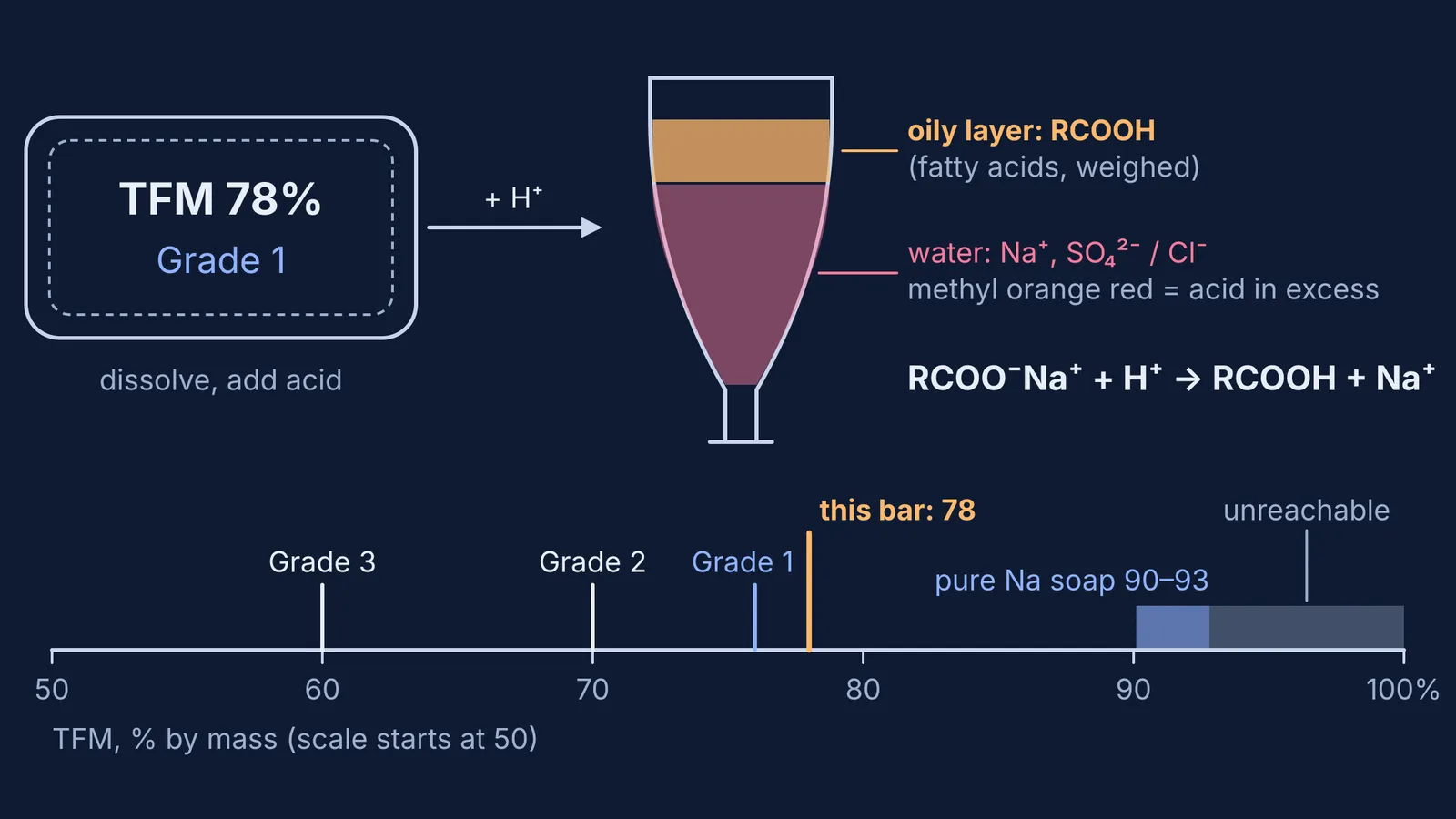
IS 2888:2004 sets three grades by minimum TFM, percent by mass:
Grade 1: at least 76.0%
Grade 2: at least 70.0%
Grade 3: at least 60.0%
The same table caps free caustic alkali at 0.05% (as NaOH) for all three grades, rosin acid at 3.0% of the TFM, and chlorides at 1.50%, and it sets a minimum lather volume. The standard's foreword explains that Grade 2 came from the old low-cost "Janata" soap. The 2004 text has three amendments (2007, 2008, 2013), and none of them changes the TFM limits.
How does acid turn soap back into fatty acid?
NCERT describes soap as the sodium salt of a long-chain carboxylic acid, made by saponifying a fat with NaOH. You have probably made it in the soap preparation practical. A carboxylic acid is a weak acid. A strong acid pushes the carboxylate back to the free acid:
RCOO⁻Na⁺ + H⁺ → RCOOH + Na⁺
For sodium stearate with hydrochloric acid: C₁₇H₃₅COONa + HCl → C₁₇H₃₅COOH + NaCl. Count the atoms: 18 C, 35 H, 2 O, 1 Na and 1 Cl on each side, and no net charge. Long-chain fatty acids do not dissolve in water, so they separate as an oily layer on top.
This is the same displacement you see when a strong acid releases a weak one from its salt. Avoid quoting a single pKa for stearic acid; long-chain acids clump together in water, so their pKa there is not well defined. All you need is that a strong acid in excess converts essentially all of the carboxylate.
How is TFM measured in the lab?
The IS 286 procedure, in outline:
Weigh 5 to 10 g of soap and dissolve it in about 100 mL of warm water.
Add dilute H₂SO₄ (1 : 1) until it is in slight excess, judged with methyl orange.
Warm (not above 60 °C) until the fatty acids separate as a clear layer. Add saturated NaCl solution and cool.
Extract the fatty acids into ethyl ether in a separating funnel, using three portions for the aqueous layer.
Wash the ether layer with water until the washings are no longer acidic to methyl orange.
Distil off the ether, chase the last traces with a little acetone and warm air, dry at about 90 °C and weigh. Repeat until two weighings differ by less than 0.005 g.
TFM, % = mass of fatty matter × 100 ÷ mass of soap taken. The basis is the soap as sampled, moisture included.
Why methyl orange and not phenolphthalein?
Methyl orange turns red only below a pH of about 3.1. If the solution is red, there is clearly more strong acid than the soap can use up, so every carboxylate has been converted. Phenolphthalein becomes colourless already around pH 8, long before that point, so it cannot tell you the acid is in excess. Choosing an indicator by the pH you need to reach is the same idea as in choosing an indicator for a titration.
Worked example: grading a bar and checking its alkali
(a) Find the grade. 10.00 g of a toilet soap gives 7.80 g of dried fatty matter.
TFM = 7.80 × 100 ÷ 10.00 = 78.0%.
Compare with IS 2888: 78.0 is above 76.0, so the bar meets Grade 1.
(b) Why TFM can never reach 100%. Take a soap that is pure sodium stearate, C₁₇H₃₅COONa (306.5 g/mol). Acid turns it into stearic acid, C₁₇H₃₅COOH (284.5 g/mol). Each mole loses Na (23.0) and gains H (1.0).
TFM of pure sodium stearate = 284.5 ÷ 306.5 × 100 = 92.8%.
For pure sodium laurate, C₁₁H₂₃COONa (222.3 g/mol) → lauric acid (200.3 g/mol): 200.3 ÷ 222.3 × 100 = 90.1%.
Shorter chains lose a bigger share of their mass, because the same 22 g/mol swap is a larger fraction of a smaller molecule.
So a 100% sodium soap scores only about 90–93% TFM. Working backwards, a 78% TFM bar holds roughly 78 ÷ 0.928 ≈ 84% to 78 ÷ 0.901 ≈ 87% actual soap, depending on its fats. The rest is water, glycerol, fragrance, colour and any permitted additives.
(c) Check the free caustic alkali. Free caustic alkali is NaOH left over from saponification. IS 286 measures it by dissolving about 10 g of soap in neutral ethanol, adding barium chloride to remove carbonate, and titrating with standard acid using phenolphthalein. Ethanol matters here: in water, soap hydrolyses and turns phenolphthalein pink by itself, but in alcohol only the free alkali does.
Suppose 10.0 g of the same bar needs 0.60 mL of 0.100 M HCl.
Moles of HCl = 0.60 × 0.100 = 0.060 mmol, so 0.060 mmol of NaOH.
Mass of NaOH = 0.060 × 40.0 = 2.4 mg.
Free caustic alkali = 0.0024 g × 100 ÷ 10.0 g = 0.024%.
IS 2888 asks for this to be recalculated to the minimum TFM, because bars lose moisture on the shelf: 0.024 × 76.0 ÷ 78.0 ≈ 0.023%.
That is under the 0.05% limit, which is why a properly made bar does not sting the way raw lye would.
The Fermi Problem Library has a step-by-step solver that explains the reasoning if you want to practise more percentage-composition and titration problems like these.
Is a bathing bar a fake soap?
No. A "bathing bar" is made to a different standard, IS 13498, which allows non-soap synthetic surface active agents alongside the fatty matter. Its foreword notes that a TFM figure alone does not fully predict how a bar performs. It has its own limits, so it is not graded under IS 2888. Read the label for what it is; a different standard is not a sign of adulteration. How soap and synthetic detergents behave differently in hard water is covered in the difference between soap and detergent.
Quick checklist
TFM = mass of fatty matter recovered by acid splitting × 100 ÷ mass of soap.
IS 2888:2004 grades: Grade 1 ≥ 76%, Grade 2 ≥ 70%, Grade 3 ≥ 60%; free caustic alkali ≤ 0.05% as NaOH.
RCOO⁻Na⁺ + H⁺ → RCOOH + Na⁺: a strong acid displaces the weak fatty acid.
Methyl orange (red below pH about 3.1) confirms the acid is in excess.
Pure sodium soaps score only about 90–93% TFM, because Na is swapped for H.
Free alkali is titrated in ethanol with phenolphthalein, then recalculated to minimum TFM.