

On this page
You are washing clothes and notice white flakes in the bucket instead of a rich lather. You keep adding more cleaning bar, but the water just turns cloudy and leaves a sticky residue on the fabric. This is the classic battle of soap against hard water, and it perfectly illustrates why chemists had to invent detergents.
What is the difference between soap and detergent?
The answer lies in their chemical structure and origins. Here is a direct comparison of their properties:
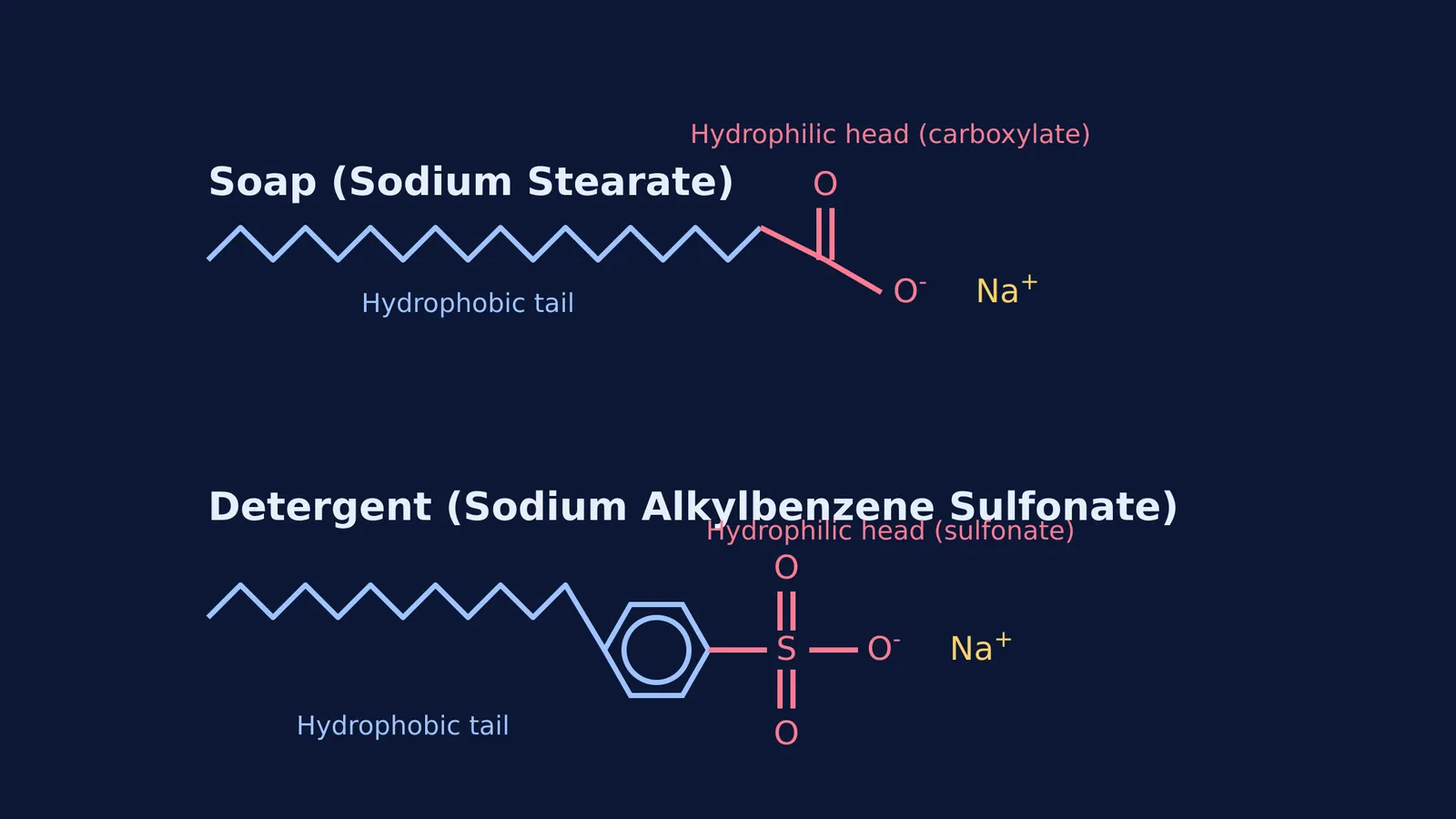
Chemical composition: A soap is defined as a sodium or potassium salt of a long-chain fatty acid (source). A detergent is a synthetic product whose main active ingredient is typically an alkylbenzene sulfonate (source).
Source materials: Soaps are derived from natural animal fats or vegetable oils. Detergents are typically synthesised from petroleum hydrocarbons, making them entirely artificial.
Action in hard water: Soap reacts with minerals in hard water to form an insoluble precipitate called scum. Detergents are more soluble in hard water because their polar sulfonate groups are less likely to bind to calcium ions (source).
Biodegradability: Because soaps are made from natural fats, bacteria easily break them down in the environment. Many synthetic detergents have complex hydrocarbon structures that bacteria cannot digest, which can lead to severe water pollution.
You can learn more about how these molecules are manufactured in the lab by reviewing the saponification practical for Class 10.
Both molecules share a critical structural feature: they have a long hydrophobic (water-fearing) tail and a short hydrophilic (water-loving) head. This dual nature allows them to act as surfactants. They form clusters called micelles around oily dirt, trapping the grease in the centre while the water-loving heads face outward. This mechanism bridges the gap and explains how oil and water do not mix naturally until a surfactant brings them together.
Why do soaps fail in hard water?
Hard water contains high concentrations of dissolved calcium and magnesium ions. When you add soap to hard water, the negatively charged carboxylate heads of the soap molecules react immediately with these positively charged calcium and magnesium ions. This chemical reaction produces an insoluble, greyish-white solid known as scum.
Instead of forming a micelle to lift away dirt, the soap is wasted forming this sticky scum. The scum clings to the fibres of your clothes, making them look dull and stiff, and leaves a stubborn ring around your bucket or bathtub. You have to use a massive amount of soap just to precipitate all the calcium and magnesium ions before any lather can finally form to clean the fabric.
If you want to master the chemistry behind these precipitation reactions and carbon compounds, the Fermi Concept Library has a lesson for every concept, showing its place in the map.
Are detergents biodegradable?
A substance is considered biodegradable if natural bacteria can break it down into harmless components over a short period. Soaps are highly biodegradable because their straight hydrocarbon chains are identical to the fatty acids found in nature, which bacteria consume easily.
Detergents, however, have a more complicated environmental record. Early synthetic detergents featured highly branched hydrocarbon chains. Bacteria lack the enzymes to break these branched chains down effectively. As a result, these non-biodegradable detergents built up in rivers and lakes, causing thick layers of toxic foam on the water surface and devastating aquatic ecosystems. Today, manufacturers deliberately synthesise detergents with straighter hydrocarbon chains to make them more biodegradable, though they still carry a larger environmental footprint than traditional soap.
Which is better: soap or detergent?
Neither product is universally better; you must choose based on the task and your local water supply.
For personal hygiene: Soap is generally milder on the human skin and far more environmentally friendly. Our bodies do not need the harsh, stripping cleansing power of a detergent, and most residential bathing water is soft enough to allow soap to work efficiently.
For laundry in hard water: Detergent is absolutely essential. The sulfonate heads in detergents bind to calcium ions but, crucially, their resulting calcium salts remain completely soluble in water. This means they form lather instantly, trapping dirt and washing it away without leaving any dull residue on your clothes.
For environmental impact: If you live in an area with naturally soft water, using soap for both bathing and washing clothes significantly reduces the synthetic chemical load on local water treatment plants and natural waterways.


