

On this page
If you pour cooking oil into a glass of water, the two liquids quickly separate into distinct layers. This everyday kitchen observation is one of the most fundamental lessons in chemistry. Understanding why this happens explains the science behind everything from salad dressing to how your cell membranes function and keep you alive.
What makes a molecule polar?
The answer starts with the shape and electrical charge of the molecules. Water (H₂O) is a highly polar molecule. The single oxygen atom has eight protons in its nucleus, which pulls the shared electrons much more strongly than the single proton in each of the two hydrogen atoms. This unequal sharing of electrons creates a permanent dipole moment: the oxygen end develops a slight negative charge, and the hydrogen ends develop a slight positive charge. This makes every water molecule act like a tiny magnet.
Oil, on the other hand, is composed of long hydrocarbon chains. In these chains, the carbon and hydrogen atoms share their electrons almost perfectly evenly because their electronegativities are very similar. As a result, the molecule has no significant charged ends. It is entirely non-polar and interacts only through very weak forces. To see how these bonds form and electrons are shared, you can practise drawing electron dot structures for covalent molecules.
Why do oil and water not mix?
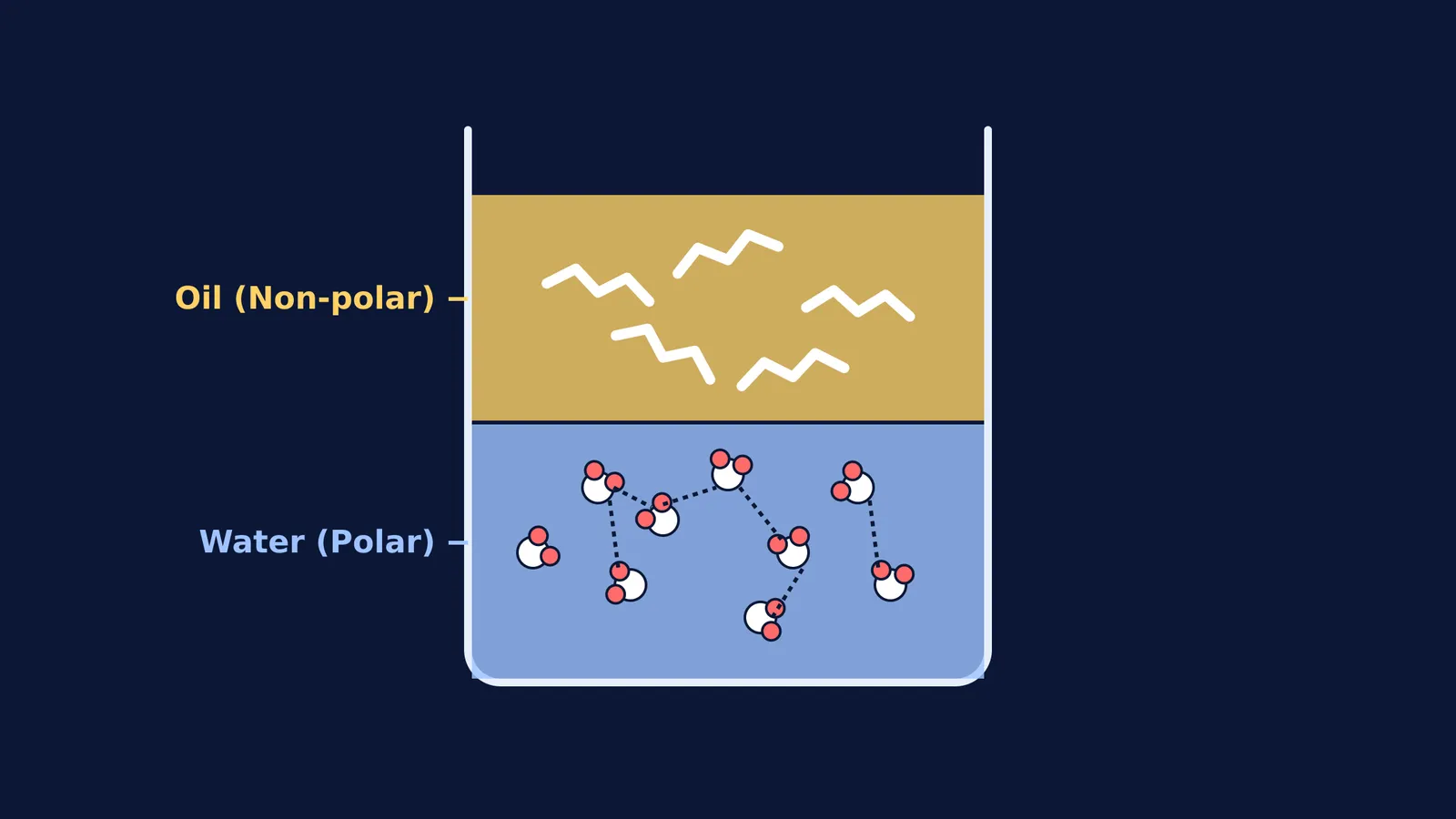
Because water molecules are polar, they attract each other strongly. The positive hydrogen end of one water molecule links up with the negative oxygen end of another to form a hydrogen bond.
These connections are remarkably robust and give water its unique properties. In liquid water, breaking a hydrogen bond requires about 21 kJ/mol of energy, a significant thermodynamic barrier. When you try to mix oil and water, the water molecules flatly refuse to break their strong network of hydrogen bonds to make room for the non-polar oil molecules, which offer no strong attraction in return.
Instead, the water molecules clump together and squeeze the oil out. This process is driven by the hydrophobic effect. If an oil molecule is forced into water, the surrounding water molecules must form a highly ordered "cage" around it, which drastically reduces the water's entropy (its natural disorder). The segregation of water and non-polar substances maximizes the entropy of the water and minimizes the area of contact between the two liquids. By forcing all the oil together, the water frees itself from these cages.
How does the "like dissolves like" rule work?
In chemistry, the phrase "like dissolves like" is a reliable rule of thumb for predicting solubility. It dictates that a solute will dissolve best in a solvent that has a similar chemical structure and polarity.
Polar solvents readily dissolve polar or ionic solutes, such as salt in water. The water molecules surround the charged ions and pull them apart. Non-polar solvents dissolve non-polar solutes, such as grease in petrol or paint thinner. Because oil and water have completely different polarities, they are immiscible. The oil simply floats to the top because it is less dense than water.
Can you force them to mix?
While they will not mix on their own, you can force them to stay mixed using an emulsifier. Emulsifiers are special molecules that contain both a polar "head" and a long non-polar "tail".
When you make mayonnaise, for example, the lecithin in the egg yolk acts as an emulsifier. The non-polar tails embed themselves into the oil droplets, while the polar heads face outward to interact with the water. This creates a stable emulsion where small oil droplets remain suspended. This exact chemical battle is also what makes soap necessary for washing oily hands. The chemistry of how soaps use micelles to clean relies on these identical principles to trap grease and wash it away.
If you struggle to picture how these molecules interact in three dimensions, you are not alone. For the ideas that are easier to see than to read, the Simulation Lab provides interactive simulations. You can watch how hydrogen bonds form and see the hydrophobic effect in action, rather than just reading about the thermodynamic barrier.
Next time you shake a bottle of vinaigrette, you will know exactly why it separates again.


