On this page
Our post on periodic acid cleavage of vicinal diols shows how IO₄⁻ cuts the C–C bond between two carbons that carry OH groups, and says the reaction helps locate those groups. This post is about counting. Count the periodate used and the formic acid made, and you can measure how much glycerol is in a bottle, or decide whether a sugar ring has five atoms or six. Periodate cleavage is beyond the rationalised NCERT text but appears in JEE Advanced-style problems, so treat it as an extension of the glucose chapter.
How many periodate ions does glycerol use?
Two rules do all the work:
One IO₄⁻ per C–C bond cut. Periodate cuts a C–C bond only when both carbons carry an OH (or C=O) group. Each cut takes 2 electrons, and IO₄⁻ (iodine +7) → IO₃⁻ (iodine +5) supplies exactly 2.
What each carbon becomes depends on how many cuts it has. A carbon cut on one side becomes an aldehyde (a terminal CH₂OH becomes HCHO). A CHOH carbon cut on both sides becomes formic acid, HCOOH.
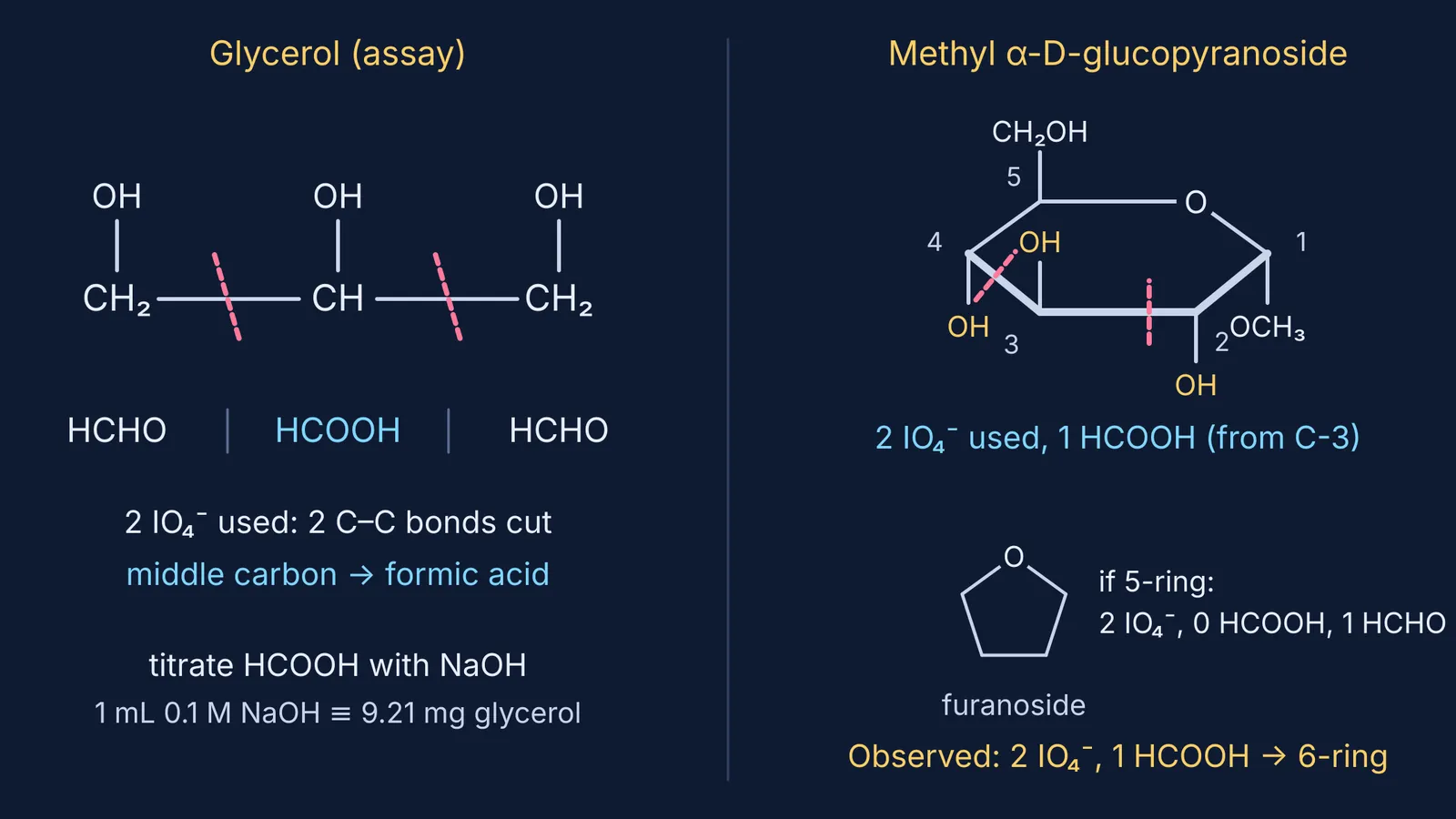
Glycerol, HOCH₂–CHOH–CH₂OH, has two bonds between OH-bearing carbons. Both are cut. The two ends become formaldehyde and the middle carbon, cut on both sides, becomes formic acid:
HOCH₂–CHOH–CH₂OH + 2IO₄⁻ → 2HCHO + HCOOH + 2IO₃⁻ + H₂O
Check it: the left side has 3 C, 8 H, 11 O, 2 I and charge −2. So does the right. Oxidation numbers agree too: each end carbon goes from −1 to 0 and the middle carbon from 0 to +2, a total of 4 electrons, exactly what 2 IO₄⁻ accept.
Formaldehyde is neutral. Formic acid (pKa about 3.75) is an acid NaOH can titrate. So 1 glycerol → 1 HCOOH → 1 NaOH.
How does the pharmacopoeia turn this into a titration?
The USP monograph for glycerin describes the classic method:
Take 400 mg of glycerin in 50 mL of water and neutralise it carefully, so any free acid already present is not counted.
Add 50 mL of sodium periodate solution (60 g/L, slightly acidified with H₂SO₄). Stand for 30 minutes at room temperature in the dark.
Add 10 mL of a 1 : 1 ethylene glycol–water mixture and stand for 20 minutes.
Dilute and titrate with 0.1 N NaOH using a pH meter. Run a blank with water in place of the sample.
The monograph says each mL of 0.1 N NaOH, after blank correction, is equivalent to 9.210 mg of glycerol, and sets the limit at 99.0 to 101.0% (anhydrous basis). Check the current IP or BP edition for its version.
The times and temperature are fixed for a reason. With long standing, warmth or a large excess, periodate slowly attacks formic acid and formaldehyde too (over-oxidation), and the count drifts.
Why add ethylene glycol before titrating?
The periodate is added in excess. 50 mL of 60 g/L NaIO₄ is about 14.0 mmol, while 400 mg of glycerol (4.34 mmol) needs only about 8.7 mmol. So when the glycerol is used up, about 5 mmol of periodate is still in the sample flask, and the full 14 mmol is still in the blank.
That would ruin the blank correction. Periodate is not a spectator in an acid–base titration: periodic acid has a second pKa near 8, right where the end point sits, so leftover periodate takes some NaOH, and the sample and blank contain different amounts. Ethylene glycol destroys it:
HOCH₂–CH₂OH + IO₄⁻ → 2HCHO + IO₃⁻ + H₂O
It gives only formaldehyde, never formic acid, because it has no middle carbon. After this step every iodine in both flasks is iodate. The only difference left between sample and blank is the formic acid from glycerol, which is exactly what the titration should see.
Worked example: assay of a glycerin sample
Teaching numbers, following the USP method.
Data. 0.4000 g of glycerin is taken through the procedure. After blank correction, the titre is 43.0 mL of 0.1000 M NaOH.
Moles of NaOH = moles of HCOOH. 43.0 × 0.1000 = 4.30 mmol.
Moles of glycerol. One HCOOH per glycerol, so 4.30 mmol.
Mass. 4.30 mmol × 92.09 mg/mmol = 396.0 mg.
Purity. 396.0 ÷ 400.0 × 100 = 99.0%, at the lower edge of the limit.
Where 9.21 mg comes from. 1 mL of 0.1 M NaOH is 0.1 mmol, which neutralises 0.1 mmol of HCOOH from 0.1 mmol of glycerol: 0.1 × 92.09 = 9.21 mg. So the whole calculation is 43.0 × 9.21 = 396.0 mg.
How did periodate prove glucose is a six-membered ring?
Glucose's cyclic forms are drawn as a pyranose ring: five carbons and one oxygen, closed between C1 and C5. Haworth argued for that ring using methylation (see Walter Haworth and the ring structures of sugars). In 1937 E. L. Jackson and C. S. Hudson gave a quicker check by periodate counting (J. Am. Chem. Soc. 59, 994).
They used methyl glycosides, not free glucose. In a glycoside the C1 position is locked as an acetal, so the ring cannot open. Free glucose mutarotates through the open chain, and its periodate count reflects the open chain and the ring reacting together, so it cannot settle the ring size.
Pyranoside (six-membered ring, O between C1 and C5). The free OH groups are on C2, C3, C4 and C6. C6 has no OH-bearing neighbour (C5 carries the ring oxygen). So the cuttable bonds are C2–C3 and C3–C4. C3 is cut on both sides and leaves as formic acid. Result: 2 IO₄⁻ used, 1 HCOOH, no HCHO.
C₇H₁₄O₆ + 2IO₄⁻ → C₆H₁₀O₅ (a dialdehyde) + HCOOH + 2IO₃⁻ + H₂O
Furanoside (five-membered ring, O between C1 and C4). The free OH groups are on C2, C3, C5 and C6. The cuttable bonds are C2–C3 and C5–C6. No carbon is cut on both sides, so there is no formic acid, but C6 leaves as formaldehyde. Result: 2 IO₄⁻ used, no HCOOH, 1 HCHO.
Both rings use the same amount of periodate, so the periodate alone cannot decide. The products do. Methyl α-D-glucopyranoside gave 2 IO₄⁻ and 1 HCOOH, the six-membered pattern.
What does open-chain glucose give?
Compare the open chain, OHC–(CHOH)₄–CH₂OH. All five C–C bonds join functionalised carbons, so all five are cut:
C1 (the CHO) becomes HCOOH.
C2, C3, C4 and C5, each cut on both sides, become 4 HCOOH.
C6 (CH₂OH) becomes HCHO.
C₆H₁₂O₆ + 5IO₄⁻ → 5HCOOH + HCHO + 5IO₃⁻
Atoms balance (6 C, 12 H, 26 O, 5 I) and charge is −5 on both sides. So 5 IO₄⁻, 5 HCOOH and 1 HCHO for the open chain, against 2, 1 and 0 for the pyranoside.
If you want more practice tracking every carbon through a cleavage, the Fermi Problem Library has a step-by-step solver that explains the reasoning.
Quick checklist
One IO₄⁻ per C–C bond between two OH- or C=O-bearing carbons; IO₄⁻ → IO₃⁻ is 2 e⁻.
Cut on one side: aldehyde (CH₂OH gives HCHO). CHOH cut on both sides: HCOOH.
Glycerol: 2 IO₄⁻, 2 HCHO, 1 HCOOH. Titrate the HCOOH: 1 mL of 0.1 M NaOH ≡ 9.21 mg.
Ethylene glycol destroys excess periodate, giving only HCHO, so sample and blank end up alike.
Methyl glucopyranoside: 2 IO₄⁻, 1 HCOOH. Furanoside: 2 IO₄⁻, 0 HCOOH, 1 HCHO.
Open-chain glucose: 5 IO₄⁻, 5 HCOOH, 1 HCHO.