On this page
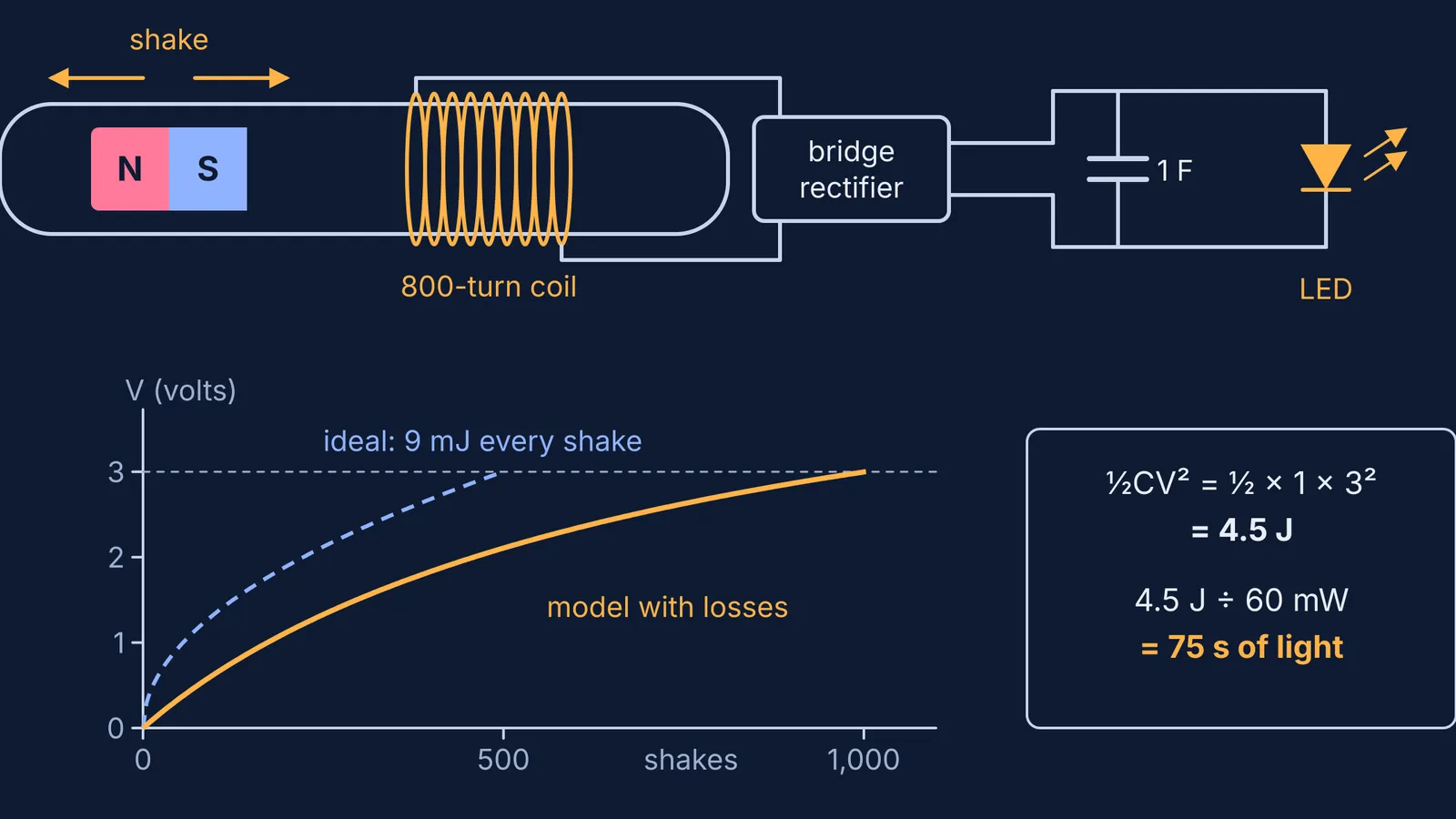
A shake torch has no battery to replace. You shake it for a minute or two, and an LED lights up. Inside a clear one you can see everything: a magnet that slides along a tube, a coil of copper wire wound round the middle, a few diodes, a capacitor and the LED. It is Faraday's law, a rectifier and ½CV² in one object, and every number in it can be worked out with Class 12 physics.
How does a shake torch make electricity?
Each shake sends the magnet through the coil and back. As the magnet approaches, the magnetic flux through each turn of the coil rises; as it leaves, the flux falls. Faraday's law says a changing flux linkage induces an emf:
ε = −N dΦ/dt
The emf depends on how fast the flux changes, not on how much flux there is. A magnet resting inside the coil gives no emf at all. A magnet moving quickly through it gives a large one.
The emf reverses direction as the magnet enters and leaves, so the current from the coil is alternating. A bridge rectifier of four diodes turns both directions into current that flows one way, into a capacitor. The capacitor stores the energy, and the LED runs from it. The same moving magnet, and the drag that induced currents put on it, appear in why a magnet falls slowly through a copper pipe.
How big is the induced emf?
All the values below are round illustrative numbers, not the specification of any real torch.
Flux through one turn. Suppose the magnet gives about 0.3 T across a coil of radius 6 mm. Φ = BA = 0.3 × π × (0.006)² = 3.39 × 10⁻⁵ Wb.
Flux linkage. With 800 turns, NΦ = 800 × 3.39 × 10⁻⁵ = 0.0271 Wb.
Time. Shaken at about 1 m/s, the magnet takes about 10 ms to move into the coil, so the flux linkage rises from about zero to 0.0271 Wb in 10 ms.
Average emf. ε = ΔΦ/Δt = 0.0271/0.010 = 2.7 V.
Quote the average emf over the pass, as here. The peak is higher. In the model used for the graph in the hero image, the flux rises smoothly and the peak emf is about 5.3 V, roughly twice the average. That matters, because the rectifier only passes current when the coil's emf is larger than the capacitor voltage plus two diode drops.
How much energy does the capacitor store?
Many shake torches store the energy in a capacitor of large capacitance. Take 1 F charged to 3 V:
E = ½CV² = ½ × 1 × 3² = 4.5 J
A small white LED drawing 60 mW would run for 4.5/0.060 = 75 s if all of that energy reached it. In practice the LED dims as the capacitor voltage falls, so the useful time is shorter. The same ½CV² sum, for a 3000 F cell against a phone battery, is in supercapacitor vs phone battery energy.
How many shakes does it take to fill?
Here is the energy budget for one shake.
Kinetic energy of the magnet. A 30 g magnet at 1 m/s has ½mv² = ½ × 0.030 × 1² = 15 mJ.
Energy captured. Suppose 30% of that is turned into stored energy on each pass. One shake is two passes (there and back), so it stores 2 × 0.30 × 15 = 9 mJ.
Shakes needed. 4.5 J/0.009 J = 500 shakes.
Time. At 3 shakes a second, 500/3 = 167 s, about 2.8 minutes.
Your arm keeps putting the speed back after every stroke, so the energy comes from your muscles, not from the magnet. A shake torch is not free energy: every joule in the capacitor was supplied by the person shaking it.
Why does charging slow down as the capacitor fills?
The 500-shake answer assumes every shake stores the same 9 mJ. It does not. Two things get in the way.
The threshold rises. Current flows only while the coil's emf exceeds the capacitor voltage plus the diode drops. At 0 V almost the whole pulse charges the capacitor. Near 3 V only the tip of each pulse does.
Most of the energy sits in the last volts. Energy goes as V², so a capacitor at half its voltage holds only a quarter of the energy. At 1.5 V the 1 F capacitor holds ½ × 1 × 1.5² = 1.125 J, and the remaining 3.4 J is still to come.
To see the effect, we modelled the torch numerically: the same coil and magnet, a coil resistance of 10 Ω, 0.3 V per diode, and the magnet kept at 1 m/s through each pass (all illustrative). The capacitor reached 1.5 V after about 300 shakes but needed about 1,000 to reach 3 V. Over the whole charge, only about a third of the work done against the coil ended up stored; the rest heated the coil and diodes. Real torches differ, but the shape is the same: fast at first, slow near full.
Why is a shake torch harder to shake when it is charging?
When current flows in the coil, the coil becomes an electromagnet. By Lenz's law, its field opposes the motion that made it: it pushes back on the approaching magnet and pulls back on the leaving one. You feel that as extra drag on your arm. If the circuit is open, no current flows and there is no drag beyond friction.
This is energy conservation at work. The electrical energy delivered to the capacitor has to come from somewhere, and the drag is how your arm pays for it. The argument is set out in why Lenz's law follows from conservation of energy.
If you want to watch flux, emf and Lenz drag change together as a magnet moves through a coil, try the interactive models in the Simulation Lab.
Quick checklist
Shaking moves a magnet through a coil; the changing flux induces ε = −N dΦ/dt.
Use the average emf ΔΦ/Δt over a pass: 800 × 3.39 × 10⁻⁵ Wb in 10 ms gives 2.7 V.
A bridge rectifier lets both halves of each pulse charge the capacitor.
1 F at 3 V stores 4.5 J, about 75 s for a 60 mW LED at most.
9 mJ per shake gives 500 shakes; losses and the rising threshold make the real count larger.
Half the voltage is a quarter of the energy.
The drag you feel is Lenz's law; every joule comes from your arm.