

On this page
A supercapacitor the size of a soft-drink can is rated at 3000 farads. That sounds enormous next to the microfarad capacitors in your textbook, and it is. Yet a phone battery in your pocket stores several times more energy. This post uses E = ½CV² on a real datasheet to show why, and where supercapacitors win instead.
What is a supercapacitor, and why is its capacitance so large?
A parallel plate capacitor has C = ε₀KA/d. To get thousands of farads you need a huge area A and a tiny gap d. A supercapacitor (also sold as an ultracapacitor) gets both.
Area. The electrodes are porous activated carbon, with an internal surface area of the order of a thousand square metres per gram.
Gap. There is no dielectric slab. When the cell is charged, ions from the electrolyte line up against each charged carbon surface. The charge separation in this electric double layer is under a nanometre.
So C = ε₀KA/d only describes it loosely, as a picture of why A large and d small give a large C. You would not calculate a real cell's capacitance from it. Some designs also store part of their charge by fast surface reactions (pseudocapacitance). The flip side of the tiny gap is a low voltage: about 2.7 V per cell, set by the electrolyte, not thousands of volts. For why one farad is already a large unit, see why one farad is a very large capacitance.
How much energy does a 3000 F cell store?
We will use Maxwell's BCAP3000 P270 datasheet. It lists a rated capacitance of 3000 F (a minimum; typical is about 3250 F), a rated voltage of 2.7 V, a typical mass of about 475 g and a typical DC resistance (ESR) of about 0.15 mΩ, with a maximum of 0.23 mΩ.
Worked example. Find the energy stored in the cell at 2.7 V, its specific energy, and how many cells match a phone battery.
Energy. E = ½CV² = ½ × 3000 × 2.7² = ½ × 3000 × 7.29 = 10,935 J ≈ 10.9 kJ.
In watt-hours. 1 Wh = 3600 J, so E = 10,935 ÷ 3600 ≈ 3.04 Wh. The datasheet gives a minimum stored energy of 3.0 Wh, so this checks out.
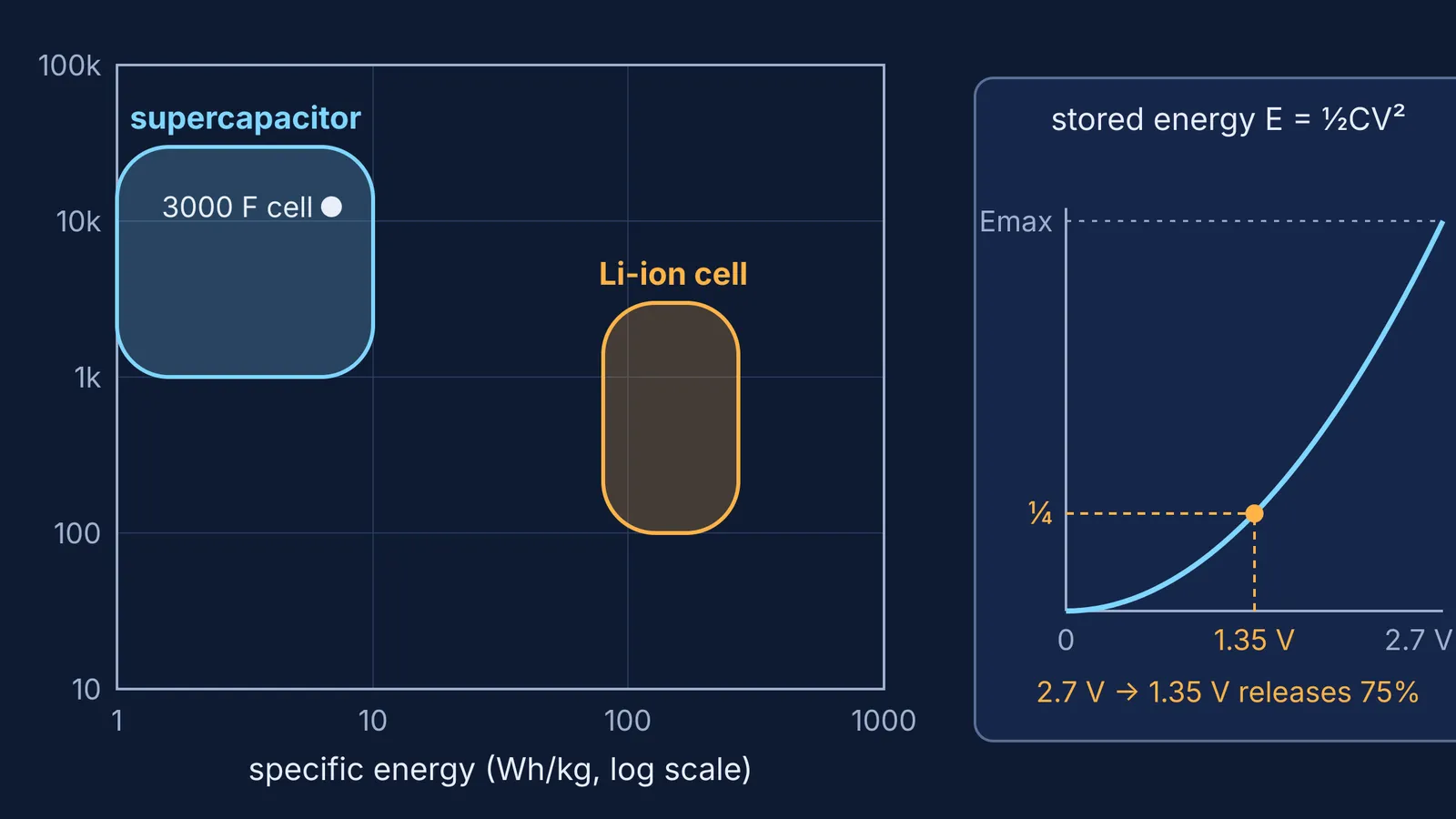
Specific energy. 3.04 Wh ÷ 0.475 kg ≈ 6.4 Wh/kg.
Phone battery. Take a typical 5000 mAh battery with a nominal 3.85 V. These are round illustrative values, not one product. Energy = 5.0 Ah × 3.85 V = 19.25 Wh = 69.3 kJ.
Cells needed. 19.25 ÷ 3.04 ≈ 6.3, so you need seven cells, about 3.3 kg of supercapacitor, to hold what a phone battery holds.
Now compare a lithium-ion cell. Panasonic's NCR18650B datasheet gives a rated capacity of 3200 mAh at a nominal 3.6 V, in a cell of at most 48.5 g. That is 3.2 × 3.6 = 11.5 Wh, and the datasheet quotes about 243 Wh/kg. Per kilogram, the Li-ion cell stores roughly 38 times more energy than the supercapacitor.
Why does the capacitor store so little energy if its charge is so large?
The charge on the full cell is Q = CV = 3000 × 2.7 = 8100 C. Since 1 Ah = 3600 C, that is 2.25 Ah, almost half the phone battery's 5 Ah. So the charge is not the problem.
The difference is the voltage at which that charge is delivered. A battery delivers its charge at a nearly steady voltage, so E ≈ QV. A capacitor's voltage falls in proportion to its charge as it discharges, so on average the charge leaves at half the starting voltage: E = ½QV = ½ × 8100 × 2.7 ≈ 10.9 kJ. Add the low cell voltage and the energy falls far behind. If you mix up mAh and Wh here, see how to convert battery mAh to coulombs: mAh × V gives mWh, not mAh alone.
Can you use all of the stored energy?
No, and this is where ½CV² often gets misused. Stored energy depends on V², so
At V/2 the cell still holds (½)² = ¼ of its energy.
Discharging from 2.7 V to 1.35 V therefore releases 75% of the energy, about 0.75 × 10.9 ≈ 8.2 kJ.
Many circuits cannot work below about half the rated voltage, so the usable energy is set by the voltage window, not by ½CV² at full charge. The same ¼ factor is a favourite exam trap with ordinary capacitors too; the three equivalent forms ½CV², ½QV and Q²/2C are covered in energy stored in a capacitor: which of the three forms to use.
A constant-current check: drawing 100 A from 2.7 V down to 1.35 V takes t = CΔV ÷ I = 3000 × 1.35 ÷ 100 ≈ 41 s (ignoring the small ESR drop).
Where do supercapacitors beat batteries?
Power: how fast the energy comes out. The internal resistance is tiny, so the current can be enormous. The maximum power into a load happens when the load resistance equals the internal resistance, and then P = V² ÷ 4R.
With the typical 0.15 mΩ: P = 2.7² ÷ (4 × 0.00015) ≈ 12 kW.
With the maximum 0.23 mΩ: about 7.9 kW.
That is kilowatts from one hand-sized cell. The datasheet's own impedance-match figure, 25.6 kW/kg typical, gives the same 12 kW for a 0.475 kg cell. At matched load half the power heats the cell, so this is a ceiling, not an operating point. The datasheet's usable specific power, about 12 kW/kg, is more realistic.
That is why supercapacitors are used where short, strong bursts matter: capturing regenerative braking energy in buses and trains, backing up memory and control circuits, and smoothing quick swings in the grid. They also survive far more charge–discharge cycles than Li-ion cells. Batteries win when you need a lot of energy over hours, which is why your phone uses one. The Concept Library has the capacitor and battery ideas behind this, laid out concept by concept.
Quick checklist
E = ½CV²: a 3000 F, 2.7 V cell stores about 10.9 kJ, or 3.04 Wh.
That is about 6.4 Wh/kg, against roughly 240 Wh/kg for an 18650 Li-ion cell.
Q = CV = 8100 C is large, but it is delivered at an average of V/2.
Going from V to V/2 releases 75% of the stored energy.
Peak power is V² ÷ 4R: supercapacitors are power devices, batteries are energy devices.
Datasheet values vary between makers and versions; quote them as approximate.


