On this page
A single photon carries about 3 eV. Hit a metal with it and you might free one electron, a charge of 1.6 × 10⁻¹⁹ C, far too small for any ordinary circuit to notice. A photomultiplier tube (PMT) turns that one electron into about a million, all arriving at the output within a few nanoseconds. That is enough to see each photon as a separate pulse. This post works out where the million comes from, how big the pulse is, and why the tube is so fussy about its power supply.
How does a photomultiplier tube work?
A PMT is an evacuated glass tube with three kinds of electrode.
Photocathode. A thin film inside the window. A photon above the threshold frees a photoelectron by the photoelectric effect.
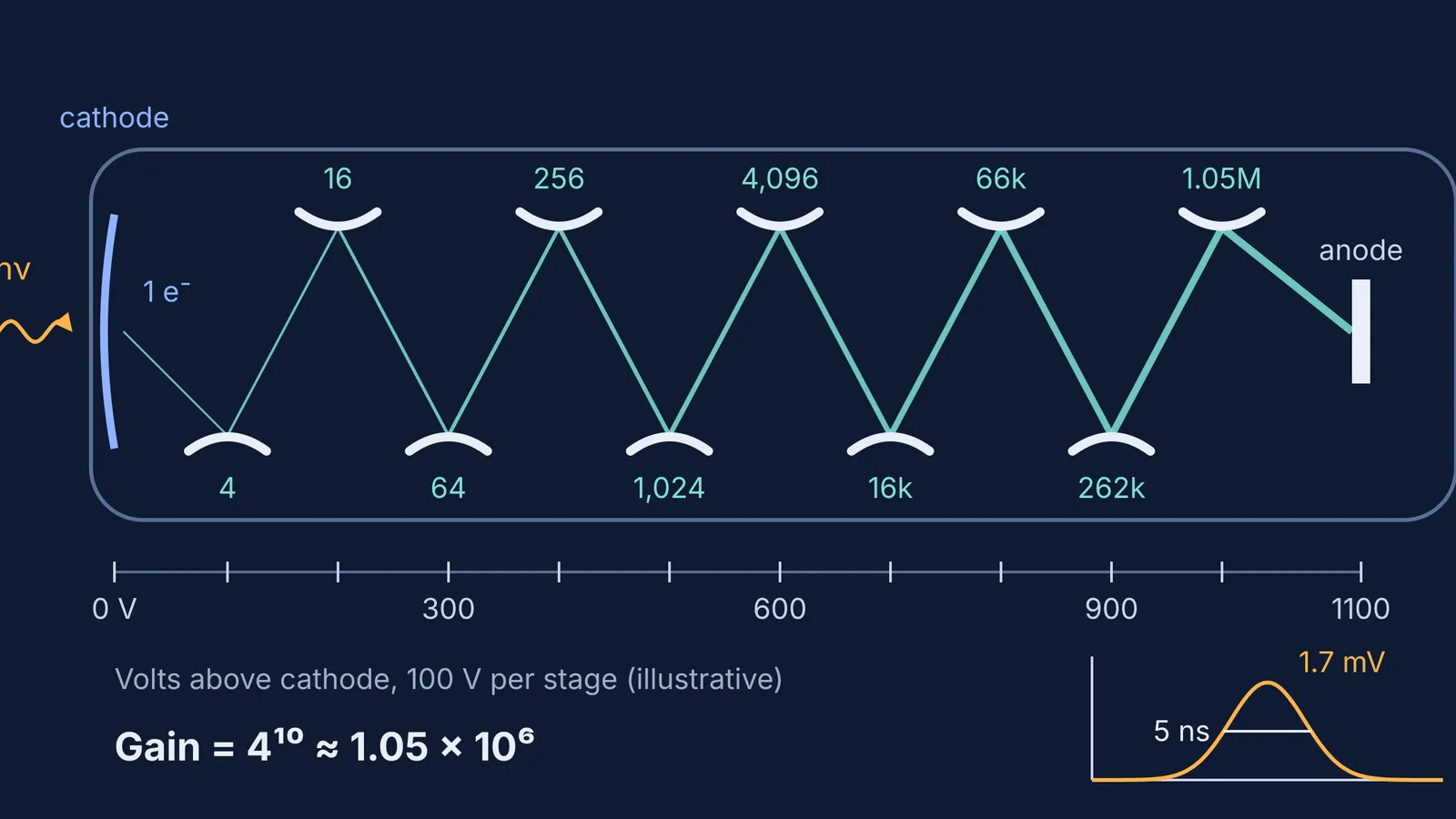
Dynodes. A chain of metal electrodes, often around ten, each held a hundred volts or so above the one before. The photoelectron is pulled to the first dynode, hits it, and knocks out several electrons. Those are pulled to the second dynode, and so on.
Anode. It collects the final cloud of electrons and delivers it to the external circuit as a current pulse.
Only the first step involves light. Everything after the cathode is electrons hitting metal.
Is a dynode an example of the photoelectric effect?
No, and this is the commonest slip. The dynodes are struck by electrons, not photons. When an electron accelerated through about 100 V lands on a dynode, its kinetic energy (about 100 eV) is shared among electrons in the surface, and several of them escape. This is secondary emission. The average number of electrons released per incoming electron is the secondary emission ratio, δ.
The Hamamatsu photomultiplier tube handbook gives δ = a·Eᵏ, where E is the voltage between dynodes, a is a constant, and k is set by the dynode material and structure, between 0.7 and 0.8. A value of δ around 3 to 5 per stage is a reasonable illustrative figure; the real number depends on the dynode surface and the voltage.
The photoelectric step is different, and it has already been covered in quantum efficiency in the photoelectric effect: only a fraction of photons free an electron at all.
How do you calculate the gain of a photomultiplier?
If every dynode multiplies the number of electrons by δ and there are n dynodes, the gain is
G = δⁿ
Worked example: from one photon to a pulse
Take δ = 4 per stage and n = 10 dynodes (illustrative values).
Count the electrons. After dynode 1 there are 4; after dynode 2, 16; after dynode 3, 64. After dynode 10 there are 4¹⁰ = 1,048,576, about 1.05 × 10⁶.
Charge at the anode. Q = G × e = 1.05 × 10⁶ × 1.602 × 10⁻¹⁹ C = 1.68 × 10⁻¹³ C.
Current. If that charge arrives in about 5 ns, the average current during the pulse is I = Q/t = 1.68 × 10⁻¹³ / 5 × 10⁻⁹ = 3.4 × 10⁻⁵ A, or 34 µA.
Voltage. Across a 50 Ω load, V = IR = 3.4 × 10⁻⁵ × 50 = 1.7 × 10⁻³ V, or 1.7 mV.
Compare. 1.7 mV for a few nanoseconds is easy for a fast amplifier and counter to register. One photoelectron makes one clear pulse.
The pulse width is realistic: the same Hamamatsu handbook lists output pulse widths of roughly 1.3 to 25 ns, depending on the dynode design.
Other combinations scale fast because n is an exponent:
δ = 3, n = 12: 3¹² = 5.3 × 10⁵.
δ = 4, n = 12: 4¹² = 1.7 × 10⁷.
δ = 5, n = 10: 5¹⁰ = 9.8 × 10⁶.
Adding two dynodes at δ = 4 multiplies the gain by 16.
Can a photomultiplier count single photons?
Yes, as long as the photon frees a photoelectron in the first place. That depends on the quantum efficiency (QE) of the cathode, not on the gain. Hamamatsu's handbook lists a typical bialkali photocathode with a peak quantum efficiency of about 27% near 390 nm, and gives 25% as a working assumption in its examples. A photon of 400 nm light carries E = 1,240/400 = 3.10 eV.
So even with a gain of a million, a bialkali PMT misses about three photons in every four. Gain amplifies the electrons you have; it cannot create a photoelectron that was never emitted.
Here is a quick estimate for very dim light. Suppose 1 pW of 400 nm light reaches the cathode.
Photons per second. 1 × 10⁻¹² W ÷ (3.10 × 1.602 × 10⁻¹⁹ J) = 2.0 × 10⁶ photons per second. The method is the one in number of photons emitted per second.
Photoelectrons. With QE = 0.25, that is 5.0 × 10⁵ photoelectrons per second.
Anode current. 5.0 × 10⁵ × 1.05 × 10⁶ × 1.602 × 10⁻¹⁹ C = 8.5 × 10⁻⁸ A, about 85 nA.
A picowatt of light becomes a current that is easy to measure.
Why does a photomultiplier need such a stable high voltage?
With a resistor chain dividing the supply V equally between stages, each stage gets a voltage proportional to V. Then δ ∝ Vᵏ for every stage, and the gain is
G = δⁿ ∝ Vᵏⁿ
That exponent is large. With k = 0.7 and n = 10, G ∝ V⁷.
Raise V by 1%. The gain changes by a factor of 1.01⁷ = 1.072.
So a 1% supply change shifts the gain by about 7%. With k = 0.8 it is about 8%.
The Hamamatsu handbook makes the same point: because gain varies as Vᵏⁿ, it is sensitive to drift, ripple and temperature changes in the high-voltage supply. That is why PMTs are run from regulated supplies of several hundred to over a thousand volts.
If you want to check a gain or signal calculation step by step, the Fermi Problem Library has a step-by-step solver that explains the reasoning.
Where are photomultipliers used?
Anywhere light is extremely faint or extremely brief: scintillation counters that turn a gamma-ray flash into a pulse, spectrometers, and large particle-physics detectors. Many newer instruments use silicon photomultipliers, which are arrays of tiny avalanche photodiodes, instead of vacuum tubes. PMTs are also mentioned in which metals show the photoelectric effect with visible light, since their cathodes use alkali metals for exactly that reason.
Quick checklist
Cathode: photoelectric effect, about 25% QE for bialkali near 400 nm.
Dynodes: secondary emission by electron impact, δ per stage.
Gain G = δⁿ; δ = 4 and n = 10 give 1.05 × 10⁶.
One photoelectron at that gain: 1.68 × 10⁻¹³ C, about 1.7 mV across 50 Ω in 5 ns.
Signal = photons × QE × gain × e.
G ∝ Vᵏⁿ, so 1% in supply voltage is about 7% in gain for 10 stages.