

On this page
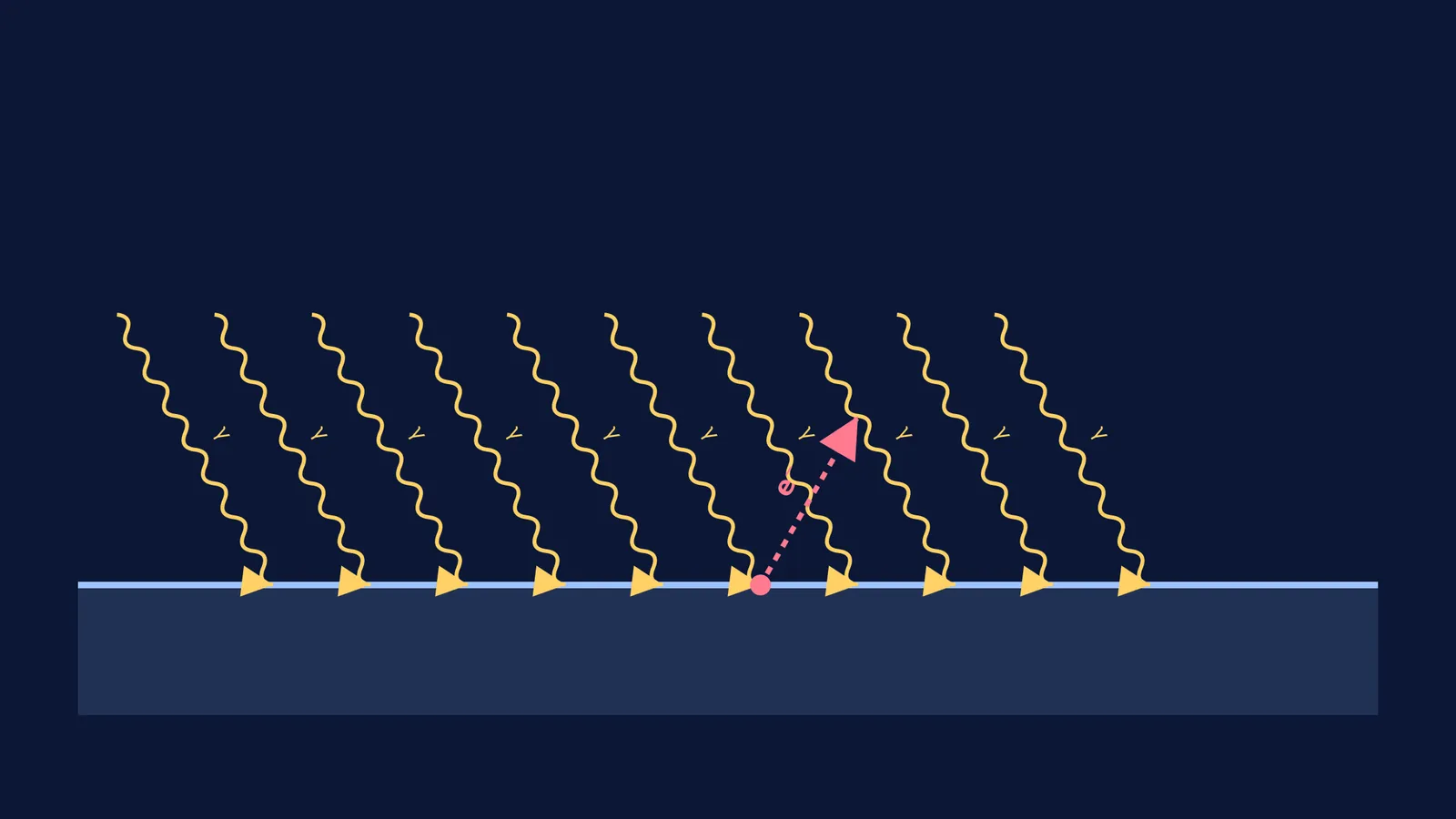
When you study the photoelectric effect, it is easy to imagine a perfect transaction: one photon goes in, and one electron comes out. But in reality, striking a metal plate with light does not guarantee that every single photon will free an electron. Most photons simply bounce off, pass through, or scatter their energy as heat.
The success rate of this process is called quantum efficiency. If you are preparing for JEE Main, NEET-UG, or your Class 12 board exams, knowing how to use this efficiency to connect light power to the resulting photocurrent is a common requirement.
What is quantum efficiency in the photoelectric effect?
Quantum efficiency (η) is the ratio of the number of photoelectrons emitted to the number of incident photons. It measures how effectively a material converts incoming light into an electrical current.
In the real world, this efficiency varies wildly depending on the material and the light's wavelength. For example, a standard photographic film has a quantum efficiency of less than 10%, while modern charge-coupled devices (CCDs) can exceed 90%. Standard metal plates used in basic physics demonstrations have a very low efficiency, meaning it takes many incident photons to eject just one electron.
How do you convert photons to electrons?
To find the number of electrons emitted, you first need to know how many photons are hitting the surface. Light is a stream of energy, and the total power (P) of the light beam is the sum of the energies of all the individual photons arriving each second.
The energy of a single photon is given by E = hc / λ, where h is Planck's constant, c is the speed of light, and λ is the wavelength. To speed up your calculations, you can remember that E = 1240/λ: the quick photon-energy formula in eV and nm.
Once you have the energy of one photon, you can find the number of photons emitted per second (n_p) by dividing the total power by the energy of a single photon:
n_p = P / E
To convert this stream of photons into a stream of electrons (n_e), simply multiply by the quantum efficiency (η):
n_e = η × n_p
If you find yourself freezing when asked to build these chains of equations, Fermi's AI tutor can help. It works out what you already know and builds a plan for the session, checking your understanding as it goes.
How to find photocurrent from light power and wavelength?
The photocurrent (I) is the total charge flowing per second. Since each electron carries a fundamental charge (e = 1.6 × 10⁻¹⁹ C), you find the current by multiplying the number of emitted electrons by this charge:
I = n_e × e
Let us look at a worked example. Suppose a 2.0 mW laser with a wavelength of 400 nm shines on a metal surface, and the quantum efficiency is 5% (0.05). What is the resulting photocurrent?
Find the energy of one photon.
Using standard SI units, E = (6.63 × 10⁻³⁴ J s × 3.0 × 10⁸ m/s) / (400 × 10⁻⁹ m) = 4.97 × 10⁻¹⁹ J.
Find the number of incident photons per second.
n_p = (2.0 × 10⁻³ W) / (4.97 × 10⁻¹⁹ J) = 4.02 × 10¹⁵ photons per second.
Find the number of emitted electrons.
With a 5% efficiency, n_e = 0.05 × 4.02 × 10¹⁵ = 2.01 × 10¹⁴ electrons per second.
Calculate the photocurrent.
I = 2.01 × 10¹⁴ × 1.6 × 10⁻¹⁹ C = 3.22 × 10⁻⁵ A, or 32.2 μA.
Why isn't every photon successful?
When a beam of light hits a metal target, several things get in the way of a perfect 100% conversion rate. First, the incident light might be below the threshold frequency. If the photon energy is less than the metal's work function, the quantum efficiency is exactly zero. No matter how intense the light is, electrons will not budge.
Even if the frequency is high enough, other hurdles remain:
Reflection: The metal surface reflects a large portion of the incoming light before the photons even have a chance to interact with the electrons inside.
Depth of interaction: Many photons penetrate deep into the metal before they strike an electron. Even if an electron absorbs the photon's energy, it must travel back to the surface. Along the way, it collides with the crystal lattice and loses kinetic energy. If it loses too much energy, it drops below the work function required to escape and remains trapped inside.
Competing processes: Sometimes, the energy from a photon is transferred directly to the atomic lattice as vibrational heat (phonons) rather than ejecting a photoelectron.
These obstacles explain why textbook problems often specify such low efficiencies. By understanding the physical barriers at play, the mathematical penalty applied to your incident photons makes logical sense. If you want to review the full theory behind this, the Fermi Concept Library explains every concept in physics. To practice more scenarios involving varying efficiencies and work functions, the Fermi Problem Library has worked problems with a step-by-step solver that explains the reasoning rather than printing an answer.


