On this page
The biggest things at a coal power station are the cooling towers, with white plumes rolling off the top. They are not chimneys. Each one is a giant evaporator that dumps the heat the station cannot turn into electricity. You can work out how much water it boils off with two Class 11 formulas, Q = mcΔT and Q = mL, and the answer comes out close to the figure India's Central Electricity Authority (CEA) uses for plant design: about 2 litres of water for every unit (kWh) of electricity.
Why does a power station have to throw heat away at all?
A thermal power station is a heat engine. Steam drives a turbine, and the used steam must be condensed back to water before it returns to the boiler. The second law of thermodynamics (Kelvin–Planck statement) says no engine working in a cycle can turn all the heat it takes in into work. Some heat must always go to a colder reservoir.
In a power station that colder reservoir is the condenser, cooled by a huge flow of water. How the steam moves round the cycle is covered in William Rankine's cycle and how steam power plants make electricity, and the rough split between heat in and electricity out is worked for a nuclear plant in how much uranium a 1000 MW reactor uses per day. Here we follow the rejected heat to the end of its journey.
How does a cooling tower get rid of the heat?
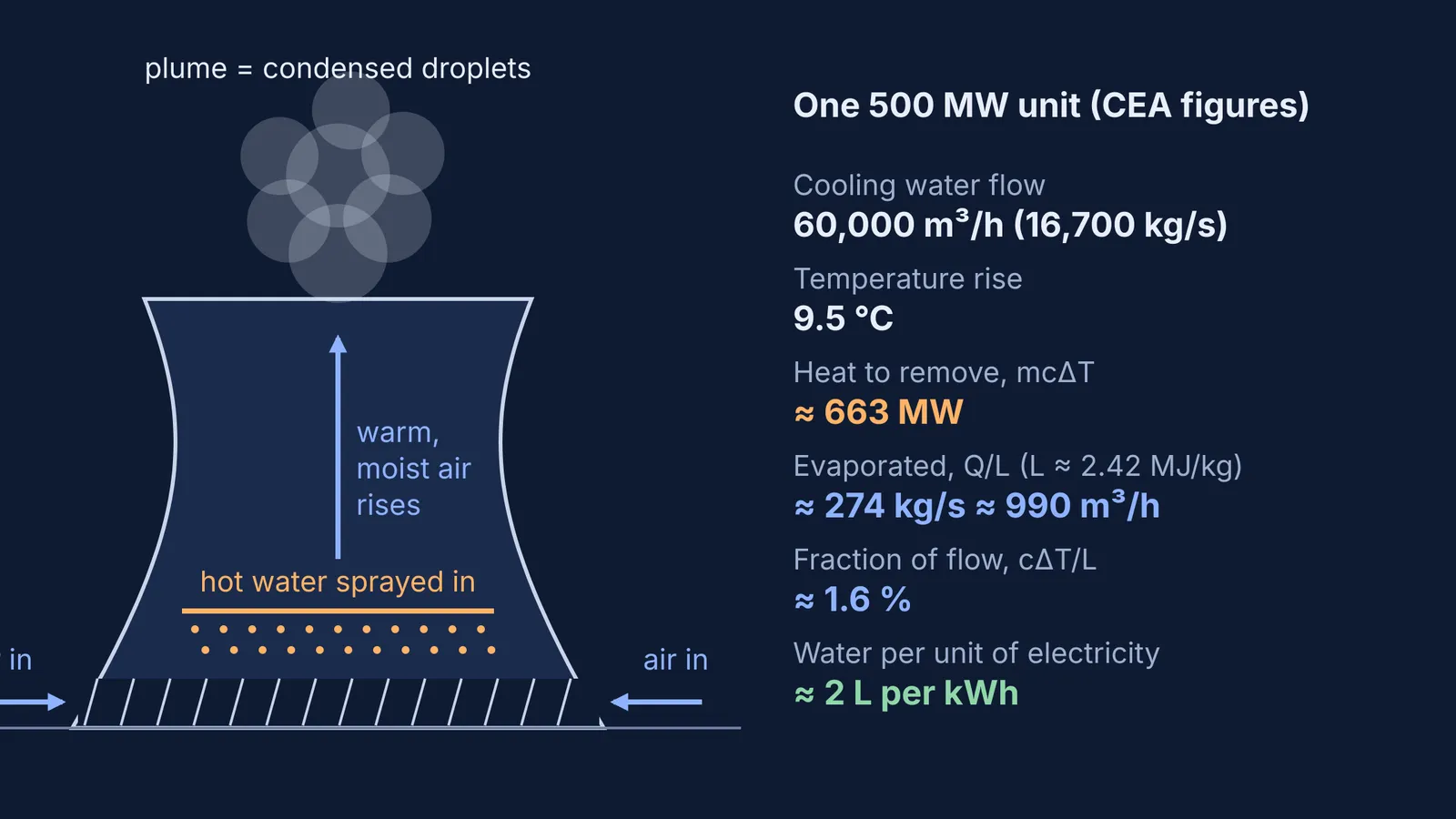
The condenser warms the cooling water by a few degrees. That warm water is pumped to the cooling tower and sprayed down over packing inside it. Air enters through the open base and moves up through the falling water.
Two things happen as air meets the warm water:
Evaporation. A small part of the water evaporates. Each kilogram that turns to vapour takes its latent heat with it, cooling the rest. This is the same physics as how a clay pot matka keeps water cool, on an industrial scale.
Sensible heating. The air itself gets warmer, carrying some heat away without any change of state.
The cooled water collects at the bottom and returns to the condenser. The warm, moist air rises up the tower. In a natural-draught tower it rises on its own: warm air is less dense, and moist air is lighter still, because a water molecule (M = 18 g/mol) is lighter than the average air molecule (about 29 g/mol).
How much water does a cooling tower evaporate? A worked example
The CEA's 2012 report on minimising water use in coal-based thermal power stations says a typical 500 MW coal unit needs about 60,000 m³/h of cooling water for its condenser and auxiliaries, with a temperature rise of about 9.5 °C across the condenser.
Mass flow of cooling water. 60,000 m³/h ÷ 3,600 s/h = 16.7 m³/s. Taking 1 m³ of water as about 1,000 kg, this is about 16,700 kg/s.
Heat removed. Q = mcΔT = 16,700 kg/s × 4,186 J/(kg K) × 9.5 K ≈ 6.63 × 10⁸ W, or about 663 MW. That is 1.3 times the unit's electrical output.
Latent heat. The water in the tower is at roughly 30–40 °C, not 100 °C. Steam tables give the latent heat of vaporisation at 35 °C as about 2.42 MJ/kg.
Evaporation rate. If all of that heat left as latent heat, the mass evaporated would be 6.63 × 10⁸ W ÷ 2.42 × 10⁶ J/kg ≈ 274 kg/s. That is about 990 m³/h.
Compare with the CEA. The same report says evaporation in the cooling tower of a typical 500 MW unit is about 1,000 m³/h. Our estimate lands on it.
Per unit of electricity. In one hour the unit makes 500 MWh = 500,000 kWh and evaporates about 987 m³ = 987,000 L. That is about 2.0 L per kWh.
Over a full day the unit evaporates about 23,700 m³, roughly nine and a half Olympic pools (taking about 2,500 m³ per pool). If your 1.5 kW air conditioner runs for 8 hours on coal power, that is 12 kWh, so about 24 L of river water went up a cooling tower to supply it.
Why does only about 1.6% of the water evaporate?
Divide the two heat equations. For the heat taken from the circulating water to equal the heat carried off by evaporation, m_evap × L = m_cw × c × ΔT, so
m_evap / m_cw = cΔT / L = 4,186 × 9.5 ÷ 2.42 × 10⁶ ≈ 0.016, or 1.6%.
The CEA report puts cooling tower evaporation at 1.5–1.7% of the circulating water flow. It depends only on the temperature rise and the latent heat, not on the size of the plant. Water's large latent heat is the reason a small fraction can carry so much heat: evaporating 1 kg removes as much heat as warming about 61 kg of water by 9.5 °C.
Is all the heat carried away by evaporation?
No. Some leaves as sensible heat in the warmed air, and the share depends on the weather. In hot, dry air, evaporation does nearly all the work. In cold or very humid air, more of the heat goes into warming the air. So treat 274 kg/s as an upper-end estimate. That it matches the CEA figure tells you that in Indian design conditions, evaporation carries almost all of the load.
Evaporation is also not the only loss. Water that evaporates leaves its dissolved salts behind, so the circulating water gets saltier. To stop scale forming, the plant drains off some of it (blowdown) and loses a little as spray carried out of the tower (drift). For a 2 × 500 MW plant the CEA table lists evaporation 2,040 m³/h, drift 60 m³/h and blowdown 450 m³/h, so the make-up water drawn from the river is 2,550 m³/h, about 2.6 L per kWh. Only the evaporation is set by the physics above.
What is the white plume, and why not just use river water once?
The plume is not smoke. The air leaving the tower is warm and nearly saturated. As it mixes with cooler outside air it cools below its dew point, and the vapour condenses into tiny droplets, just like your breath on a winter morning. The vapour itself is invisible.
A plant could instead pass river water once through the condenser and send it back warmer, which heats the river. The CEA report notes that since 1999, new plants using fresh water have not been allowed to use once-through cooling for this reason, while coastal plants may still use sea water this way. For more on heat, temperature and change of state, the Fermi Concept Library covers latent heat and the second law.
Quick checklist
A power station must reject heat (second law); the cooling tower does it mostly by evaporation.
Heat removed: Q = mcΔT with the circulating flow and its temperature rise.
Water evaporated: Q ÷ L, with L ≈ 2.42 MJ/kg at about 35 °C, not 2.26 MJ/kg.
Fraction evaporated ≈ cΔT/L ≈ 1.6% for a 9.5 °C rise.
A 500 MW unit evaporates about 1,000 m³/h, roughly 2 L per kWh.
Make-up water is larger than evaporation because of blowdown and drift.
The plume is condensed droplets, not smoke.