On this page
You walk across a carpet, reach for a metal door handle and a spark snaps across before your finger touches it. The voltage behind that spark can be thousands of volts, yet you walk away unhurt. The reason is that your body behaves like a small capacitor. Treat it as one, use Q = CV and U = ½CV², and the numbers explain both the sting and why it is harmless.
Why does your body act like a capacitor?
A capacitor is two conductors separated by an insulator. Your body is a conductor. The floor, walls and nearby metal are the other conductor. The air around you and the soles of your shoes are the insulator. When you walk on a carpet, rubbing transfers charge between your shoes and the carpet, and you build up a charge that has nowhere to go. Why this happens far more in dry weather is covered in why we get static shocks more in dry winter weather, so we start from the charged body.
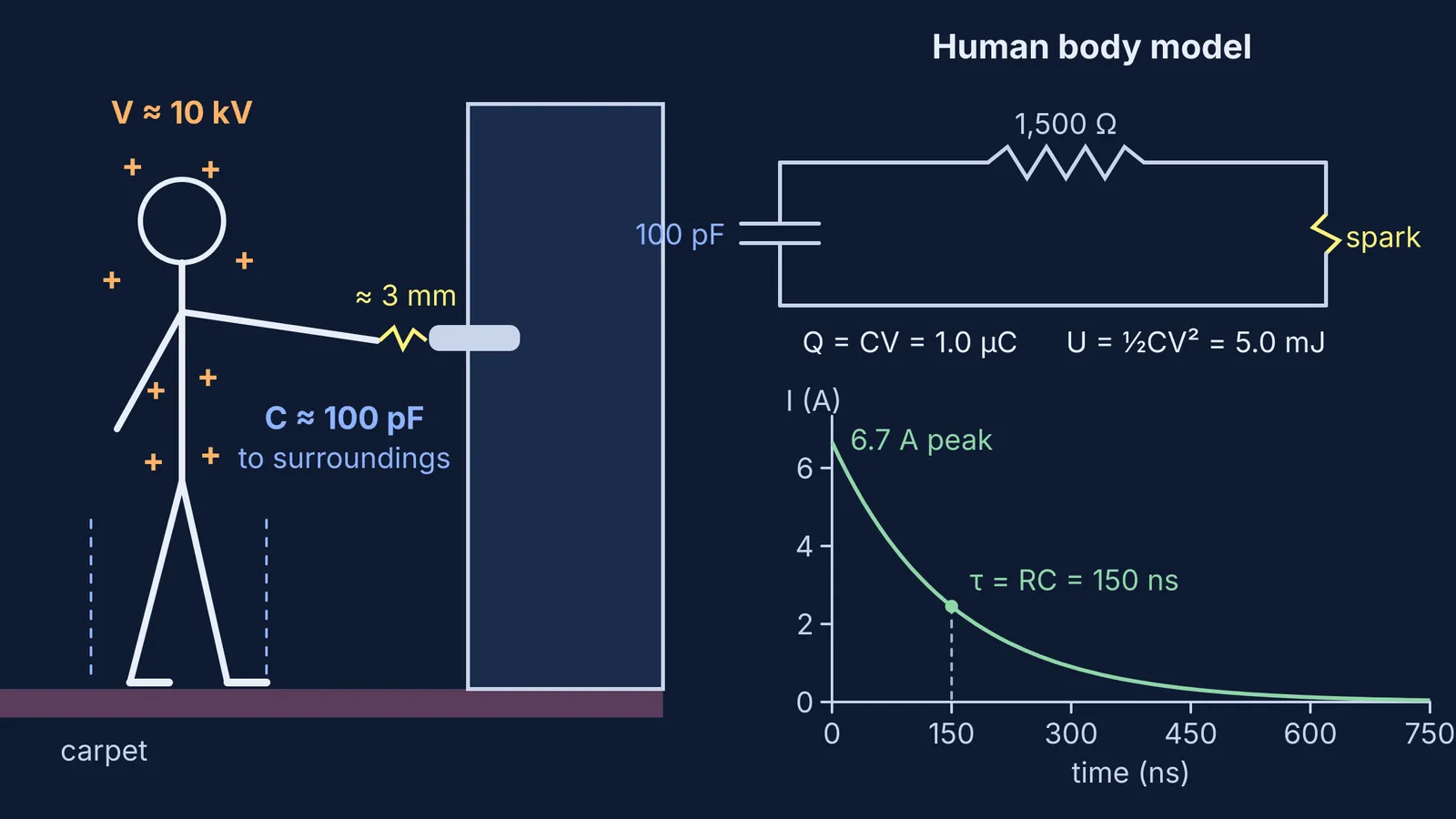
How big is the capacitance? The electronics industry needs a standard answer, because charged people damage microchips. Its human body model treats a person as a 100 pF capacitor that discharges through a 1,500 Ω resistor, as described by the ESD Association in its guide to device sensitivity and testing. Real people vary with posture, shoes and floor, so treat 100 pF as a standard model value, not a measurement of you.
For a feel of the size: an isolated metal sphere would need a radius of about 0.9 m to have 100 pF, since C = 4πε₀R. Your body gets there partly because it sits close to the floor, with only your soles in between.
How high can the voltage get?
The ESD Association's introduction to ESD gives typical voltages for walking across a carpet: about 35,000 V at 10–25% relative humidity, but only about 1,500 V at 65–90%. The real value depends on the shoes, the carpet and how you walk. For the worked example we take a round, illustrative 10 kV, well inside that range.
How much charge and energy is in a door-handle shock?
Take C = 100 pF and V = 10 kV.
Charge. Q = CV = 100 × 10⁻¹² F × 10,000 V = 1.0 × 10⁻⁶ C = 1.0 µC.
Number of electrons. n = Q/e = 1.0 × 10⁻⁶ ÷ 1.602 × 10⁻¹⁹ ≈ 6.2 × 10¹² electron charges, gained or lost depending on the materials. That sounds like a lot, but it is about a millionth of a coulomb.
Stored energy. U = ½CV² = ½ × 100 × 10⁻¹² × (10⁴)² = 5.0 × 10⁻³ J = 5.0 mJ. That is about the energy needed to lift a 1 g object by half a metre.
Peak current. With the model's 1,500 Ω, I₀ = V/R = 10,000 ÷ 1,500 ≈ 6.7 A.
How long it lasts. The time constant is τ = RC = 1,500 Ω × 100 × 10⁻¹² F = 1.5 × 10⁻⁷ s = 150 ns. After 5τ (0.75 µs) the discharge is essentially over.
Check the units. F × V = C, F × V² = J, and Ω × F = s. All consistent.
So a 6.7 A peak sounds alarming, but it lasts well under a microsecond and carries only 5 mJ. Because U grows as V², halving the voltage to 5 kV cuts the energy to a quarter, 1.25 mJ. At the dry-air extreme of 35 kV, the energy rises to about 61 mJ, still a small amount.
Why does the spark jump before you touch the handle?
As your finger approaches the handle, the gap between them shrinks while the voltage across it stays at about 10 kV. The field in the gap is roughly E = V/d, so it grows as d gets smaller. Air breaks down at about 3 MV/m, the same figure used in the maximum charge a sphere can hold in air.
Set E = 3 × 10⁶ V/m and solve: d = V/E = 10⁴ ÷ 3 × 10⁶ ≈ 3.3 × 10⁻³ m, about 3 mm. That is why the spark leaps across a small gap. Treat this as an estimate. The 3 MV/m value applies to gaps of a centimetre or more; very short gaps need a higher field before they break down (Paschen's law), and the field around a fingertip is not uniform. The order of magnitude, millimetres, is still right.
Why is a 10 kV shock harmless when 230 V mains is dangerous?
Voltage alone does not decide danger. What matters is how much charge flows through you, and for how long.
The static shock is a fixed parcel of charge, about 1 µC. Once it has flowed, the capacitor is empty. The whole event is over in under a microsecond and delivers a few millijoules.
Mains supply is not a small capacitor. The supply keeps pushing current for as long as you stay in contact, second after second, with no limit to the energy it can deliver.
That difference, a tiny stored charge against a source that never runs out, is why the door-handle spark is startling but not dangerous in itself, while mains can kill. Never test this with mains wiring.
Why does holding a key stop the sting?
The sting comes from the spark's current flowing into a tiny patch of skin at your fingertip, where there are many nerve endings. If you hold a metal key firmly and touch the handle with its tip, the spark jumps between key and handle. The same charge then flows into your hand through the large area of skin in contact with the key, so the current per unit area at the skin is much smaller and you barely feel it.
The same tiny charge is a problem for electronics. The ESD Association notes that many devices are damaged by less than 100 V, far below what you would ever feel, which is why repair benches use grounded wrist straps. If you want more capacitor problems worked like this one, the Fermi Problem Library has a step-by-step solver that explains the reasoning. The field-energy view of the same 5 mJ, u = ε₀E²/2, is worked in energy density in an electric field.
Quick checklist
Your body is a capacitor: you are one plate, the surroundings the other.
Human body model: 100 pF in series with 1,500 Ω.
Q = CV: 1.0 µC at 10 kV, about 6.2 × 10¹² electrons.
U = ½CV²: 5.0 mJ at 10 kV; energy grows as V².
τ = RC = 150 ns, so the discharge is over in under a microsecond.
Spark gap ≈ V/E ≈ 3 mm at 3 MV/m (an estimate).
A static shock is a fixed small charge; mains keeps supplying current.