On this page
Hot-rolled steel comes off the mill covered in a dark grey crust of iron oxides called scale. Before the steel can be galvanised, cold-rolled or drawn into wire, that crust has to go. The usual way to remove it is to run the steel through a bath of hydrochloric acid. This is called pickling. Its reactions are Class 10 and 11 chemistry, and one of them lets the plant turn its waste acid back into fresh acid.
Why is steel pickled in hydrochloric acid?
Scale forms when red-hot steel meets air. It builds up in layers: wüstite (FeO) next to the metal, magnetite (Fe₃O₄) in the middle, and a thin skin of haematite (Fe₂O₃) on the outside. Layer thickness varies with rolling temperature and cooling, so there is no fixed composition.
All three are basic oxides, so they dissolve in acid to give a salt and water. Each equation below balances in atoms and in charge:
FeO + 2HCl → FeCl₂ + H₂O
Fe₃O₄ + 8HCl → FeCl₂ + 2FeCl₃ + 4H₂O
Fe₂O₃ + 6HCl → 2FeCl₃ + 3H₂O
Magnetite gives both chlorides because it contains Fe²⁺ and Fe³⁺ in a 1 : 2 ratio. Read it as FeO·Fe₂O₃ and add the first and third equations.
Hydrochloric acid at about 18% is the most common pickling agent for carbon steel, according to the Wikipedia article on hydrochloric acid. Sulphuric acid is also used. It gives FeSO₄·7H₂O as a by-product, but this post follows the HCl route.
Why is spent pickle liquor mostly FeCl₂, not FeCl₃?
Once the scale cracks, the acid reaches bare iron, and the iron does two things.
First, it reduces the ferric chloride the scale has made:
Fe + 2FeCl₃ → 3FeCl₂
This is a comproportionation. Iron goes from 0 to +2 and two Fe³⁺ go from +3 to +2, so the electrons balance (2 lost, 2 gained). The standard potentials agree: Fe³⁺/Fe²⁺ is +0.77 V and Fe²⁺/Fe is −0.44 V, so E°cell = 0.77 − (−0.44) = +1.21 V, which is strongly favourable. The same electrode potential ladder explains why iron and dilute HCl give ferrous chloride, not ferric.
Second, the acid attacks the iron itself:
Fe + 2HCl → FeCl₂ + H₂
For the plant this reaction is pure waste. It eats steel and acid, and some hydrogen enters the metal and can make it brittle. So baths contain inhibitors, organic compounds that adsorb on bare metal and slow this reaction while the oxide still dissolves.
Both routes end at Fe²⁺. That is why a tank of spent liquor is pale green FeCl₂ with some leftover free HCl, and only a little Fe³⁺.
How does a roaster turn FeCl₂ back into HCl?
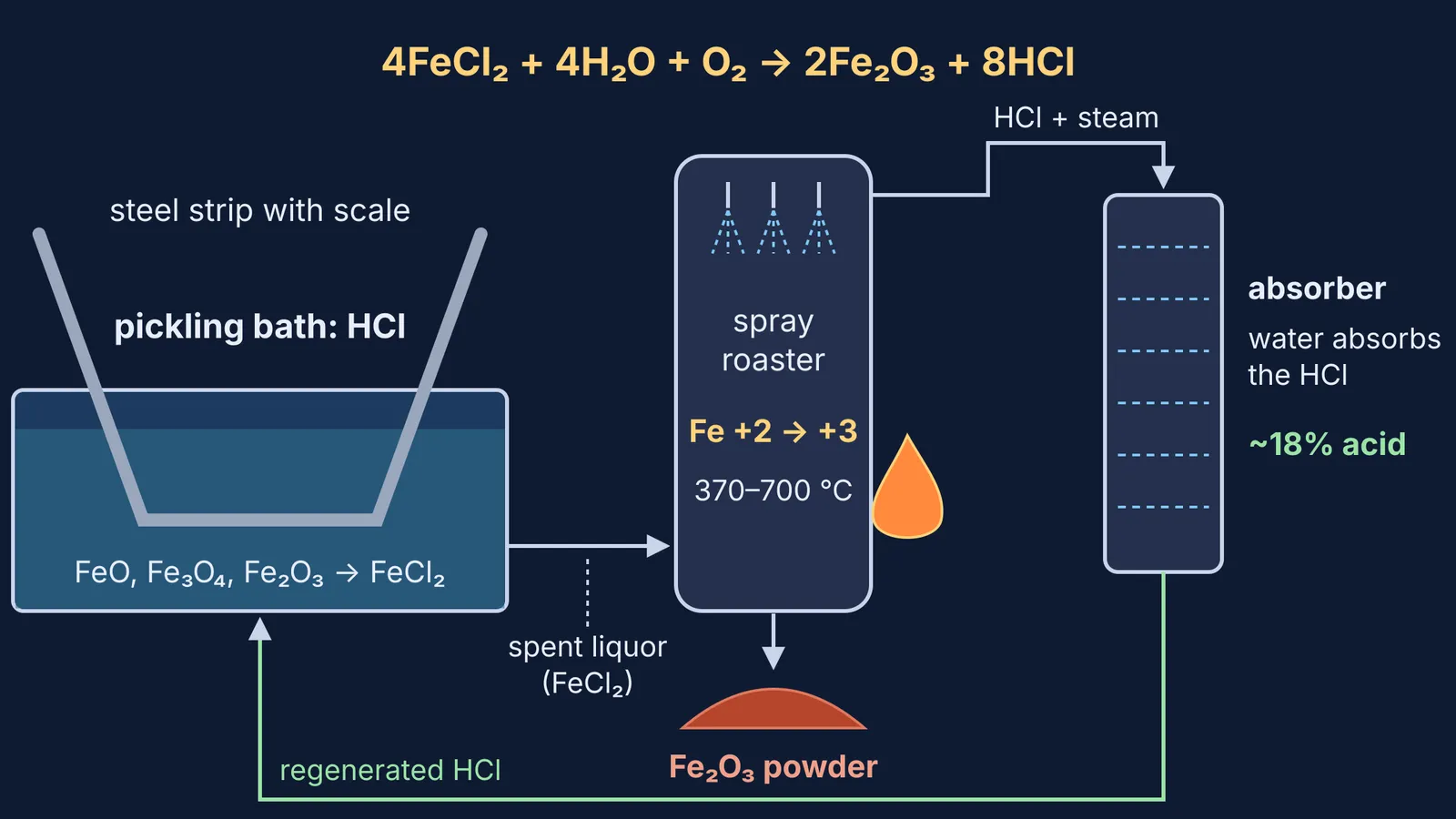
Rather than dump it, many plants regenerate the acid by pyrohydrolysis. The overall reaction is:
4FeCl₂ + 4H₂O + O₂ → 2Fe₂O₃ + 8HCl
Check it: Fe 4 = 4; Cl 8 = 8; H 8 = 8; O 4 + 2 = 6 = 6. For the redox part, four Fe²⁺ each lose one electron (+2 → +3), and one O₂ gains four.
You can see it as two steps. Air oxidises Fe²⁺ to Fe³⁺. Then the iron(III) chloride is hydrolysed by steam, 2FeCl₃ + 3H₂O → Fe₂O₃ + 6HCl, in the same way that heating hydrated MgCl₂ gives MgO and HCl fumes. An H⁺ leaves with a Cl⁻ as HCl gas, and because the gas escapes, the reaction runs to the oxide. Fe³⁺ has a higher charge density than Fe²⁺, so the oxidation step is what makes the hydrolysis go readily.
In a spray roaster (the Ruthner type), the liquor is sprayed in at the top of a tall, gas-fired chamber. The droplets dry, oxidise and hydrolyse as they fall, and Fe₂O₃ powder collects at the bottom. The Wikipedia article on acid regeneration gives temperatures from about 700 °C at burner level to about 370 °C at the gas exit, and a typical regenerated acid strength of 18% by mass. The other common design is the fluidised-bed roaster (the Lurgi type), which turns the oxide into granules instead of powder.
The hot gas goes to an absorption column, where water dissolves the HCl, and the acid returns to the tank. The iron oxide is sold, for example for ferrites and pigments.
Why does the recovered acid stay below about 20%?
HCl and water form a maximum-boiling azeotrope at about 20.2% HCl, which boils at about 108.6 °C at 1 atm (Wikipedia). Boil an acid weaker than this and the vapour is richer in water than the liquid, so the liquid gets stronger, but only up to 20.2%. At that point vapour and liquid have the same composition, and boiling cannot concentrate it further. Our post on minimum and maximum boiling azeotropes explains the negative deviation from Raoult's law behind this.
The roaster gas carries a lot of steam from the liquor's own water, so the absorber is making acid from a wet gas, not from dry HCl. That is one reason regenerated acid is quoted near the azeotrope (typically about 18%) rather than at the 32–36% of commercial concentrated acid. It suits the plant, because about 18% is the strength the bath runs on anyway.
Worked example: how much acid does one cubic metre of liquor give back?
The figures are illustrative teaching values, not plant data. A spent liquor contains 125 g/L FeCl₂ and 20 g/L free HCl. You roast 1.00 m³ of it. Find the mass of HCl recovered, the mass of 18% acid it makes, the mass of Fe₂O₃, and the oxygen needed.
Moles of FeCl₂. Molar mass of FeCl₂ = 55.85 + 2 × 35.45 = 126.75 g/mol. 1.00 m³ = 1000 L, so the mass is 125 kg. Moles = 125,000 / 126.75 = 986 mol.
HCl from the roaster. From the equation, 4 FeCl₂ give 8 HCl, so 1 : 2. HCl = 2 × 986 = 1,972 mol. Mass = 1,972 × 36.46 g/mol = 71.9 kg.
Add the free acid. The 20 g/L of free HCl simply evaporates and is recovered too: 20 kg. Total HCl = 71.9 + 20 = 91.9 kg.
Mass of 18% acid. 91.9 / 0.18 = 511 kg, about 510 kg of regenerated acid.
Iron oxide. 4 FeCl₂ give 2 Fe₂O₃, so 1 : 0.5. Fe₂O₃ = 493 mol × 159.69 g/mol = 78.7 kg.
Oxygen. 4 FeCl₂ need 1 O₂. O₂ = 986 / 4 = 247 mol. At 0 °C and 1 atm (22.4 L/mol) that is about 5.5 m³ of O₂, or roughly five times that volume of air.
In the ideal case every chloride ion comes back as HCl, and only iron leaves the loop, as oxide. Real plants lose a little HCl in exit gas and rinse water. If stoichiometry chains like this trip you up, the Fermi Problem Library has a step-by-step solver that explains the reasoning at each mole ratio.
Quick checklist
Fe₃O₄ gives FeCl₂ and 2FeCl₃ with 8 HCl.
Bare iron reduces Fe³⁺ (E°cell = +1.21 V), so spent liquor is mostly FeCl₂.
Regeneration: 4FeCl₂ + 4H₂O + O₂ → 2Fe₂O₃ + 8HCl, which is oxidation plus chloride hydrolysis.
FeCl₂ : HCl : Fe₂O₃ : O₂ = 4 : 8 : 2 : 1.
The HCl–water azeotrope (about 20.2%) helps explain why regenerated acid is about 18%, not 36%.