On this page
Drop iron filings into dilute hydrochloric acid and you get bubbles of hydrogen and a pale green solution of iron(II) chloride, FeCl2. Pass chlorine over hot iron and you get iron(III) chloride, FeCl3. Why the different oxidation states? Two numbers from the electrode potential table explain it, and one reagent proves it.
Why does iron give ferrous chloride, not ferric, with HCl?
The reaction textbooks write is Fe + 2HCl → FeCl2 + H2, as given on the iron(II) chloride page_chloride), which also notes that FeCl2 gives pale green solutions.
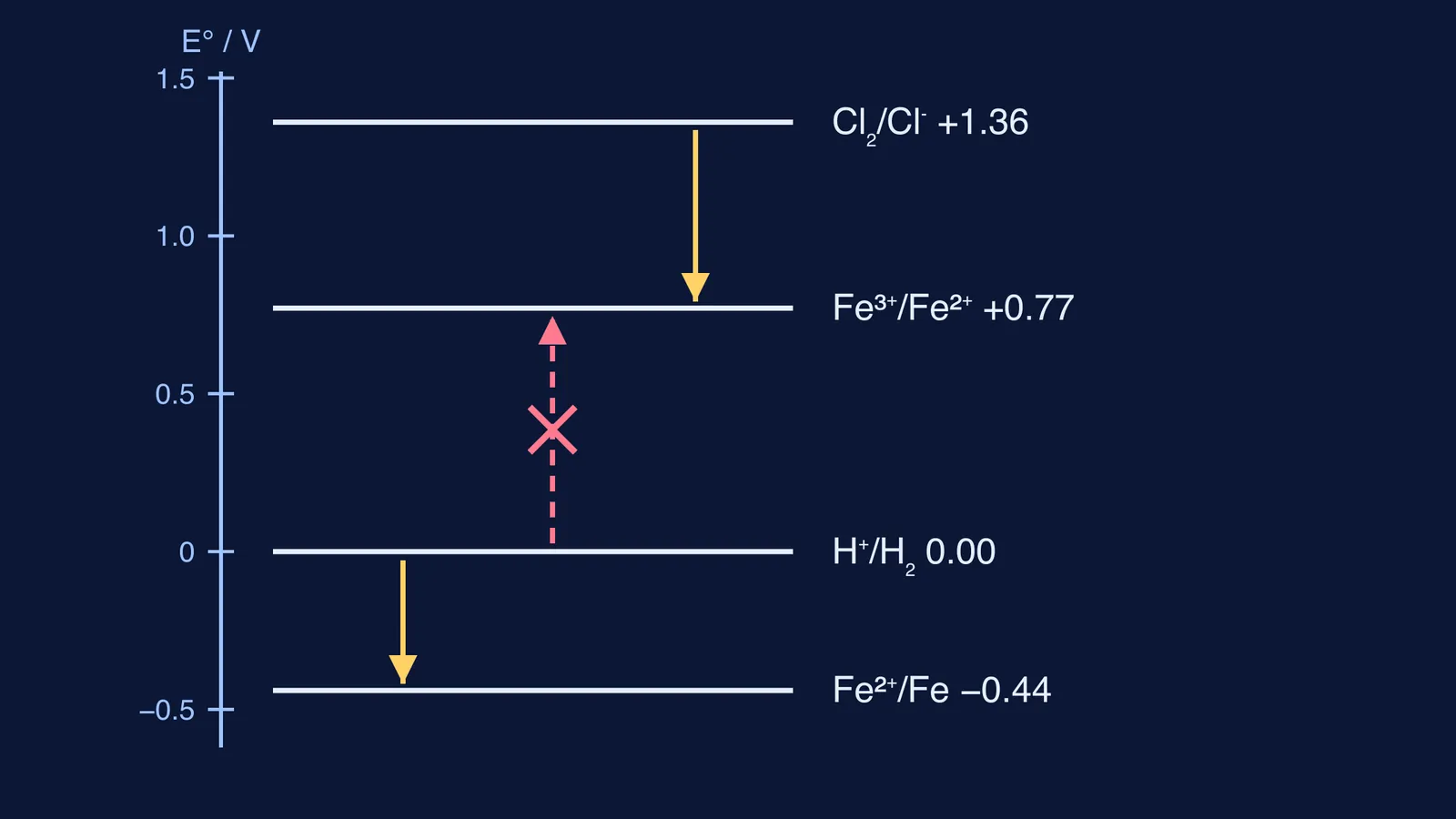
To see why it stops there, line up the standard reduction potentials from the standard electrode potential data table):
Fe2+ + 2e− → Fe: E° = −0.44 V
2H+ + 2e− → H2: E° = 0 V (the reference)
Fe3+ + e− → Fe2+: E° = +0.771 V
Cl2 + 2e− → 2Cl−: E° = +1.36 V
The rule: under standard conditions, an oxidising agent can oxidise anything whose couple sits below its own on this ladder. For a redox reaction, E°cell = E°(couple being reduced) − E°(couple being oxidised), and a positive E°cell means a negative ΔG° (since ΔG° = −nFE°cell), so the reaction is thermodynamically favourable.
Step 1, iron to Fe2+. H+ is reduced, iron is oxidised. E°cell = 0 − (−0.44) = +0.44 V. Positive, so H+ can take iron to +2. This is the hydrogen you see bubbling.
Step 2, Fe2+ to Fe3+. Can H+ go further? E°cell = 0 − (+0.771) = −0.771 V. Negative, so no. H+ is too weak an oxidant to pull another electron off Fe2+.
If you mix up which potential goes first, our post on reduction vs oxidation potential signs walks through it.
Why does chlorine give FeCl3 instead?
Using the same data table), Cl2/Cl− sits at +1.36 V, above both iron couples.
Fe to Fe2+: E°cell = 1.36 − (−0.44) = +1.80 V, so yes.
Fe2+ to Fe3+: E°cell = 1.36 − 0.771 = +0.589 V, so yes again.
Chlorine can take iron all the way to +3. The iron(III) chloride page_chloride) gives the principal industrial route as 2Fe + 3Cl2 → 2FeCl3 at several hundred degrees, and notes that excess chlorine is used to make sure the intermediate ferrous chloride is converted to the ferric state.
The same ladder explains why air spoils FeCl2 solutions over time. The O2/H2O couple is listed at +1.229 V in the data table), above +0.771 V, and Doc Brown's iron chemistry notes confirm that iron(II) compounds are readily oxidised by dissolved oxygen to iron(III). That is why the test below uses a freshly made solution.
How do you prove it is Fe2+ in the lab?
Use potassium ferricyanide, K3[Fe(CN)6]. Its reference page states that it reacts with ferrous iron in acidic solution to give an insoluble blue pigment called Turnbull's blue, and that ferric iron is detected with potassium ferrocyanide instead. Doc Brown's notes also use the dark blue precipitate from K3[Fe(CN)6] as the test for Fe2+.
Add a few iron filings to dilute HCl in a test tube and wait until the fizzing slows.
Decant a little of the clear, pale green liquid into a clean tube.
Add a few drops of potassium ferricyanide solution.
A dark blue precipitate means Fe2+ is present.
For contrast, test a ferric chloride solution with potassium ferrocyanide, the ferric test.
Do this with your teacher and wear eye protection.
A three-step check for any "what product forms?" question
The same logic works for other metals and oxidants. Before you write a product, run this check:
List every couple the metal can pass through (for iron: 0 to +2, then +2 to +3) with its E°.
Put the oxidant's E° next to each one. The metal climbs only the steps where E°cell comes out positive.
Ask what else is present. Excess metal pulls a higher state back down; air pushes a lower state up.
The same reasoning explains a related exception in our post on why metals don't give hydrogen gas with nitric acid, and sign slips like these appear in four common electrochemistry numerical mistakes.
If the idea of an E° ladder still feels shaky, the Fermi Concept Library has a lesson for each concept in chemistry and shows where it sits in the map. To practise the arithmetic, the Fermi Problem Library has worked problems with a step-by-step solver that explains the reasoning rather than printing an answer, so you can see exactly where a sign went wrong.